The System Inside Me: Looking Into My Own Body Led Me to Bioengineering
By Ioannis (John) Eugenis, PhD | Friday, August 21, 2026
The conference hall was loud in the best way. All around me, rows of poster boards covered in data filled the room. Conversations among scientists overlapped in every direction: dystrophin mutations, gene therapies, preclinical animal models.
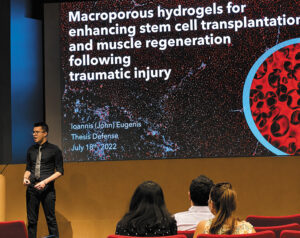
Ioannis (John) Eugenis, PhD
I stood among the crowd, presenting research addressing a fundamental question: Can we rebuild muscle that has been lost? I had developed an implant that showed how we could.
Mid-conversation, I caught part of a neighboring presenter’s explanation: “…patients with X-linked genetic disorders…”
The phrase stopped me, cutting through the chatter. The terminology was familiar, but the first time I heard those words was 15 years earlier, and the setting was much quieter.
Invisible mechanics
In a sterile Manhattan exam room, a physician sketched “XX” and “XY” on a sheet of paper, explaining how genetics dictated my muscle function. While my elementary school classmates were learning about the solar system, I was learning about genetic inheritance. This discussion led to a diagnosis: Emery-Dreifuss muscular dystrophy (EDMD).
The unknown quickly shifted to curiosity. I became fixated on the invisible mechanics driving my physical limitations. My arms not straightening. The weakness in my muscles. What was happening beneath the surface?
Beside me, my mom kept asking questions. She had immigrated from Greece and was navigating medical terminology in her second language. She wasn’t just translating English; she was trying to translate a future she hadn’t planned for.
Later, I lay in a darkened room with cold gel spread across my chest while a technician pressed an ultrasound probe against my skin. Straight ahead, on a wall-mounted television, a vibrant green ogre began his morning routine to the song “All Star.” Then, a rhythmic whoosh coming from the machine to my left drowned out the music.
I turned away from Shrek’s story toward the one unfolding beside me in black and white. My own heart appeared in motion. I watched the valves open and close with each beat — a beautifully complex machine. Though I didn’t fully understand what I was looking at, I couldn’t look away.
Rewiring the system
Over the next 15 years, annual echocardiograms remained the norm, always returning stable results. Throughout that time, curiosity became a habit: Enter an unfamiliar space, learn its language, and build.
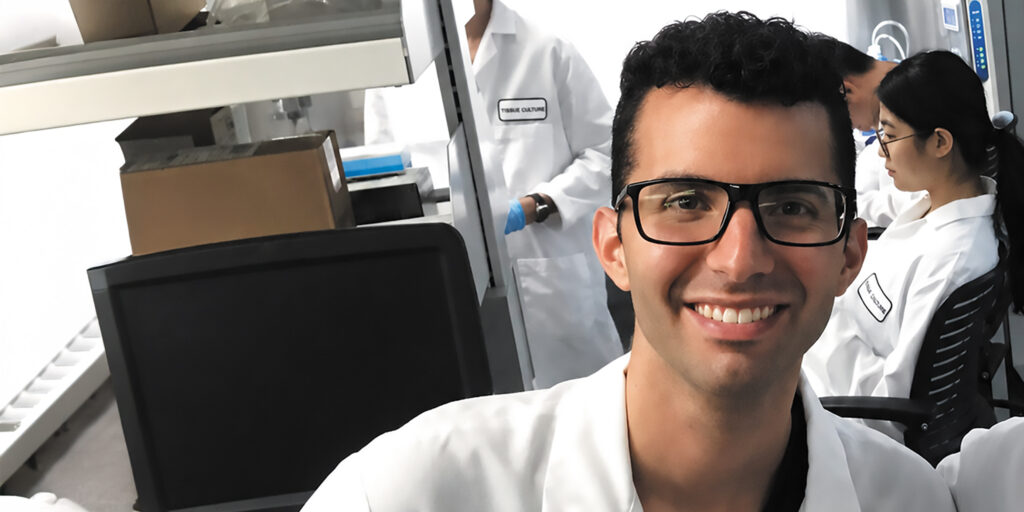
I chose to channel that drive into the laboratory, moving from trying to understand my own genetic inheritance to tinkering with DNA myself. By graduate school, I was engineering at an entirely different scale, building structures that allowed stem cells to grow into muscle tissue.
One afternoon, looking through the microscope at one of my samples, I watched muscle fibers begin to twitch in unison. Cells that had started scattered and unorganized had fused into something that moved together. I kept returning to the same question: How do you keep a system functioning the way it’s supposed to? The engineering I was doing in the laboratory was about to become a lot more personal.
EDMD had always affected my skeletal muscles, which was familiar, but one day, while I was sitting still, a chaotic rhythm suddenly took over. My heart began racing as a heavy throbbing climbed into my throat. Pressing two fingers to my neck, my gut confirmed what my fingers felt. Something was profoundly wrong with the circuitry of my heart. Eventually, those conduction faults led to a pacemaker.
Adaptive response
At my first routine pacemaker check, a nurse tapped a tablet that communicated with the device in my chest. As the test began, a sudden spike in my heart rate triggered an old reflex. My chest tightened, instinctively bracing for a rhythm I could not control. But this rate was deliberate. The settings changed. My pulse responded.
For years, I had built systems that lived apart from me. Now, I lived with one inside me.
The pacemaker did not pull me away from engineering; it drew me closer. I immersed myself in spaces where technology and medicine intersect, eventually returning to operating rooms — this time, not as the patient, but alongside teams working to improve patient care. The environment was different, but the pattern was familiar. Another language to learn. Another space where I could eventually build.
I recognized that feeling from years ago, sitting beside my mother as we faced a diagnosis that felt like a foreign tongue. We moved through the uncertainty together, asking one question at a time until it became a language we could speak.
Confronting the unknown has never been a cue for me to shrink back. Whether I’m navigating the uncertainties of EDMD or growing muscle fibers in a lab, new variables constantly emerge. Yet my response remains identical to that of the child who turned toward the ultrasound monitor, squinting to make sense of the pixels on the screen. Even then, I was trying to understand the system inside me.
Ioannis (John) Eugenis, PhD, is a bioengineer-turned-product manager building the future of biotech and medtech. Connect with him on Instagram at @ioanniseugenis.
Next Steps and Useful Resources
- Experts now recognize that neuromuscular diseases affect the heart more than they realized. Read about new cardiac insights and how to manage heart risk.
- Find more voices from the MDA community in Quest Magazine’s From Where I Sit.
- Stay up to date on Quest content! Subscribe to Quest Magazine and Newsletter.


Disclaimer: No content on this site should ever be used as a substitute for direct medical advice from your doctor or other qualified clinician.