From Research to Reality: Meet 2 Researchers Driving Drug Development Progress
By Janet Celosia | Friday, August 21, 2026
Every therapy or intervention has a backstory. Long before a treatment reaches a clinic, it often begins with a grant that gives researchers the time and support to follow a promising idea. That path from lab to real life can take years, but it is how progress happens.
The two researchers profiled here represent different stages of that journey. Together, their stories show how MDA funding can support discovery at every stage and turn scientific insight into meaningful change for the community.
MDA grant opens doors
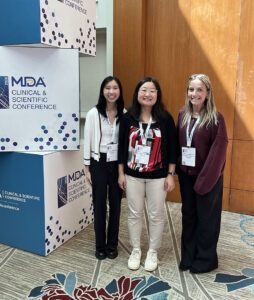
Asuka Eguchi, PhD (center)
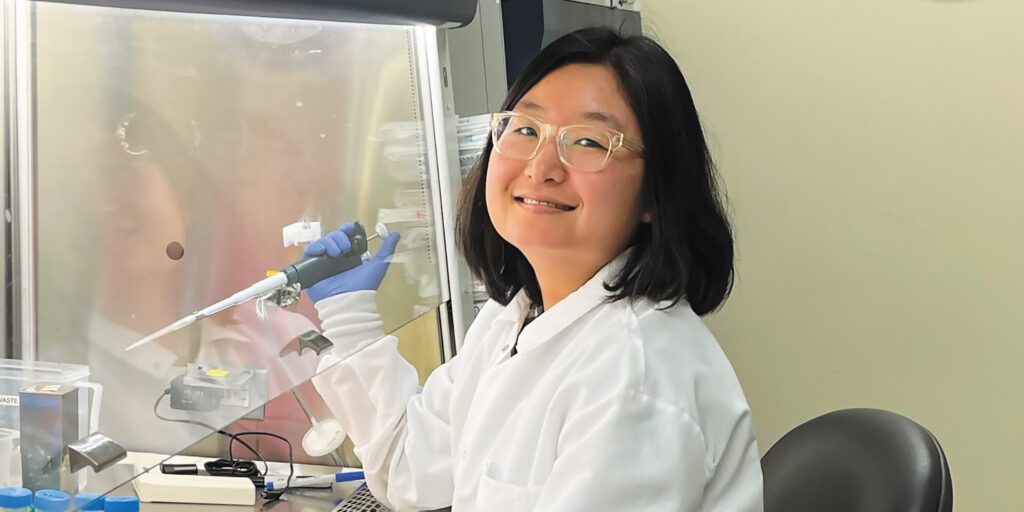
As an early-career investigator, Asuka Eguchi, PhD, an assistant professor of Physiology and Biophysics at the University of California, Irvine, launched the Eguchi Lab in 2023 with the goal of answering an urgent question: How can gene therapies better protect the heart in Duchenne muscular dystrophy (DMD)?
Dr. Eguchi’s path into science was anything but direct. “I honestly didn’t know that being a scientist was a career path,” she says. A first-generation college student, she thought she might join her family’s elder-care business.
But after an academic advisor encouraged her to gain lab experience, “I fell in love with research,” she says. That spark led her to the University of Wisconsin-Madison, where she earned her doctorate, focusing on how adult cells can be reprogrammed into stem cells.
Dr. Eguchi has spent roughly nine years working in DMD and heart research since beginning her postdoctoral work at Stanford University in 2017.
There, she started investigating how to help heart cells survive longer. Because the heart has very little ability to replace lost cells, damage can build up over time and weaken its function. Her earlier work showed that protecting telomeres — the ends of DNA strands — could help heart cells live longer.
A multiyear, $210,000 Development Grant from MDA in 2022 helped Dr. Eguchi launch her lab at UC Irvine and build momentum for later funding from the National Institutes of Health (NIH) and the American Heart Association. MDA’s support was not only financial. Dr. Eguchi says the annual MDA Clinical & Scientific Conference helped her build connections early in her career and led her to volunteer at MDA Summer Camp.
Now, Dr. Eguchi and her team are comparing gene therapy approaches for DMD using heart cells made from patient-derived stem cells. Her lab’s model offers a way to test how well these therapies may work in human heart cells.
For Dr. Eguchi, this is a hopeful time. “I’m excited about the development of better gene therapies for neuromuscular disorders,” she says.
Decades of discovery
An established leader in the field, Thomas Cooper, MD, a professor of Pathology and Immunology at Baylor College of Medicine, has been building his research career since the 1980s. He has spent decades advancing the understanding of myotonic dystrophy type 1 (DM1).
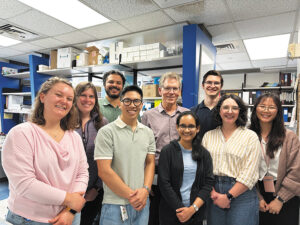
Thomas Cooper, MD (back row, center)
After earning his medical degree in 1982, Dr. Cooper was not sure medicine would be his final path. In 1986, he completed postdoctoral training in basic science at the University of California, San Francisco, which helped him decide to pursue research.
His move into the neuromuscular field came through “serendipity.” Dr. Cooper was studying alternative splicing — the process cells use to make different protein forms from a single gene — when he realized that a protein disrupted in DM1 plays a key role in that process. That connection led him to a major finding in 1998: Disrupted splicing is a key driver of DM1. The Tom Cooper Lab at Baylor College of Medicine has been investigating DM1 ever since.
With a multiyear MDA Research Grant awarded in 2019, Dr. Cooper’s team recently uncovered a hopeful clue: Some DM1-related heart damage may be reversible.
Using a mouse model designed to switch the disease-causing RNA on and off in the heart, Dr. Cooper’s team recreated several signs of DM1-related heart disease, including rhythm disturbances and reduced cardiac function. When that toxic RNA was shut off, the heart began to recover. But timing matters. Early intervention led to the strongest recovery, while later treatment brought only partial improvement. These findings, led by team member Rong-Chi Hu, were published in the March 2026 issue of the Journal of Clinical Investigation Insight.
Dr. Cooper’s team has also been examining how digestive symptoms can affect daily life. In a mouse model of DM1, his team found that gastrointestinal (GI) smooth muscle appeared hypertonic (partly contracted) rather than simply weak. That challenged conventional thinking and may help support a different treatment approach.
Dr. Cooper is still expanding his research. Noting that many people with DM1 report brain-related symptoms, such as personality changes, cognitive impairment, and sleepiness, he aims to move toward treatments that can target multiple tissues affected by DM1. “Skeletal muscle is definitely a major issue, but heart, GI, brain — that’s where we will be focusing.”
Investing in progress
Together, the work of Dr. Eguchi and Dr. Cooper shows how research funding can make an impact at every career stage. For the neuromuscular community, these investments are helping move ideas from discovery toward real progress.
Janet Celosia is a contributor to Quest Magazine.
Next Steps and Useful Resources
- Read more about how drug development moves neuromuscular disease therapies from research to reality.
- Stay up to date on Quest content! Subscribe to Quest Magazine and Newsletter.


Disclaimer: No content on this site should ever be used as a substitute for direct medical advice from your doctor or other qualified clinician.