
MDA Ambassador Guest Blog: Accessible Air Travel is About More Than Getting from Point A to Point B
By James (Jimmy) Grammig | Monday, August 17, 2026
5 Second Summary
MDA Ambassadors play an essential role in furthering MDA’s mission while representing and empowering the neuromuscular disease community. Quest Ambassador Guest Blog series provides a platform to share their personal stories, perspectives, and experience.
James (Jimmy) Grammig is a 23-year-old from Tampa, Florida. He was diagnosed with limb-girdle muscular dystrophy (LGMD) and has used a wheelchair since he was about 13 years old. He graduated from the University of Notre Dame with a degree in management consulting. Jimmy spent a gap year working as a volunteer teacher in his hometown and will begin working at a consulting firm in Dallas, Texas in August. His love for travel inspired him to write this piece.
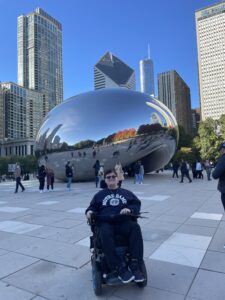
Jimmy at “Cloud Gate” In Chicago, Illinois
Growing up, I fell in love with travel. Before my muscular dystrophy progressed, I had the opportunity to visit all 50 states and 43 countries before I even turned sixteen. Every trip introduced me to new cultures, people, and experiences that shaped who I am today. From going on safaris in Zambia to riding on camels in Mongolia, travel gave me confidence, independence, and a deeper appreciation for the world around me.
As my condition progressed and I became increasingly reliant on my wheelchair, I watched that same passion become increasingly difficult to pursue.
Instead of looking forward to each trip, I found myself worrying, particularly about the step between being at home and my destination: the flight. Would my wheelchair make it to my destination without being damaged? Would transferring into the narrow aisle chair be safe? Would airport staff understand how to handle my equipment and assist me with dignity? These concerns aren’t unique to me, as I’m sure many of you are aware.
Advocating for accessible air travel
For many people, flying represents freedom. For many people with disabilities, it can also represent uncertainty. That realization is what inspired me to become an advocate for accessible air travel.

Jimmy’s Family in Cape Town, South Africa
While studying consulting at the University of Notre Dame (go Irish!), I had the opportunity to research accessibility in aviation and develop recommendations for improving the flying experience for passengers with disabilities. My work focused on reducing barriers through better employee training, safer boarding procedures, and increased awareness of accessibility resources. I also explored ways airlines could better communicate these improvements so travelers with disabilities can feel more confident when choosing to fly.
For example, I proposed equipping aircraft with portable boarding ramps to reduce the physical strain and injury risk associated with lifting passengers during transfers. At an estimated cost of about $200 per ramp, outfitting Delta’s fleet of approximately 1000 aircraft would cost just under $200,000—a relatively small investment compared to the cost of preventable injuries and accessibility-related lawsuits.
Improving accessibility is not only the right thing to do, it also makes strong business sense. More than 25.5 million Americans have travel-limiting disabilities, yet approximately 70% report avoiding air travel because of accessibility concerns. That represents nearly 17.9 million people who want to fly but feel the experience is too risky. At the same time, adults in the US with disabilities account for an estimated $490 billion in disposable income, highlighting a significant market that remains underserved by the airline industry. By investing in accessibility, airlines have the opportunity to welcome millions of new travelers, earn even more profit, and promote inclusiveness all in one.
Exciting innovations

Jimmy and his family in Honolulu, Hawaii
One of the most exciting developments I encountered was the collaboration between Delta Flight Products and the Air4All initiative, championed by Christopher Wood, the director of Flying Disabled, which is a company that represents ⅓ of the Air4All group. Their goal is remarkably simple: create aircraft seating that allows wheelchair users to remain in their own wheelchair throughout the flight instead of transferring into a standard airplane seat. The system is designed to provide greater safety and comfort while also fitting within existing aircraft layouts, making it a practical solution for airlines as well as passengers. From a purely financial perspective, airlines do not want to permanently remove a seat for a possible wheelchair to be there. This new design allows for a foldable airline seat with a wheelchair restraint system installed under it.
For many travelers, changing from whatever chair they are seated in into a different one may seem like a minor inconvenience. For wheelchair users, however, it can be one of the most physically demanding and stressful parts of the entire journey.
Every transfer introduces the possibility of injury. A customized wheelchair, which is worth thousands of dollars and specifically built for each person’s needs, could be damaged while stored in cargo. In fact, thousands of wheelchairs are mishandled by airlines every year, and those incidents can leave travelers stranded long after the flight has landed. This experience is not uncommon. I’ve faced it more than once! In a similar vein, many people with disabilities have been injured, and unfortunately even passed away, from injuries that occurred when transferring from their chairs to a plane aisle seat
Changing the discussion
I’m encouraged that conversations around accessibility are changing. Airlines, engineers, disability advocates, and organizations are working together in ways that simply weren’t happening a decade ago. Ideas like the wheelchair seat on planes remind us that the best solutions are created when people with disabilities have a seat at the table throughout the design process.

Jimmy and his family visiting Tsonjin Boldog, Mongolia
Of course, innovation alone isn’t enough. Accessible travel also depends on properly trained employees and thoughtful policies. Technology can surely help to prop the doors open, but actual advocacy can open that door even wider!
On National Accessible Air Travel Day, I hope we celebrate the progress that’s been made while recognizing how much work remains. I still love to travel. I always will.
My hope is that future generations of people with muscular dystrophy and other disabilities won’t have to wonder whether flying is worth the risk. Instead, they’ll be able to focus on what travel has always been about: discovering new places and creating lifelong memories.
Works Cited:
Airline Flight Counts:
https://www-statista-com.proxy.library.nd.edu/statistics/564769/airline-industry-number-of-flights/
https://www.gao.gov/products/gao-23-106358
Cost of Wheelchair Damages:
Number of Wheelchair Mishandling Reports:
https://www.washingtonpost.com/travel/2023/06/06/delta-wheelchair-seat/
Number of Damages Per Airline:
https://www.transportation.gov/sites/dot.gov/files/2023-04/February%202023%20ATCR_Revised.pdf
Lawsuits because of Injury:
Disposable Income For Disabled People:
https://www.air.org/news/press-release/meeting-needs-adults-disabilities-marketplace
Number of Disabled People Hesitant to Use Planes, Overview of Travel:
Delta Flight Products Innovation:
Next Steps and Useful Resources
- Learn more about Limb-girdle muscular dystrophy (LGMD) here.
- We’ll need your help! Join the MDA Action Network, take action when you receive alerts, and continue to share your air travel stories with us.
- To learn more about MDA’s Young Adult Programs, visit here.
- Browse MDA’s Mental Health Hub.
- MDA’s Resource Center provides support, guidance, and resources for patients and families. Contact the MDA Resource Center at 1-833-ASK-MDA1 or ResourceCenter@mdausa.org
- Stay up-to-date on Quest content! Subscribe to Quest Magazine and Newsletter.


Disclaimer: No content on this site should ever be used as a substitute for direct medical advice from your doctor or other qualified clinician.