
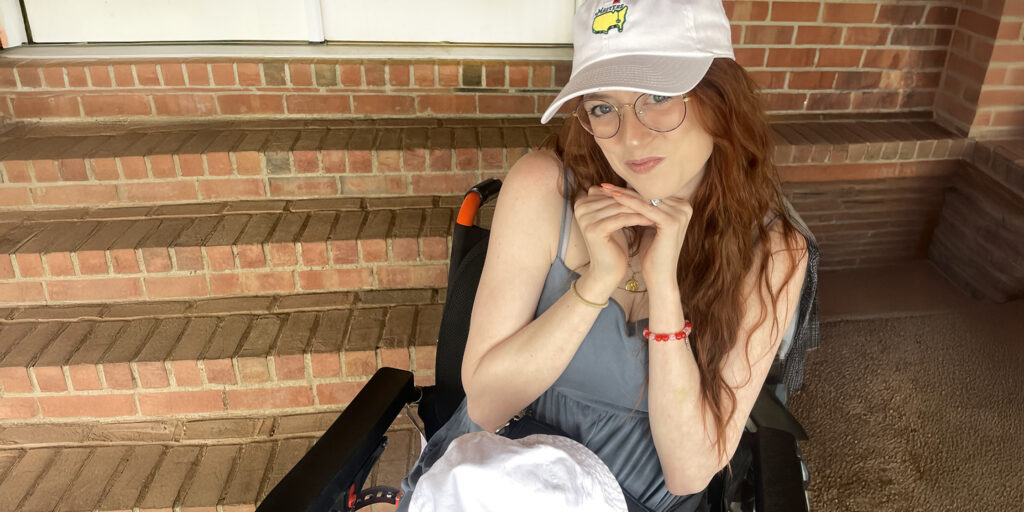
Comedian Fiona Cauley Shares Humor While Raising Disability Awareness
By Barbara and Jim Twardowski, RN | Friday, May 1, 2026
Stand-up comedian Fiona Cauley has appeared on “The Tonight Show Starring Jimmy Fallon,” toured with Nikki Glaser, and is a regular performer at Zanies Comedy Club in her hometown, Nashville, Tennessee.
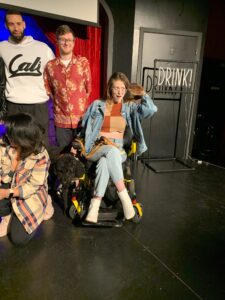
Fiona tries to make comedy venues more aware of accessibility barriers.
The 29-year-old lives with Friedreich ataxia (FRDA or FA), a progressive neuromuscular condition causing a loss of balance, muscle weakness, and speech difficulties. She uses a power wheelchair for mobility. Her candid comedy has garnered an enormous fan base.
Currently, she’s on a country-wide stand-up comedy tour. (See her upcoming shows at fionacauley.com.) Quest Media caught up with Fiona to learn more about her comedy roots, accessibility challenges, and how humor fuels disability advocacy.
When did you start your stand-up comedy career?
I started about five years ago, but before that, I had a web series on YouTube called “Capable.” They’re short videos with reenactments of daily struggles, but they’re meant to be funny.
Has your comedy always centered around having a disability?
Originally, that wasn’t my intent, but it snowballed that way pretty quickly, just because that is the lens that I see everything through. It’s been cool. I’ve been able to do a lot of advocacy work and talk to people about FA.
Does your audience leave with a better understanding of disability?
That’s kind of my number one reason for doing all of this. I don’t think I initially understood what an impact bringing a neuromuscular disease or disability into mainstream comedy would have. Most people have a very two-dimensional concept of what disability is and what it looks like. I am a wheelchair user, but I’m not paralyzed. I have a neurological disorder, and people can get upset that I can move my legs.
Were you always funny?
Yeah. I’m a middle child, and my parents separated when I was young. Being funny was always a coping mechanism. But then I got diagnosed with FA at 18, and it was devastating. I was very sad for about six years. This was the hardest thing I had ever gone through, so I started using humor.
Was there anything else you did to get out of that funk? Like therapy?
No, I didn’t do therapy, but I probably should have. I felt bad for myself for a while because everyone else felt bad for me. Then I realized I had a choice about whether I was sad. So, I tried to find things I could control. I got a degree in graphic design, and I started my own company. I was in charge, and it was going well. Comedy was just a hobby, but it pretty quickly started taking off, because I don’t think a lot of people have heard what I was talking about in the comedy space.
Can you find humor in every situation in your life, or do you need some distance?
That varies depending on the situation. For the most part, I can immediately find the humor in stuff. In comedy, anything that evokes a strong emotion — sadness, anger, fear — can be funny, because emotions are relatable to everyone. If you find a way to talk about that, then people feel seen.
Are you hearing from people with disabilities? Are they in your audience?
Yes, that’s been my favorite part of all of this. A ton of people with different disabilities or their family members reach out to me. They’re just happy someone’s talking about what life with a disability is like. Every time I go on the road, there seem to be more people with disabilities in the audience.
Has comedy impacted your life off-stage?
I think I’m easy to recognize. Because a lot of people know who I am now, more people are helpful — which should not be how it works, but that is something I’ve noticed.
Your tour schedule includes more than 20 cities this year. Do you find traveling difficult, and do you have any travel tips for our readers?
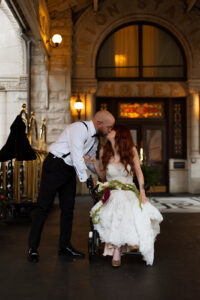
Fiona and fellow comedian Matt Taylor were married at Union Station in Nashville, Tennessee.
Chronic fatigue is part of my disease, and traveling is exhausting. I’m very grateful my husband travels with me a lot. He’s also a comedian and opens the shows for me. Without him, I’m not sure I’d be able to do the amount of traveling I’m doing now.
Know your legal rights. At airports, my wheelchair was put under the plane [in the cargo hold] and was constantly broken. The Air Carrier Access Act says planes with 100 or more seats must have a closet. [The designated area must accommodate at least one collapsible wheelchair.] I searched for a wheelchair that could fold up small enough to fit in the wheelchair compartment on board. But the airline staff will tell me the compartment doesn’t exist. Situations like this have taught me why it’s so important to speak up for yourself.
Have you encountered any accessibility barriers in the venues where you perform?
Almost every single one of them lacks accessibility — that is a constant barrier. Many times, I have to be carried onto the stage. Once, I performed at a club that was upstairs, and the elevator was broken. I told them that a lot of people who come to see me are disabled. The club carried like six people and their wheelchairs upstairs. The venues are beginning to see their obstacles.
Slowly, I’ve seen some changes. My home club bought a ramp so I could get on stage without being carried. They’ve installed grab bars in the bathrooms where none were before. It’s a process.
Thinking big, what is the next thing you’d like to do career-wise?
I would love to do some acting. I think that would be really cool — like turning my web series, “Capable,” into a Netflix show with 30-minute-long episodes. That would be a dream.
Next Steps and Useful Resources
- Read the Quest for Success series for more stories about people in from our community pursuing their dreams.
- Stay up to date on Quest content! Subscribe to Quest Magazine and Newsletter.


Disclaimer: No content on this site should ever be used as a substitute for direct medical advice from your doctor or other qualified clinician.