Quest Podcast: Pizazz, Purpose, and Periodic Paralysis: How Cienna Ditri Turns Lived Experience into Advocacy
By MDA Staff | Thursday, March 26, 2026
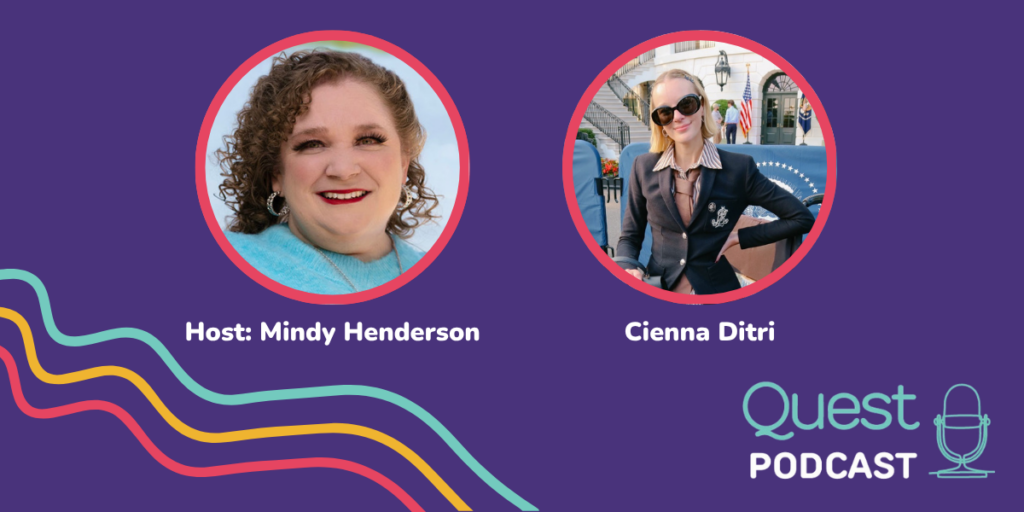
In this Quest Podcast episode, we chat with advocate, social media influencer, and President of the Periodic Paralysis Association (PPA), Cienna Ditri, who lives with periodic paralysis. Cienna shares her diagnostic journey — from childhood soccer games where something felt “off” to finally getting answers — and how living with an unpredictable condition has shaped her into a fierce and passionate self-advocate. And because style is never far from the conversation, she shares her love of adaptive fashion and how personal style has become a powerful form of self-expression and identity. Cienna shares her experiences, expertise, and advice when it comes to resilience, pizazz, and the belief that every one of us — whether in the doctor’s office, on the plane, or in the fitting room — deserves to be assumed competent.
Read the interview below or check out the podcast here.
Mindy Henderson: Welcome to the Quest Podcast, proudly presented by the Muscular Dystrophy Association as part of the Quest family of content. I’m your host, Mindy Henderson. Together, we are here to bring thoughtful conversation to the neuromuscular disease community and beyond about issues affecting those with neuromuscular disease and other disabilities and those who love them. We are here for you to educate and inform, to demystify, to inspire and to entertain. We are here shining a light on all that makes you, you. Whether you are one of us, love someone who is, or are on another journey altogether, thanks for joining. Now let’s get started.
Today, I’m joined by advocate and community voice, Cienna Ditri, who lives with periodic paralysis, a rare neuromuscular condition that can cause sudden episodes of muscle weakness and loss of movement. Cienna is using her lived experience to spark change in powerful ways. She’s a passionate advocate for more accessible and dignified air travel, and she’s also deeply involved in the growing adaptive fashion movement, helping redefine how style, function, and disability identity intersect. In recognition of Periodic Paralysis Awareness Day, Cienna is joining us to share how she lives life with this condition, how she channels frustration into advocacy, and why visibility and representation matters so much. Cienna, I’m so glad you’re here.
Cienna Ditri: Thank you. I’m so excited to be here.
Mindy Henderson: So you and I just finally had the chance to meet recently, actually last week it was, at the MDA Clinical and Scientific Conference. And it was so fun after all this time we’ve messaged on social media and a lot of your passion areas are my passion areas. And so I’m just glad to finally have met you in person and to have you here today. So let’s jump in with some questions about living with periodic paralysis. For anyone that’s listening that may be unfamiliar, can you explain what it is and what daily life with the condition looks like for you?
Cienna Ditri: Yeah. So periodic paralysis is a rare genetic disorder and it causes episodes of extreme muscle weakness all the way to paralysis. It’s kind of a spectrum, but they all fall under paralysis and it occurs because our muscle cells, they need these particles called ions and that’s kind of how they work. But the ions like potassium, calcium, sodium, they move in and out of the cell through holes called ion channels. And genetic mutations can cause these ion channels to sometimes not open and close properly. And when that happens, it’s hard to move your muscle. And these, we call them attacks, and they can be triggered by certain triggers when you live with periodic paralysis. My biggest ones are cold and rest after exercise, but there’s a whole slew of them depending on what type of periodic paralysis you have.
Mindy Henderson: Interesting. Okay. And tell us a little bit about your diagnostic journey. When did you start to notice things? Did it feel like it was just fatigue at first or how did it come about?
Cienna Ditri: Yeah. My first symptom that I remember, I was actually when I was six years old. I used to play soccer and I love playing soccer, but my soccer games were on Michigan mornings in the spring, which are quite chilly. So the first time I remember it happening, I had played this killer first half. I remember I’d scored two goals already and I felt unstoppable. And then halftime happened. And after running that whole first half, I sat down and ate my snack, which was probably pretty carby or sugary, which can be another trigger for periodic paralysis. We had cold, rest after exercise, and sugary carby snacks. So I got up to run the second half and I felt like I was running with cement boots on. My legs were so heavy. So I saw all these other girls sitting on the sidelines and I was like, you know what?
That’s probably why they’re sitting down too. So I just went down and sat down. And I think when you grow up with something, you kind of think it’s normal and you kind of just suppose everybody else is like that. And then you find out it’s not as it kind of progresses and more things start happening.
So as I got older, I started having more attacks and different symptoms and things like that. And I accidentally kind of got diagnosed with it on accident. I was already seeing an endocrinologist for another disorder and she was helping me with it and she got this flyer and I had these symptoms that didn’t really make sense with anything else I had. And on this flyer were all of my symptoms. And she was like, “Huh, that’s interesting.” So she went to this lunch and learn and she called me from the lunch and learn and she was like, “You already have all of the clinical diagnosis criteria for periodic paralysis. Come to my office tomorrow.”
Mindy Henderson: Wow.
Cienna Ditri: And I was like, “Oh my gosh, I have a what?” Yeah. And then after that, I was introduced to the Periodic Paralysis Association and then to the MDA and here I am.
Mindy Henderson: Oh, and how old were you when your doctor put two and two together?
Cienna Ditri: I think it’s about eight years this year.
Mindy Henderson: Okay.
Cienna Ditri: Yeah. So it took a while. It
Mindy Henderson: Took a while. Yeah, no kidding. And that’s something that I know a lot of people listening will relate to because so many neuromuscular conditions mimic other things or you can’t see them under a microscope and so they can’t be found in genetic testing. Is there genetic testing for periodic paralysis or-
Cienna Ditri: There is.
Mindy Henderson: … is it more of a clinical diagnosis?
Cienna Ditri: Yeah, there’s a clinical diagnosis and then there’s a genetic diagnosis. There is. But the genetic diagnosis is the gold standard. I think we know somewhat around 80% of the genes for periodic paralysis right now, and there is free genetic testing for it too.
Mindy Henderson: Great.
Cienna Ditri: Yes, everyone can get tested.
Mindy Henderson: That’s helpful. It’s amazing how much progress we keep making and the genes that they identify and can look for in genetic testing. I know it’s going to help a lot of people. So periodic paralysis can be unpredictable. I think we already mentioned that. How do you live life that way and kind of plan your life around a condition that doesn’t always follow a schedule?
Cienna Ditri: I think you try your best and then you just keep trying because it is so unpredictable. So I think it’s kind of this thing that living with a neuromuscular condition or a disability, you learn to be really flexible. So with periodic paralysis, I know my triggers. I know what triggers me. So I try to avoid those things, but I’m still going to have attacks. There’s still going to be things that happen. Last week at the conference, we were at the advocacy collaborative and I rolled right in there. I was feeling fine and I was like, oh, I was taking notes and I was like, my hand’s feeling kind of heavy. And I looked down and my handwriting was terrible. My handwriting was just trash. I was like-
Mindy Henderson: Oh, no.
Cienna Ditri: “Oh no, I must be having muscle weakness.” So I got out, I have effervescent potassium that I take when I’m having an attack and that kind of helps it go away mostly sometimes for me. So I took one to put that in my water and drank it and then I got to keep on going. So thankfully for me that took care of my attack mostly that day and then I just kept on going. So yeah, I think you kind of learn what works for you and kind of what your normal is, but the best thing you can do is listen to your body is what I’ve
Mindy Henderson: Found. Yeah. It’s so funny. I hear that from more and more people all the time. I think it’s really great how in touch people in our community have gotten with themselves. And I’ve heard that it becomes … I mean, I know firsthand, of course, but I also have keep hearing from other people how they’re educating their doctors about their own specific brand, if you will, of the condition that they’re living with. And it’s great, number one, to be that in tune with yourself, but then that clinicians and doctors are willing to hear it and to listen to us is so important, so so important.
Cienna Ditri: Everybody’s just so different, right? Even within the same conditions, we have all different experiences, we all have different triggers, we all have different other conditions as well, possibly. So it’s this whole constellation of things, they’re going to make you completely different from even maybe your friend who has it. So I think that that advocacy for yourself and that patient perspective, there’s nothing more powerful than that. And the best quality in a doctor is somebody who listens.
Mindy Henderson: Yeah, for sure. And the other thing, I could beat this horse to death, but I think the only other thing that I just want to say is to really, really encourage people. If you feel like you’re not quite being heard, always be polite, but be assertive. It’s really important. Just like you say, we know our bodies best and it’s important to communicate, communicate, communicate until you’re heard. So what do you wish that more people, including medical professionals, understood specifically about periodic paralysis?
Cienna Ditri: Oh, I think that one’s really hard because-
Mindy Henderson: [inaudible 00:10:42] lots of things.
Cienna Ditri: … I think periodic paralysis, we’re really trying right now for so much awareness and advocacy for the condition because we do have this huge diagnostic gap.
So I think we’ve made a lot of progress in the past few years as the Periodic Paralysis Association going to conferences and talking to doctors and letting them know what the experience is like and trying to talk to researchers about not just having five people in their study, having this group that actually portrays what it’s like for people living with periodic paralysis. And we have Dr. Tyler Nelson in Gainesville, he’s studying pain in periodic paralysis, and not that long ago doctors didn’t even think it was painful. And now we know it can be a quite painful condition. So I think that that’s a big part of it, is that our pain is real. Our experiences are real, what we’re telling you is real. And with periodic paralysis, we have these attacks and it can be quite periodic.
So I think that’s a big barrier to diagnosis is people go into the ER, they can’t move and sometimes they walk right on out of it when they’re better. So doctors are like, “What was that? Wait, you couldn’t move and now you’re just walking on out of here?” So I think it’s just awareness that this exists within the emergency care setting, urgent care, all throughout different specialties so that people with periodic paralysis can truly have a way better quality of life and get to have these experiences.
Mindy Henderson: Right.
Cienna Ditri: Yeah.
Mindy Henderson: Is there anything that comes to mind? Because this is another theme that I’ve seen in talking to people in the community is sort of emergency situations where you might end up in the ER or you might have an ambulance that needs to come to you for whatever reason. And I think that it’s also important for people in our community to be empowered in those situations. And so I’m wondering from your perspective, what people living with this condition could do proactively potentially so that they’ve got the information that they can give to those clinicians and first responders to help make sure that the right thing gets done for them and that people understand what’s happening.
Cienna Ditri: Yeah. I think a big one is medical alert bracelets. When you’re in an emergency situation, if something’s going on and you can’t advocate for yourself, that’s going to do it. They’re going to see that. It’s universally recognizable no matter where you’re at. So I think that that is a great starting point. And then I think another one is this past fall at our conference, we gave out these emergency anesthesia wallet cards and you have to be in person with us to get one. We don’t have a way to distribute them yet. I’m sorry, but-
Mindy Henderson: That’s okay.
Cienna Ditri: … either we meet your doctor at a conference and we give them some cards or you meet us at a conference and we give you some cards, but it’s really, they’re amazing. So what they are is they’re little cards, kind of like your state ID. It’s the same size, the same material.
On the one side, you write your name on it, you write your type of periodic paralysis on it. I think there’s a spot for an emergency phone number, so that’s already going to help you because they’re going to pull your ID out of your wallet if you’re in a true emergency situation, and that’s going to be right behind it, is our hope and dream. And then when they pull it out on the back, there’s a QR code. So if you do have to get anesthesia, the protocol for anesthesia for periodic paralysis is right there because anesthesia can be deadly and very dangerous for people with periodic paralysis. So we’re trying to find ways to help people advocate for themselves in those situations when they can’t, because that is so important and being proactive about it because no one ever knows when they’re going to be in emergency situation.
Mindy Henderson: Right.
Cienna Ditri: Yeah.
Mindy Henderson: That’s great to know. So March 23rd, which is coming up, it’ll probably be passed by the time this episode airs, but we want to make sure that it gets on everybody’s radar and people know about it. So March 23rd is Periodic Paralysis Awareness Day. Is it the same day every year? Let me ask you first.
Cienna Ditri: Yes. March 23rd is always World Periodic Paralysis Day.
Mindy Henderson: Oh, got it. Okay. Thank you.
Cienna Ditri: Yeah.
Mindy Henderson: So tell me what this month and this awareness day means to you personally, and why is awareness so important for this community?
Cienna Ditri: Yeah, I think with periodic paralysis, we’ve kind of talked about that diagnostic delay. So what’s so special about World Periodic Paralysis Day is it wasn’t just a day that the PPA created on our own. It was a day we talked to our community to create. We got together in Chicago with a lot of the different organizations and we picked everything from the colors that meant something to us and talking about color theory behind it to the words we were using really big to promote the day, the messaging, the branding. It is all for us by us and our community. Amazing. To kind of just slash this diagnostic delay and stigma that can come along with it. So we’re hoping that this is the first day ever created to unite our global community and that together we’re going to find this strength and connection and build that global community of support that we truly need having a rare disease so that we can navigate this journey of living with periodic paralysis together.
Yeah. We have a lot of goals for the day, like reducing the diagnostic delay, increasing public and medical knowledge about periodic paralysis, and then fostering that supportive global community because it’s so important people know that they’re not alone because you have a rare disease and especially a rare neuromuscular disease, it can be so isolating, but you aren’t alone. There are so many people out there, you’re not alone in your experiences or your symptoms, and we’re all here for you. And today’s a day, not today, that day, the 23rd is a day for us all to celebrate together. The progress we’re making, our community, finding each other and just advocating together.
Mindy Henderson: Yeah, that’s incredible. So what are your plans for Monday to recognize the day and celebrate the day?
Cienna Ditri: Oh my gosh, we have so many. So this is our second World Periodic Paralysis Day and it has grown exponentially. So this year, Chicago, Philadelphia, Tampa, and the San Diego Convention Center are all illuminating for World Periodic Paralysis Day or around it. Then as the Periodic Paralysis Association, we are going to Capitol Hill and we are meeting with members there and advocating for periodic paralysis, for more funding for research for periodic paralysis, for our legislative agenda that’s going to support patients with periodic paralysis. Last year we kicked off that program for the first time. So it’s really cool. We have me and another board member there this year, and we’re going to meet with a bunch of offices. And then following that for a few days, we have a virtual Hill Day with 10 people, researchers, board members, and community members that are going to be meeting with representatives as well. We have lots of fun on social media, little graphics to share. So yes, lots and lots of things.
Mindy Henderson: That’s a lot of stuff. Right. So if there’s anyone listening who wants to support you in the advocacy work, what ways would you recommend that people do that and maybe support the legislation or the asks that you’re going to be making on Capitol Hill?
Cienna Ditri: Yeah. So I think if you can go to worldperiodicparalysisday.com, and we have lots of great resources on there. There’s tabs on how to get involved. You can become a power partner. We have things you can share on social media. We have these little postcards you can print off and take pictures of or with, which is really fun.
Yeah. So I think we have a specific document on there that’s like six ways to get involved with World Periodic Paralysis Day as well. And we’ve even had people print the flyers off from the website and bring them to their doctor’s offices to get hung up or to educate people. So I think it’s just about sharing your story, which reminds me. Another cool thing about worldperiocaralysisday.com is we actually have a global map and on there you can add your own pinpoint and add your story to the map so that people can see all the people around the world living with periodic paralysis and see that they’re not alone.
Mindy Henderson: Oh, what a great idea.
Cienna Ditri: Yeah. And you don’t have to put your town. For me, mine just says Michigan and my name, and then it has my little story. So if you click on my little zebra point, you find me. But there’s so many of us that you can find and there’s so many more who can add their story too. So I think it’s a really cool way of uniting that global community too.
Mindy Henderson: Yeah. That’s fantastic. I love it. So I want to talk a little bit more about advocacy. Like I mentioned, you and I have some passion areas in common. Was there a specific moment or experience that pushed you to start speaking out and using your voice for awareness and progress?
Cienna Ditri: Yeah. So I’ve always had chronic conditions my whole life. And I think when you grow up having chronic conditions, like personally, I learned to advocate for myself from a very young age, having 504 plan meetings and IEPs and all those things, I just learned to talk about my conditions. It wasn’t something that was wrong with me or something that was bad. It was just part of me like my eyes are brown. So for me, it was just something very normal to talk about. If I was having a sleepover at my friend’s house, I would let them know what could happen or if I wasn’t feeling well, that we need to call my mom. And no one was surprised when these things happened. So I think I learned really early about all of that, but I think I actually got into advocacy more on the environmental side of things.
Mindy Henderson: Oh, interesting.
Cienna Ditri: Yeah. It’s kind of the backstory that no one knows-
Mindy Henderson: Yeah, I love it.
Cienna Ditri: … is that growing up, like many other children, I loved the Crocodile Hunter. Steve Irwin was everything to me. I was his wife two years in a row for Halloween.
Mindy Henderson: Oh my gosh.
Cienna Ditri: Terry Irwin was my queen as a child. Oh, wow. I was like, she is everything. So I loved animals and conservation and all of that. So me and my neighbor, shout out Drew, we created this website called animalanimalanimal.com and they had animal facts on it. It was like awareness thing about animals and the environment around us. And then we created a little scouting group for the other neighborhood kids called Nature Scouts because we were both frustrated that we couldn’t be in Girl Scouts or Boy Scouts together. We wanted to do something together where you could actually be outside and learn about the environment and nature that is around you. So we kind of started our own thing.
So I think that’s kind of where I learned how to advocate and raise awareness for things. And then it kind of grew from there. As my conditions developed and I got older and things progressed, I think I just very naturally kind of started advocating over here.
Mindy Henderson: Wow. Yeah. I love that. We’re peeling the onions.
Cienna Ditri: Right.
Mindy Henderson: It’s so good. Well, accessible air travel, you and I have talked a lot about accessible air travel and we’ve had some progress in the legislative and the rulemaking world over the last couple of years, but still plenty more work to do. And I think you and I both know from our work and talking to a lot of people how stressful air travel can be for a lot of people, but presents unique challenges, of course, for people with disabilities. What have been your personal experiences navigating airports and airlines?
Cienna Ditri: Wow. I think I’ve had so many of them. I fly a lot, a lot between my work and advocacy with the Periodic Paralysis Association and my job as a creator, model, consultant, all of that, I am on a plane a lot. So I’ve had lots of experiences from my wheelchair being lost to it being broken to, I fly with a service dog, I fly with medications, aisle chairs, having to go to the bathroom on a plane. What do you do? So I think navigating TSA, that was a huge learning curve for me. But I think right now it’s learning the system and then finding the ins and outs that work for you of how best to advocate. And it is that doing things in preparation beforehand to me that have really changed the experience. I mean, you can’t stop bad things from happening, but you can be prepared. And I think that’s the best thing to do in today’s environment of air travel.
Mindy Henderson: Yeah. Well, and I think there are some things that you can potentially influence or prevent by speaking up at the airport and Oh yeah, definitely. … and being prepared like you’re talking about, that just make the whole ecosystem of flight with a disability a little bit better. I’m not saying it’s going to obviously solve every problem or prevent everything all the time, but I think you make a really good point that preparedness and communication is so
Cienna Ditri: Important. Yeah. I think there’s so many things you can do before you get to the airport, you can call the airline, you should call your airline and talk to them about your wheelchair, about your aisle chair, making sure it’s all on the reservation, talking about … For me, I use the accessible disability priority seat block a lot because I do use an aisle chair.
Mindy Henderson: You just taught me about this when we met in Orlando. Will you share again what that is and how people can benefit from it?
Cienna Ditri: Yeah. So every airline has this disability accessible priority seat block. They call it something along those lines. And that’s what I always ask for. I’ve flown almost all of the big airlines in the US and you call them up and I ask to talk to their disability team. And then I tell them, “This is an accommodation I need for my disability. I’m a wheelchair user. I’m non-ambulatory. I use an aisle chair to get to my seat. I would like a closer seat. It’s going to make your boarding a lot faster. It’s going to make it better for everyone. It’s going to make it easier for me. ” And personally, since I can’t get up, I don’t like sitting. I can transfer independently. So I like to sit by the window so that people have to go to the bathroom. I don’t have to worry about them all up in my space.
So I will request very specifically that I want that window seat as a accommodation for my disability. And you know what? 10 out of times, that’s what I get because you call prior, which is way before you get to the airport, this is days before.
Just like for me, it’s the same day I called TSA Cares so that I have a manager from TSA waiting for me at the airport to go through with me and help me with my things and help advocate for me just to make that situation a lot easier because a lot of my medications are liquid. So along with that and being a wheelchair user and all that, it just makes TSA a breeze, honestly, having them with you. And I also get, I have PreCheck, which is something you have to pay for. But as a wheelchair user, you don’t need a pat down now. They just swab your hands, your wheelchair, your medical device, if you have one and you are on your way, no 6:00 AM pat down to start the day, which was the best thing in the world.
Mindy Henderson: That’s really great news. I wasn’t sure about the PreCheck and if that actually eliminated-
Cienna Ditri: It does.
Mindy Henderson: I’m so glad to heard that.
Cienna Ditri: Sometimes you have to remind them because they’re not … But if you advocate for yourself and you’re like, “Hey, so I do have PreCheck. I did pay for this. This is how the screening works for me. These are my rights.” That’s how it goes. So yeah.
Mindy Henderson: Okay, great. You are a wealth of knowledge. What are some specific improvements that you believe airlines and airports could implement right now? I mean, I know that we’ve got our ultimate vision, I think, for airlines. We do. But what could people do right now that would make travel safer and more dignified?
Cienna Ditri: I think a big one about making it safer and more dignified is the assistance services at the airport. So many people with such a broad range of disabilities use it. And just having that education, them knowing the, what is it, Disabled Passengers Air Travel Bill of Rights, those aren’t the right combination of words, but it’s that one. You can print that off and have it with you, and I think that’s helpful as
Mindy Henderson: Well. The Bill of Rights, yes.
Cienna Ditri: Yeah. But just educating them on aisle chairs and actually strapping people in or service dogs or how to talk to people with disabilities and to talk to us. Don’t talk to whoever’s traveling with me. Talk to me.
Mindy Henderson: Goodness. Thank you. Yes.
Cienna Ditri: Assume competence. I think that is something that Judy Heumann always told me, and I think that that was huge. It was so big to me because I remember being on the phone with her one day and being like, “Everyone is talking to everybody but me, but I’m the one who knows. They don’t know.” And she was like, no, they have to assume competence, advocate for yourself. If they’re talking to somebody else, be like, “Hey, I’m down here.” Be polite, but be assertive and be confident because you know yourself best, just like at the doctors, at the airport, wherever you are in life, you are your own best advocate.
So I think that that’s so powerful, especially in air travel. So I think that’s one that they could quickly change
Mindy Henderson: Everywhere
Cienna Ditri: Is just listening to disabled people and having disabled people educate them on how they need to educate the people helping us. For us by us is always the best way.
Mindy Henderson: Yeah. Cannot agree more. You hit the nail on the head. So you had the opportunity, I’m so jealous, to speak directly with Pete Buttigieg about accessible air travel. He was the Secretary of Transportation through, I guess it was 2024 and was a real advocate and ally to people living with disabilities. He got the final rule approved wheelchair user rule that had a lot of really important provisions in it. Tell me what that experience was like having that … I think you interviewed him. Did anything about that conversation surprise you?
Cienna Ditri: I think Secretary Pete is just a wonderful person. He is so warm. He is such a good listener. He’s so genuine. His advocacy is out of a genuine care and love for our community. And he wants to listen. He doesn’t want to be making this up. He wants to listen to us and create the change we need with us and then use his platform and his position to amplify that and create that change. Which I think when you meet people like that, you just know right away. I was interviewing him, but he was so much more interested in hearing about my experiences and all of that. But I think one thing that he said that I thought was so important is I asked him, “What can we do? These rules are kind of threatened right now. Some of them are suspended or paused. It’s really heartbreaking for our community. We created these with you. We worked so hard with you to make this change that we desperately need.” My wheelchair being broken is not a small thing, that stops your life completely.
It’s like your legs being broken. And he said, “The biggest thing we can do is talk about it.” He’s like, “People aren’t going to know if we don’t talk about it.” He’s like, “Just keep talking about it and don’t stop. Talk about it to everyone. Talk about it everywhere. Don’t feel like you’re talking about it too much because every time you talk about it, somebody new is going to hear about it.” And that might be the person who’s going to help us change it all. You never know. So true. And that’s just making that snowball bigger and bigger, that movement so that when we come together, we truly are creating the change that we all need together. And I think that that is so powerful
Is just working together and keep talking about it because we are kind of within our own bubble and the disability community. We all know that this isn’t good, but we kind of have to pop that to get the entire world to know this is happening because a lot of people don’t know that this is happening. And I talk about it when I’m waiting to get on the plane, I’ll talk to the people around me about it. They’ll be like, “Oh my gosh, what are you doing up here?” I’m like, “Oh, I’m going to get on my aisle chair.” And they’re like, “Wait, where’s your wheelchair going?” I’m like, “Oh, under the plane with your suitcase.” I’d be like, “Wait, so how’d you go to the bathroom?” I’m like, “Oh, I don’t. Just got to hold it. So yeah, right when I get off that plane, I’m the last one off by the way too. I got to keep holding it and then I got to go as fast as I can to go to the bathroom.”
And it’s just sharing your experience in it though, sharing your story because I think everybody can connect to that human experience.
Mindy Henderson: Again, such good advice. And it’s such a simple recommendation that he made, but such a powerful one too. Because like you said, you never know … I mean, a lot of the time you know who you’re talking to, but sometimes you don’t.
Cienna Ditri: At the airport, you don’t.
Mindy Henderson: And their roommate or their brother or something is going to be, like you said, somebody in a position to really make a change. And so I love that you got to have that experience. And it’s true. I talk to people all the time still, and it baffles me how people just don’t know. And I suppose if you don’t live with this as something in your life, it makes sense that maybe you don’t know, but there’s still so many people who don’t understand what a wheelchair user or someone with a different kind of disability maybe has to wade through each time they fly. So you are also, I’m going to switch gears a little bit because I want to talk to you a little bit about adaptive fashion. You are deeply involved in this space and I’ve told you more than once I’m obsessed with your fashion style.
Cienna Ditri: Thank you.
Mindy Henderson: Yeah. You have such a unique and fun way about styling yourself. How did you first discover adaptive fashion and what role has it played maybe in your confidence and your self-expression?
Cienna Ditri: Yeah. So my mom actually went to school for fashion. She majored in fashion back when it was a science degree.
Mindy Henderson: Oh, wow.
Cienna Ditri: So I grew up loving fashion, watching every runway show with her, clipping Vogue magazines, and designing my own clothes with her, which is where adaptive fashion kind of came into play with it. Because if your mom’s … My mom, she would buy patterns, of course. But if there wasn’t something I liked or my dream was not like that, we would make our own and then we would make it work for me. And adaptive fashion didn’t even exist. This was the early 2000s. We were just doing what worked for me and what I liked. And so that’s kind of how it came into play. And then I realized these things I liked, there were things at the store that were kind of like them.
So when I was shopping or picking out my clothes, that went into it like, oh, elastic pants are easier for me to put on because sometimes it’s really hard for me to do the snaps or buttons or whatever it might have been. I used to love those little snap off pants.
Mindy Henderson: Yes. Oh my gosh.
Cienna Ditri: I love those. And I love the ones where it went from the cargo pants to shorts with a zipper.
Mindy Henderson: I forgot about those.
Cienna Ditri: I was your typical 2000s kid. I loved all of them, all the modifications. I was very into it. And I think that’s kind of where it came from, was just this shared love of fashion and exploring it. And then as I got older, discovering that space and being like, oh, I do already do this. I know how to do this. And again, you’re your own best advocate. So all the things we’re talking about are really quite similar, whether it’s at the doctor’s office, travel or fashion, you know yourself best.
Mindy Henderson: Very, very true. So the adaptive fashion market has really grown a lot. I feel like it’s maybe having a moment. Where are you seeing real progress and where do you feel most strongly that there’s still work to be done?
Cienna Ditri: Well, I think it has come a very long way. I want to start with that. I do think we have a long way to go, but I think my favorite thing is when they actually have the adaptive pieces in the store. Now that is magical. Very hard to find, but magical. But my other one that I love is when what they make is that it’s adaptive. It’s not its own separate thing. If you’re going to a bigger brand store that happens to have adaptive fashion, when it’s like the same shirt as the non-adaptive version, it’s not like its own thing. It’s when the store goes, “Okay, these are things that our buyers like that are very popular season on season on season. These are staples you can have in your closet,” because we know it’s an investment. Adaptive fashion, it’s not inexpensive generally. Unless it’s on sale, watch for those. Clearance sections are your friend. They do wind up there. Or platforms like Nuuly where you can rent them. That’s also a great place to try that out.
Mindy Henderson: Oh, what’s it called?
Cienna Ditri: Nuuly. It’s Anthropologie’s. So a lot of Anthropologie’s adaptive pieces, you can rent them actually.
Mindy Henderson: I have not heard that.
Cienna Ditri: So that’s a great one. Yeah. But I love, I think Anthropologie and JCPenney’s do it where they take those staples of the season or the thing they think that’s going to be really trendy or the really cool print and they make it adaptive. So I think that’s what it’s supposed to be. I don’t want this old separate, different thing. I want what everybody else wants to, because I’m just a girl in the world. At the end of the day, that’s what I want. I think beauty actually does it best because beauty, it’s not a separate thing. In fashion, it’s still a separate category, but in beauty, it’s the same category. We’ve seen Selena do it with Rare. Tilt is killing the game right now, but it’s one thing. It’s one mascara that they’ve made easy to hold and put on. It’s one lipstick. It’s the thought and the packaging, the description of the colors, it’s the braille on the box.
Beauty has really got it. They still have places they can improve too. But I think that’s something fashion needs to look at is that they’re not two separate things like they’re in fashion and beauty. They are one thing. And I think when fashion figures that out, that’s when it’s really going to get momentum over there.
Mindy Henderson: You are speaking to my soul because I’ve wondered, honestly, and I actually interviewed for the February podcast, Izzy Camilleri, who I just watched it. Yeah, she’s one of my favorite adaptive fashion designers. And she was talking a lot about the obstacles and the cost to mainstream brands to create adaptive clothing. And I get all of that. And I understand that it’s a bit of a barrier for companies to get into this space. But I loved what you said about even just a few staple pieces. I’ve wondered all the time why they wouldn’t have a pair of jeans that go from size zero to 22 or whatever they do, but then also, and then they have long versions and short versions. Have a seated version. Your market, I think, I’ll just say for the record, is bigger than you think it is.
Cienna Ditri: Oh, it is. We should not be an afterthought. We should be a twice. Just like all of those that’s offered across the board because it’s one in four people who have some sort of disability in the US. We have these aging baby boomers as well. This is so helpful for everyone.
Mindy Henderson: Everyone.
Cienna Ditri: Who has an easy time doing their bra on the back? No one. No one. Who does that work for? Absolutely no one. So I think it’s just realizing that this is a big part of your market and we do matter. We need to be consulted while you’re designing this. And this needs to be an option in everything. It’s not this side thing. It’s here to stay and it needs to be an option just like tall or curvy or whatever your other options are. And you should have pictures of us on your website as well and all throughout your company and the design process, not just in front of the camera, but all throughout the process, I think is how you do that genuinely. But I know even if it’s not somebody who’s disabled, like my sister’s wedding, I got a dress from Reformation for it, but you know what made me think of that dress? They had a model who was sitting down wearing it in the picture. It was just like one of the pictures when you swiped. She wasn’t a wheelchair user, but she was sitting down in it and she was stunning in it. And I was like, “You know what? I got to go try that on.”
Mindy Henderson: “That works for me.” Yeah, that would work for me. Yeah. Oh, that gave me goosebumps. I love that. Fashion is often seen as aesthetic, but for many people living with disabilities, it’s also functional and empowering. What does this … I hate this, but this is my last fashion question. Okay. What does personal style mean to you?
Cienna Ditri: Oh, that’s a big one. I love personal style. I love seeing other people’s personal style, talking to them about it. I’m just the biggest fan of it. The fact that personal style is one of the few ways you can take and show that person you are on the inside to the rest of the world. How cool. And it’s just supposed to be this fun thing. It’s just this way to express yourself and share that joy with the world and be like, I do love this purple sweater, but I’m Cienna, I need a little ruffle. I need a little pop of pink. I need a little pizazz in my day, but it’s my personality. And it’s just this way to share that with the world. And I think that is so fun. And when you’re trying to find that personal style, I think people overcomplicate it sometime.
I do get it can be tricky. I’m not saying it isn’t, but I do think, just think, who are you? Are you playful? Are you more introverted? Are you more … And kind of go from there and then figure out these words that describe yourself. And then that’s the best starting point to finding your personal style, but I just love it. That’s so
Mindy Henderson: True. And honestly, I know I haven’t known you long, but I feel like just from following you on social media, and we’re going to put your handles and things in the show notes so people can follow you if they’ve been living under a rock.
Cienna Ditri: Let’s all be friends.
Mindy Henderson: I know, are not already following you.
Cienna Ditri: No, come join.
Mindy Henderson: But I feel like I have such a good sense of who you are and what your personality is just from watching your style and seeing what you gravitate toward and how you present yourself in the world. And it’s so important that people have the options to do that. Yeah.
Cienna Ditri: Yeah.
Mindy Henderson: So love it. So just a couple of really quick little kind of fun rapid fire questions that I’ve got for you. Mentioned you travel a lot. What is one travel item you cannot leave home without?
Cienna Ditri: Okay. So Trader Joe’s has this hand sanitizer spray and it doesn’t dry your hands out and it smells … There’s a few different flavors, but one of them’s rosemary scented. They smell nice and they feel nice and things are clean and your hands aren’t dry. I love it. It has to be in my purse at all times.
Mindy Henderson: Okay. Good tip.
Cienna Ditri: Yes.
Mindy Henderson: This may be harder to answer because we said that adaptive fashion is growing, but what is your favorite adaptive clothing brand right now?
Cienna Ditri: Oh my gosh.
Mindy Henderson: One or two.
Cienna Ditri: There’s so many good ones. All right. So my top three in no order are Vertis Adaptive, probably spoony threads. And then I do love tilt. They just have those sweatsuits come out. And I was so privileged to be sent a set of them and I cannot take them off. They have the little elastic pull loops to put on your pants and it magnets at the neck for the hoodie part of it, so it’s easy on off. And they fit so well seated. Everything is so thought out. The cuffs don’t get in your wheels when you’re wheeling. Nice. I need a hundred of them, please.
Mindy Henderson: Okay. I’m going to go check them out this afternoon. That just made it to my to do list. What is one outfit that makes you feel instantly confident? Is there a go to outfit you have when you’re like, “I need to look good today?” I mean, you always look good.
Cienna Ditri: That’s so hard. Because I repeat all of my items a lot. If you look at my videos, you’ll see the same pieces come up and up again, but I style them different very commonly. But I love a good dress. I do love juxtaposition and fashion is my favorite thing. For me, I’m wearing a more masculine sweater today, and then I have this ruffle button-
Mindy Henderson: It’s so cute.
Cienna Ditri: … blouse under it. I love juxtaposition. So for me, if I can do that in my outfit, that’s it. That just gives me my little pizazz and makes my day.
Mindy Henderson: So pizazz is your go to. Yes. It sounds like. I love it. I love it. And then final question. Actually, first to the last question, what’s your go to hype song?
Cienna Ditri: This is just as hard. These are all so hard. I think [inaudible 00:48:11] rapid fire.
Mindy Henderson: I could never answer this one, which is why I ask other people.
Cienna Ditri: Oh my gosh, that’s so hard. There’s so many things I love. I actually went to university for music, so this is just actually the ultimate question for me.
Mindy Henderson: Oh, boy.
Cienna Ditri: Actually, right before this, it just came out. So I was listening to Harry Styles Dance No More, because I love a little boogie before I do an interview or if I’m public speaking or something, something that gets me dancing. Nice. I think that makes sense for my personality, but I just love … I think if you’re having any sort of day, if you just have a little boogie, your day’s going to be so much better. So just get moving, I guess, however that is for you.
Mindy Henderson: I think you’re right. I’ve got sort of, I don’t know, a power hype kind of playlist.
Cienna Ditri: I do have a playlist. I do have a playlist.
Mindy Henderson: Yeah. I can never recall a song off the top of my head, but I do. I’ve got a playlist, so I’m glad that you do too. So I guess my last question is just, you are clearly involved in a lot of different things, you’re passionate about a lot of things, and you’re making real change in the world. You’re having impact-
Cienna Ditri: Oh, you’re going to make me cry.
Mindy Henderson: No. No, it’s-
Cienna Ditri: In the best way. Best way.
Mindy Henderson: It’s true though. What would you say to anyone who’s listening, who maybe doesn’t believe that they could ever have a platform or use their voice the way that you do? What would your advice be to them?
Cienna Ditri: I’m just a girl in the world. I am just sharing my story. You can hit the post button too. I get that it can be scary. It can be intimidating. There’s that vulnerability to it. But even if you don’t want to share your story by posting, you can create so much change. Local grassroots organizations are always looking for people, the nonprofit for your condition. I bet they’re looking for people to come volunteer and play in the sandbox and help raise awareness. If it’s sharing about whatever’s going on within your community at the dinner table with your friends or whatever, it’s like Pete said, right? It’s just like talking about it. And I think we can all do that, whether it’s on social media or in our daily lives, because that makes a difference. And I think by doing that, we can all be a part of that change that we so badly want to create in this world, because we’re all part of that.
Everybody who talks about it in any way is part of that change. So I think just do that. And then like we’ve been talking about, it’s knowing you’re your own best advocate as well. That’s going to help create change. Just talking to your doctor and sharing with them about your condition and the actual symptoms you’re having, that changes things. That changes their perception of the condition. That’s going to help the next person who comes in that room, right?
Mindy Henderson: It’s true.
Cienna Ditri: Same thing on the airplane. Or if you’re trying on things at a store, talking to the people there about it, just sharing about it and knowing that in talking about yourself, your conditions, fashion, travel, advocating for any of it, you’re not extra in any of it. You are perfectly wonderful the way you are. And just if you like to wear the ruffle blouse with the sweater, go for it. If that’s advocating for your needs, they’re not too much. You’re not too much. And just kind of remembering that. It’s not always easy. It’s way easier to say than to do. But when you keep doing it, I think that’s where change comes from, right?
Mindy Henderson: I agree. And you kind of sparked something in my own mind when you were talking about if it’s you’re telling your story to your doctor in your doctor’s office, that’s one person, but he or she may go and tell five other people about this incredible person, Cienna, who showed up in their office today and maybe they wouldn’t do that because of HIPAA.
Cienna Ditri: Right. They’re probably not going to say my name. But when I’m at conferences and I’m sitting at the Periodic Paralysis Association table, so many doctors will come up and talk to me about their patient. “My patient is …” They can’t say a name, but they’ll start talking to me about them or they’ll have questions about them or maybe they’re a pediatrician and they’re helping this family out and what did I do when I was in elementary school or whatever it might be. They are listening to you if you get a good doctor.
Mindy Henderson: Certainly. Yeah. It amplifies. And so your willingness to be open and vulnerable with somebody may impact 50 other people who come through that office door.
Cienna Ditri: It genuinely does though.
Mindy Henderson: It does.
Cienna Ditri: Because they’re going to remember your story. Or even when I’m in Washington D.C., I come back to these offices now and they’re like, “Hey, Cienna, how was this from last time?” Because we’re all listening to each other. We’re all talking to each other. But when they look back and they think about periodic paralysis, when it comes across their desk, they think Cienna, just like your doctor thinks about you when they see your condition come across their desk or gets another patient like you and your experiences, just going out and living life is going to help the next person.
Mindy Henderson: So true.
Cienna Ditri: Yeah.
Mindy Henderson: I could talk to you all day. Thank you so much for being here. I know you’ve got a busy schedule and I appreciate you taking a few minutes to chat with me.
Cienna Ditri: I really appreciate it. I could talk to you all day as well. I can’t wait for the next conference where we’re both there because I think we need to set aside a whole afternoon this time.
Mindy Henderson: I would love that. Yes, sign me up.
Cienna Ditri: Let’s do it.
Mindy Henderson: Okay.
Cienna Ditri: We’ll sit by the pool together.
Mindy Henderson: Yes, please. With coffees.
Cienna Ditri: Yes.
Mindy Henderson: Okay. Sold. Thank you, Cienna.
Cienna Ditri: Thank you.
Mindy Henderson: Thank you for listening. For more information about the guests you heard from today, go check them out at mda.org/podcast. And to learn more about the Muscular Dystrophy Association, the services we provide, how you can get involved, and to subscribe to Quest Magazine or to Quest Newsletter, please go to mda.org/quest. If you enjoyed this episode, we’d be grateful if you’d leave a review. Go ahead and hit that subscribe button so we can keep bringing you great content and maybe share it with a friend or two. Thanks everyone. Until next time, go be the light we all need in this world.


Disclaimer: No content on this site should ever be used as a substitute for direct medical advice from your doctor or other qualified clinician.