Sports, Disability, and Perseverance: How I Adapt to Stay in the Game
By Michael Chamberlain | Monday, February 23, 2026
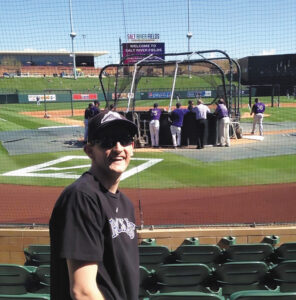
Michael at spring training
The legendary NFL Head Coach and two-time Super Bowl Champion Vince Lombardi once said, “It’s not whether you get knocked down, it’s whether you get up.”
Sports have been a part of my life since I was a little kid. I can remember wanting to run out onto the crisp, freshly cut grass of a football or baseball stadium. I lived vicariously through the athletes I watched, as if I were lacing up those cleats and playing the sports I had come to love.
The only problem with this story, and what set me apart from those athletes, is that I was diagnosed at a young age with familial spastic paraparesis (FSP), also called hereditary spastic paraplegia (HSP).
FSP is such a rare disorder that the doctors first thought I had muscular dystrophy or cerebral palsy (CP), due to the muscle weakness and tightness in my lower limbs and fingers. They called it a “spontaneous mutation,” as they had no idea how to exactly diagnose me.
FSP causes muscles to weaken over time, just as muscular dystrophy does. Similar to those who have CP, my gait is abnormal, and I use leg braces to walk due to my weaker lower leg muscles. For reference, my calves and shins are so weak and skinny that one could make the OK sign with their middle finger and thumb around them.
Following my passion
As Lombardi said, “it’s whether you get up.” As a kid from Colorado who couldn’t compete on the field, I decided to persevere and be a part of sports anyway. In middle school, I was on the C team for basketball and participated in Special Olympics cycling, basketball, and baseball. In high school, I was a team manager for our football, basketball, and baseball teams, bringing equipment to practices and games.
When I went to college at Colorado Mesa University, again, I had to adapt. Like many college freshmen, I didn’t know what I wanted to major in, but that passion for sports was always in the back of my mind. I couldn’t compete in college-level athletics, so I did the next best thing: I earned my bachelor’s degree in mass communication with a concentration in applied media strategies. With a degree and coursework in this area, I could cover sporting events in the media.
I gained hands-on experience in my chosen field by joining our student-run college radio station, becoming the Sports Director during my junior year and calling sporting events live on air.
To make the most of this opportunity, I pushed, moving heaven and earth, to get our radio station the chance to travel to away games. The highlight of my college career was traveling with our small student-run operation to call a game for Colorado Mesa University’s women’s basketball team when they reached the Elite Eight (national quarterfinals) in the NCAA Division II Women’s College Basketball Tournament.
Building a career
Coming out of college, I only knew of one person in the sports world living with a condition similar to mine — and that is still the case today. Jason Benetti, who has CP, is a sports broadcaster for the MLB’s Detroit Tigers and Fox Sports. Seeing him motivated me to continue to use my ability to adapt to get into the professional sports world, too.
I was hired as a Trackman Data and Video Operator for the Colorado Rockies’ minor league affiliate, the Grand Junction Rockies. I attended home games and recorded every play, pitch, and at-bat using a radar dish and video camera. After games, I uploaded the data and recordings to a computer app so the team could review them and use them to work on each player’s game. The Grand Junction Rockies later became an independent baseball team called the Grand Junction Jackalopes. In all, I spent nine years with these teams.
My boss with the Colorado Rockies, who I am still close with today, didn’t see my physical limitations as a downside; he only saw my work history, perseverance, and passion for sports.
As I sit here today, I’m working to get back into the sports world after a hiatus in 2024. I’m marketing my experience and the media skills I learned in college. My goal is to be a part of a professional sports team’s social media squad.
Once again, I’m in that perseverance mindset, showing that even though I have physical limitations, I can be in the sports world, doing the same work others do, in my own way.
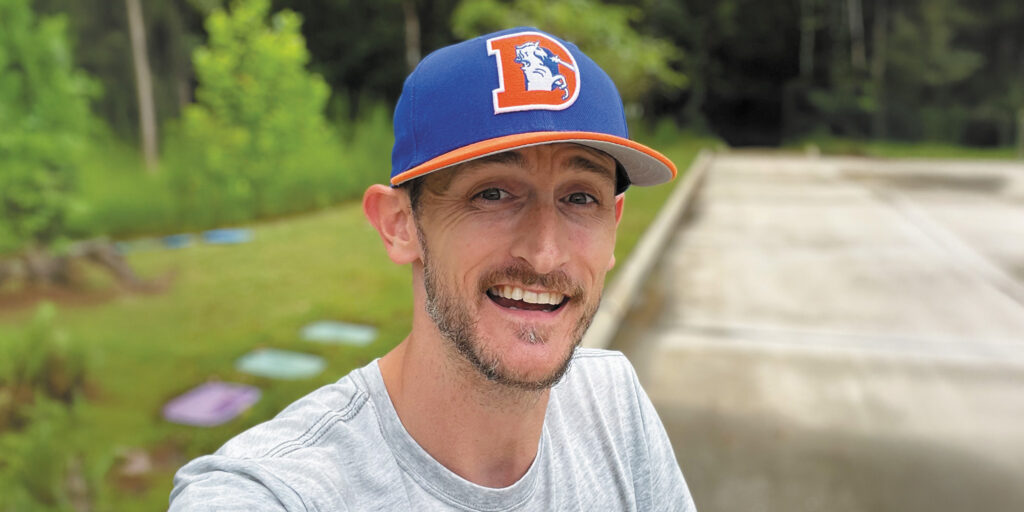
Michael Chamberlain, 35, who lives in Houston, has spent his career showing that people with disabilities can work and belong in sports. Follow him on X @mchamber1990, Instagram @m_chamber44, and TikTok @s3gwaymast3r44.
Next Steps and Useful Resources
- Read the Quest Media Adaptive Sports Guide to learn about programs and equipment.
- Find more voices from the MDA community in Quest Magazine’s From Where I Sit
- Stay up to date on Quest content! Subscribe to Quest Magazine and Newsletter.


Disclaimer: No content on this site should ever be used as a substitute for direct medical advice from your doctor or other qualified clinician.