The Joy (and Lessons) of Motherhood from MDA Ambassadors
By Rebecca Hume | Thursday, May 7, 2026
Motherhood is an incredible journey, layered with joy, growth, challenges, victories, and an abundance of love. For moms living with neuromuscular disease, the role of motherhood can sometimes entail additional layers, requiring extra patience, adaptability, and resilience. But, with a beautiful harmony, those very traits are often strengthened through daily life with a disability and serve as an asset to parenting. Through those strengths, mothers have the opportunity to demonstrate the value of compassion, creativity, grace, and grit as they navigate the chaos, the calm, and everything in between of raising children.
In celebration of motherhood, we checked in with four MDA Ambassadors about what they have learned and what they love about being a mom.
Rebecca Gregg, who lives with limb-girdle muscular dystrophy (LGMD), has two teenage daughters
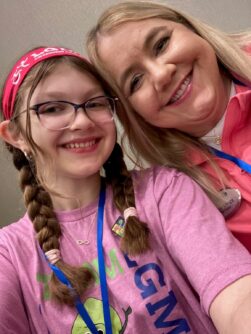
Rebecca Gregg and her daughter, Lauren
“What I treasure most about motherhood isn’t just the big milestones; it’s the simple, day-to-day moments we share. I truly love just hanging out with Addison (19) and Lauren (14). It is especially fun that one of my daughters is a fellow Swiftie! Bonding over our favorite songs and sharing that “Eras” energy makes our time together even more magical. I love watching both of my daughters grow into strong-minded, empathetic young women.
Having limb-girdle muscular dystrophy while raising daughters has presented its own set of unique challenges, but navigating those hurdles with my husband, David, has helped me realize we can truly take on a lot. It has taught me that I am far more resilient and capable than I ever imagined.
I’ve also learned to prioritize what truly matters—the connection and the memories—rather than focusing on my limitations. My daughters have shown me that I am a fighter, and I that is what truly keeps me going on the tougher days.
Living with a disability has reshaped my entire world, but it has only deepened the way I love and show up for my daughters. While our days may look different, I’ve learned that the true magic of parenting isn’t found in the activities we must work hard to coordinate, but in the quiet, simple moments we share being exactly as we are.
I am constantly finding new, creative ways to be the parent they need. By meeting every challenge with a flexible heart, I hope I’m showing my girls that strength isn’t about doing things the “standard” way – it’s about moving through life’s changes with grace and grit.
Living with a disability has shown me that motherhood is about presence and connection rather than physical ability. By being open about my journey, I’m teaching my daughters to navigate their own challenges with resilience. They see every frustration and triumph, and I feel a deep responsibility to show them that while life isn’t always fair, you can always make the most of what you’re given and have a fulfilling life.
I hope to instill in my daughters a foundation of grace, integrity, and determination. By watching me navigate the daily challenges that come with having a disability, I want them to learn that while we cannot always control our circumstances, we always have a choice in how we respond to them. I hope they carry the lesson that true strength is taking life day-by-day with a kind heart. Ultimately, I want them to know that a fulfilling life isn’t about the absence of struggle, but about the love and character you choose to lead with in spite of it.
I want to teach them that grace means learning to be kind to themselves and others, especially when things don’t go the way they want. That integrity means staying true to their values and character, regardless of the situation. And that determination means having the courage to keep moving forward and finding a way.
The best parenting advice I have ever received is that “the days are long, but the years are short.” It serves as a constant reminder to embrace the present moment, especially when life feels overwhelming or unpredictable.
Living with a disability while raising a family is a journey that requires emotional strength. Since neither disability nor parenthood comes with an instruction manual, navigating both at once can feel very overwhelming. However, I’ve found that a unique, profound strength grows at that intersection.
My advice to other parents with a disability would be to redefine “success.” It isn’t about physical stamina or doing everything perfectly. True success is found in the strength you model for your children and the deep emotional bonds you build during the difficult moments. By leaning on prayers for peace, giving self-care when you need rest, and practicing steady determination, you are doing so much more than just getting through the day. You are teaching your children how to face life’s unpredictability with dignity. Be there for them and make sure they feel your love every day.”
Shay Mirchandani lives with mitochondrial myopathy (MM) and is the mother of three boys, who share her diagnosis
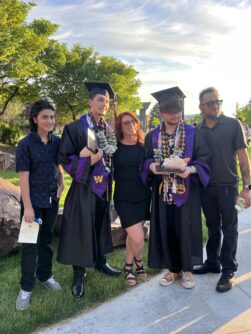
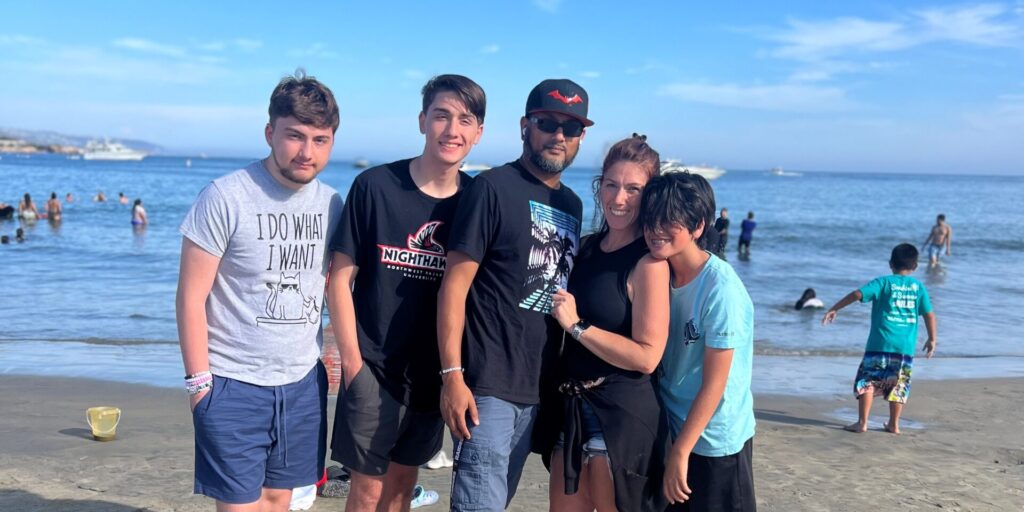
Shay Mirchandani with her husband and three sons.
“My favorite thing about being a mother is watching my boys grow and move through each stage of life and seeing who they are becoming despite everything they face. I cherish the small moments the most: the hugs, the pictures, the laughter, and the time we spend together. Those moments mean everything to me. They are what keep me going, even on the hardest days.
Motherhood has taught me that I am stronger than I ever imagined. I live in constant pain, and there are days when it’s hard just to function, but I still show up. I push through. I fight through. I often put my own needs on the back burner because my children depend on me.
Raising three medically complex boys while managing my own condition has shown me a level of resilience and determination I didn’t know I had. I’ve learned that strength isn’t about feeling okay, it’s about continuing forward even when you’re not okay.
It has also pushed me to redefine what my life looks like. When I could no longer sustain physically demanding work, I made the decision to shift careers. While continuing to care for my children, I became a realtor within the last year. It’s been a new challenge, and something that takes time to build, but it has given me a sense of purpose outside of caregiving and a way to continue growing, connecting, and contributing.
Living with a disability has forced me to be intentional with my energy. Some days, just getting through the basics takes everything I have, especially while managing chronic pain. I’ve had to learn how to pace myself and prioritize what truly matters. I learned it is okay to sometimes leave the dishes for later.
At the same time, my role as a parent has grown into something much bigger. I am constantly advocating for my children. I fight within the education system because there often aren’t enough protections in place for kids like mine. I fight within the medical system to overturn denials so they can receive the care they need.
Parenting for me isn’t just about raising my children, it’s about fighting for their access, their opportunities, and their future.
Living with a disability has given me deep empathy, patience, and persistence. Because my boys also live with mitochondrial myopathy, I understand their struggles in a very real and personal way.
It has made me a stronger advocate and a more compassionate mother. I know what it means to live in pain, to be told “no,” and to keep going anyway, and that mindset carries into how I fight for my children every single day.
At the same time, I teach my kids that we have a responsibility to live with intention, no matter what challenges we face.
I want my boys to try everything, even when it feels difficult or uncertain. I want them to believe they can achieve what others may see as impossible, that their challenges do not define them. And I want them to leave an impact, to be remembered for their strength, their kindness, and the difference they make in the world.
The biggest lesson that I’ve learned is that perfection isn’t what matters, showing up is. Being present, loving your children, and doing what you can each day is enough.
My advice to other moms is to embrace every moment and give yourself grace. Being a mother while living with a disability means you are constantly pushing through challenges that most people will never fully see or understand. You are not just parenting, you are advocating, enduring, and fighting battles on multiple fronts.
Even on the days when it feels like too much – your love, your effort, and your presence matter more than anything. You are enough.”
Lacey Woods has six children and lives with limb-girdle muscular dystrophy (LGMD)
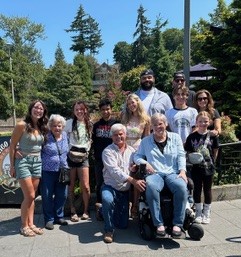
Lacey Woods gathers with her family.
“One of my favorite things about being a mother is the laughter. I love the evolving relationships I have with our children and I feel incredibly grateful that I’m able to watch them grow into amazing human beings.
Motherhood has taught me to give myself grace and to live in the moment. Letting go of self-judgment and unrealistic expectations hasn’t been easy. There are still moments when doubt creeps in, but over time, I’ve learned to offer myself the same compassion I give to others. I’ve learned to live in the moment. When you can’t take time or energy for granted, the present becomes incredibly valuable.
Living with a disability, I’ve had to adapt how I parent. I’ve had to let go of certain expectations of what parenting “should” look like and instead focus on what works best for me and my family. I rely on adaptive equipment, routines, and the support of my husband, Stewart, to make daily life work. Using a power chair has enabled me to have a lot more energy to spend time with my family instead of conserving every bit of energy just to get through the day. We have created routines that work for our family. From an early age, our children have shared in household responsibilities, not just out of necessity, but also as a way to learn responsibility and gain confidence. Having my husband next to me raising our kids, has made things easier and more meaningful. I love sharing the challenges and the victories with him.
Living with LGMD 2I/R9 has enhanced my abilities as a mother by teaching me patience and perseverance. It has forced me to slow down, which has helped me be more present with our children. I have to plan things ahead of time and let go of unrealistic expectations, which can be trying. I try to model perseverance and show our kids how to face life’s challenges without giving up. It can be a lot of pressure knowing our kids are learning from me and how I respond to limitations when somedays it feels overwhelming. Yet, in many ways, I feel that having LGMD 2I/R9 has deepened my ability to show up as mother.
The three key lessons about life that I hope to instill in our children are resilience, compassion, and responsibility. Resilience because life won’t always go as planned, what matters is how you respond to the challenges. Compassion because it’s important to be kind and understanding; you never know what someone is going through. And responsibility because your actions and attitude will shape your life.
The best general parenting advice I’ve received is that I don’t have to be a perfect parent to be a good one. Perfection isn’t what children need. They need consistency and love. There will be moments when I’m tired or when I lose patience, and that doesn’t make me a bad parent. It makes me human. What matters is that I keep trying and keep being there for our children in the ways that I can. Our children don’t need a flawless version of me; they have someone who loves them deeply and who keeps showing up.
The advice I would give to other mothers living with a disability is this: you are enough right now, just as you are. There will be days when you’re exhausted and when things don’t go as planned. That’s okay. Give yourself grace in those moments. I would encourage you to accept adaptive equipment sooner rather than later. I wish I’d started using a power wheelchair earlier; it would have allowed me to conserve energy and to be able to do more alongside my kids. Your children are always learning from you. They’re watching how you navigate your disability and how you keep persevering. Because of this, I believe they will grow into empathetic, aware, and resilient human beings. Just by being you, they will have a new meaning for what strength is.”
Ranae Beeker is a mother of two adult children and lives with facioscapulohumeral muscular dystrophy (FSHD)
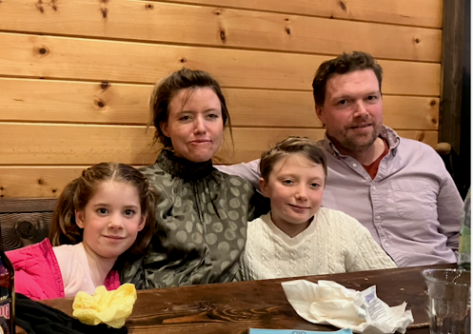
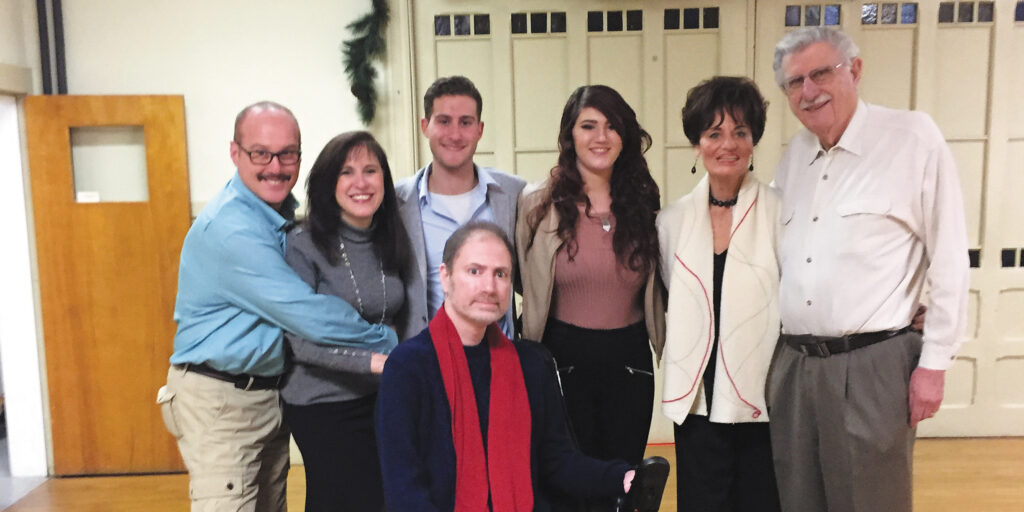
Ranae Beeker with her family.
“What a privilege being a mom has been and continues to be. What a privilege to work hard to be the best mom that I can be to the most stellar kids that I could have ever anticipated having, loving, and enjoying. Motherhood is my life’s best passion and quest.
I have enjoyed spending time with my kids through every stage of their childhood, for all of the positives and the negative situations that they maneuvered through. I have thoroughly enjoyed being part of my kids’ lives since the minute that they were born. They have such beautiful, unique, spectacular, and fun personalities. Their personalities, quite often, bring me to tears – because they are filled with compassion, joy, passion for life, and such a great sense of humor. I am truly filled with pride for both of them, for all that they do and all that they are.
Motherhood has taught me the importance of being patient, mostly with my kids and also with myself and with situations that are out of my control. Being a mother has taught me the need to not take myself so seriously. The need for humor and the ability to laugh at myself and at situations that I don’t have control over. Living with the disease process of FSHD, while trying to lovingly, appropriately, and adequately parent my kids, taught me the importance of looking beyond the specific situation and myself. My children also live with FSHD and motherhood allows me to model for them how to maneuver through life with a challenging physical disability that could be changing from day to day, week to week, or month to month.
Both of my kids, like most kids, are very energetic. I remember so many fun times playing basketball, a bit of softball/baseball, and running around games in our yard. When my ability to play with them energetically outside became more challenging, I wanted to adapt in a way that was productive and not always obvious. Sometimes it worked and sometimes it didn’t. And I had to learn that that was okay. There is no such thing as perfection in parenting. My ultimate goal was to demonstrate how to continue to fully live, even while the body wasn’t able to fully participate – and that we continue to have value in spite of our physical bodies and their deterioration.
My favorite mantra on parenting, or in general traversing through any situation, simple or quite challenging is: “Life isn’t fair, no one escapes living a full life, without their full share of challenges, cuts, bruises, and being knocked down.” (Rev. Bob Borden)
I wanted my children to know that there will be challenges but that they can utilize their great intellect and pursue their dreams or passions. One of the main things that I hope I have taught my children is just how beautiful inside and out that they are and that their many intellectual gifts are to be shared. (And they do.)
I want them to understand their own inherent beauty and worth, what they can contribute to anything they are a part of, and knowing they can accomplish whatever they set their mind and heart into doing, providing, or accomplishing.
They are great adapters. They are so smart and they have the ability to work through any situation that comes their way. The first and easy way is not always the best. They have already demonstrated this time after time. As their physical capabilities are altered by the FSHD disease process (and life in general), I hope they look to their previous “wins” and their support teams as they prepare to traverse through the challenge. I want them to remember that no matter how “hard” it may be, they do have the tools to work through every choice, situation, and challenge – and to remember that they are loved beyond compare, no matter which choice they choose to move forward.
I hope that I have shown my children how truly proud I am of both of them, for who they are, how they portray themselves, how they maneuver through life, and for their great senses of humor. I want them to know that they are never alone. I am always here for them. They are loved, cherished, and treasured more than they will ever know, by their Mom and so many other important family and friends.
I learned when my children were youngsters and in their early teens that modeling certain behaviors about accepting and living with and through a physical disability shines brightest to your children. I learned the importance of assuring that the light is shining on viewing living with challenges with positivity as much as possible and, at the same time, that demonstrating frustration is not always a bad thing. Frustration is part of life, for everyone. It is how I model working through the frustration appropriately and how it is shared with my kids that is important.
I want other parents living with a disability to know that being a mother with a disability, can be done – and it can be done well. Having a disability does not automatically take away the potential for you to be an exceptional parent.”
Next Steps and Useful Resources
- Stay up-to-date on Quest content! Subscribe to Quest Magazine and Newsletter.


Disclaimer: No content on this site should ever be used as a substitute for direct medical advice from your doctor or other qualified clinician.