MDA Ambassador Guest Blog: Never Let Your Limitations Be Your Limit: Transitioning from College to a Career with a Disability
By Sydney Horak | Monday, October 5, 2026
5 Second Summary
MDA Ambassadors play an essential role in furthering MDA’s mission while representing and empowering the neuromuscular disease community. Quest Ambassador Guest Blog series provides a platform to share their personal stories, perspectives, and experience.
Sydney Horak lives in Texas and is diagnosed with spinal muscular atrophy (SMA). She earned a master’s degree in Management Information Systems and bachelor’s degrees in Accounting and Business Honors from Texas A&M University and now works in Digital Assurance and Transparency at PwC in Houston. FUN FACT: Sydney is also a children’s book author and loves using her story to encourage others to shine. She is the author of the children’s book I Am Just Me.

Sydney Horak graduating from Texas A&M University
Transitioning from college into a career is exciting, but it can also feel intimidating. For young adults with disabilities, that transition may come with additional questions: Will my workplace understand my needs? How do I ask for accommodations? Will people recognize my abilities before they notice my disability?
As a young woman living with spinal muscular atrophy, or SMA, I have spent my life learning how to advocate for myself while pursuing opportunities that may have once seemed out of reach. I use a power wheelchair and require 24/7 assistance with many daily tasks, but I have never wanted those realities to determine the size of my dreams.
Through the Professional Program in Accounting (PPA) at Texas A&M University, I completed bachelor’s degrees in Accounting and Business Honors and earned a master’s degree in Management Information Systems. I am now studying to become a Certified Public Accountant and preparing to begin my professional career in Digital Assurance and Transparency at PwC, one of the Big Four accounting firms.
This transition has taught me that entering the workforce with a disability requires preparation, confidence, communication, and the ability to recognize the value you bring.
Finding a company that sees your potential
When I began looking for a company to work for, one of my greatest concerns was how an employer would accommodate my needs. I also wanted to ensure that each company I interviewed with shared my core values, including respect, integrity, and a genuine commitment to seeing every person’s potential.

Sydney Horak graduating from Texas A&M University
I wanted more than a company that simply said it valued inclusion. I wanted to find a workplace where those values could be seen through people’s actions.
While interviewing with several companies, I noticed a clear difference in how I was treated. At one interview, the room was not large enough for me to turn my wheelchair around, and I had to call my mother to help back me out of the space. At other interviews, people did not greet me or make an effort to help me feel welcomed.
Other companies made sure I had a larger interview room, moved chairs out of the way, and ensured the environment was accessible. Most importantly, they greeted me warmly and wanted to get to know me personally. They asked about my education, experiences, interests, and goals instead of allowing my disability to define the conversation.
Those actions may have seemed small to them, but they were enormous to me. They allowed me to focus on sharing my skills and potential instead of worrying about whether I could physically navigate the room. A company’s actions during the interview process can reveal a great deal about the culture and sense of belonging it may offer.
Advocating for accommodations
As I prepared to transition from college student to full-time employee, I learned that advocating for accommodations begins with understanding what I need to succeed and being willing to communicate those needs clearly.

Sydney Horak at Texas A&M University
College taught me how to use accommodations, but entering the workforce taught me how to explain them in a professional setting. I had to think beyond what worked in the classroom and consider what I would need to participate in meetings, complete computer-based work, navigate the office, and manage a full workday.
My needs include an accessible workspace, adequate clearance for my wheelchair, adaptive technology, assistance with computer tasks and note-taking, accessible restrooms, and consideration of transportation and work locations.
One of the most significant accommodations I had to advocate for was being allowed to bring my mother to work with me as my caregiver. Because I require 24/7 assistance with many daily tasks, having a caregiver present is essential for me to participate safely and independently in the workplace.
I had to explain that my caregiver would not perform my job or interfere with my professional responsibilities. Instead, she would assist me with the physical and personal-care tasks that allow me to focus on my work.
This experience reminded me that independence does not always mean doing everything alone. Sometimes, independence means having the right support in place so you can fully use your abilities.
For young adults preparing to enter the workforce, I recommend identifying your needs before your first day, explaining how each accommodation will help you perform your responsibilities, and offering practical solutions when possible. You do not need to have every answer, but you should be prepared to begin the conversation. Self-advocacy is also ongoing because needs may change as responsibilities, locations, and technology change.
Building confidence in professional spaces
Confidence does not always mean entering a room without fear. Sometimes, confidence means entering the room while nervous and choosing to participate anyway.
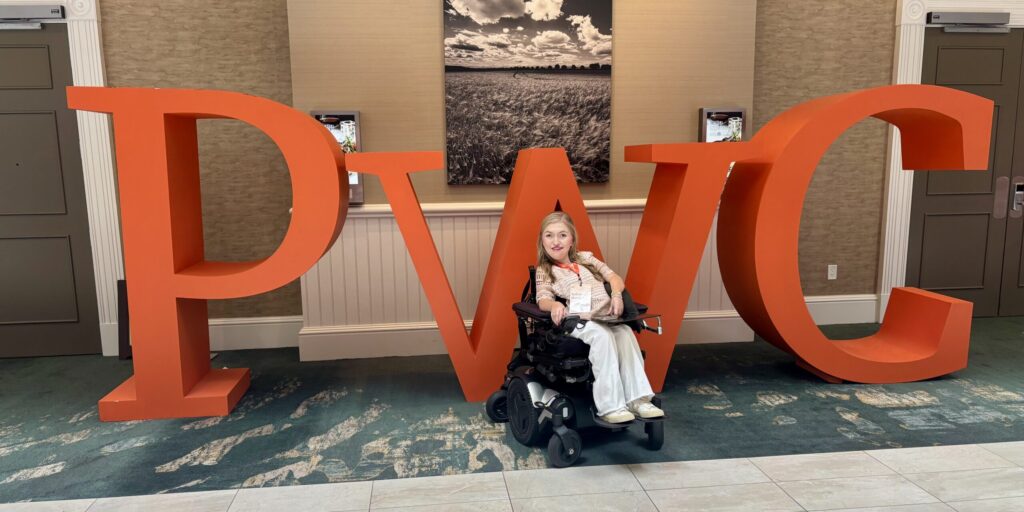
Sydney Horak at PwC, one of the Big Four accounting firms
My internship experience helped me see that I could contribute to a professional team, learn new responsibilities, and navigate the workplace with the right supports in place. It also helped me begin seeing myself not only as a student with a disability, but as a professional with valuable knowledge and experiences to contribute.
As someone with a visible disability, I know people may notice my wheelchair before they learn about my education, experiences, or ideas. I cannot always control someone’s first assumption, but I can help shape what they understand next.
I build confidence by preparing thoroughly, asking thoughtful questions, learning from feedback, and reminding myself that I earned my place in the room. My disability does not erase my qualifications. It has also helped me develop valuable skills, including adaptability, resilience, communication, attention to detail, and problem-solving.
Confidence grows through practice. Each meeting, presentation, interview, and new responsibility creates another opportunity to become more comfortable in professional spaces.
Embracing leadership opportunities
People with disabilities are often viewed primarily as individuals who need help. While support is important, people with disabilities are also leaders, professionals, innovators, authors, advocates, and decision-makers.

Sydney Horak
My leadership journey has included serving in student organizations, advocating for accessibility on my college campus, writing a children’s book, and speaking about the importance of recognizing each person’s potential.
I am also building a personal brand through Instagram, @shinewithsydneyhorak, where I share encouragement, faith, disability advocacy, and the message that people should never let their limitations become their limit.
Leadership can begin before you receive a title. It can look like sharing your perspective, solving a problem, supporting someone else, or advocating for a needed change. You do not have to wait until you feel completely ready to begin leading.
These experiences have taught me that my perspective is not something I need to minimize. It is something I can contribute.
Moving forward
I know the transition from college to a career will not be perfect. There will be new situations, difficult conversations, and lessons I have not yet learned. However, I do not need to have everything figured out before I begin. I will continue advocating for what I need, learning from the people around me, and pursuing opportunities to lead. The phrase I live by is, “Never let your limitations be your limit.”
A disability may influence how we complete a task, enter a building, communicate, or navigate a workplace. It does not determine the impact we can make. As young adults with disabilities enter professional spaces, we deserve more than simply being included. We deserve opportunities to contribute, grow, lead, and shine.
Next Steps and Useful Resources
- Learn more about Spinal Muscular Atrophy (SMA) here.
- To learn more about MDA’s Young Adult Programs, visit here.
- Browse MDA’s Mental Health Hub.
- MDA’s Resource Center provides support, guidance, and resources for patients and families. Contact the MDA Resource Center at 1-833-ASK-MDA1 or ResourceCenter@mdausa.org
- Stay up-to-date on Quest content! Subscribe to Quest Magazine and Newsletter.


Disclaimer: No content on this site should ever be used as a substitute for direct medical advice from your doctor or other qualified clinician.