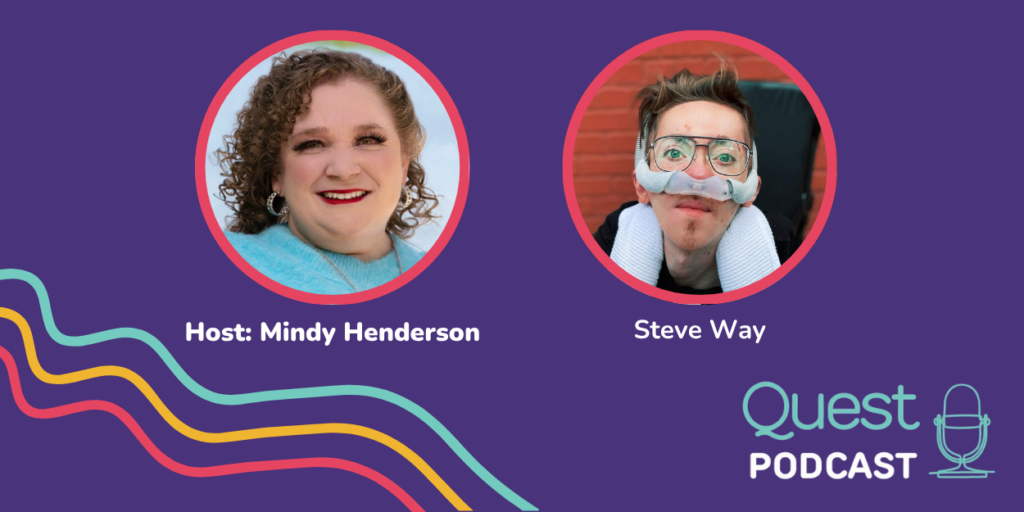
Quest Podcast: A Conversation with Steve Way, Part 2: Medicaid, Self-Advocacy, and the Life You Want
By MDA Staff | Wednesday, October 7, 2026
In this episode of Quest Podcast, actor, comedian, and disability advocate Steve Way returns to continue our conversation, this time getting even more personal about his own reliance on home and community-based services and what independence really requires. Steve explains how these services make everything possible, from getting out of bed to doing his job, why the Medicaid cuts some states are facing are so frightening, and his practical tip for making sense of dense budget bills and Medicaid code. He also talks about picking your battles when energy is limited, why keeping your contact information current with your Medicaid office matters more than ever, and how a public speaking career that began at age nine grew into using his platform from Ramy and Furious to raise awareness for the disability community. Steve shares his experiences, expertise, and candid, no-nonsense perspective on self-advocacy, the fight for healthcare, and creating the life you want instead of waiting for it.
Read the interview below or check out the podcast here.
Mindy Henderson: Welcome to the Quest Podcast, proudly presented by the Muscular Dystrophy Association as part of the Quest family of content. I’m your host, Mindy Henderson. Together, we are here to bring thoughtful conversation to the neuromuscular disease community and beyond about issues affecting those with neuromuscular disease and other disabilities, and those who love them. We are here for you to educate and inform, to demystify, to inspire, and to entertain. We are here shining a light on all that makes you, you. Whether you are one of us, love someone who is, or are on another journey altogether. Thanks for joining. Now let’s get started.
Today we are welcoming back actor, comedian, and disability advocate, Steve Way. In our first conversation, we talked about his career, his role on Hulu’s hit show Furious, and what it means to see authentic disability representation on screen. Today, we are continuing that conversation and getting, I dare say, even more personal, talking about Steve’s own experiences with home and community-based services, what independence really requires, and how he’s learned to use his voice as an advocate for himself and the disability community. Steve, thank you for coming back again. You are a trooper. You’re my favorite.
Steve Way: Thank you. Thank you.
Mindy Henderson: Yeah. I know how busy you are. So I am going to dive right in. You are an outspoken advocate and you’ve personally relied on home and community-based services throughout your life. Can you take us inside what those services make possible for you on an ordinary day, not just in terms of healthcare, but career, independence, and your ability to be part of your community?
Steve Way: Yeah. It’s pretty much every basic human function.
Mindy Henderson: Yeah.
Steve Way: Getting out of bed, getting dressed, showering, feeding, taking my medication. I can’t do my job without all that.
Mindy Henderson: Yeah.
Steve Way: And we’re at a very scary time in this country where there are states facing massive budget problems because of cuts to Medicaid. There are states that are exploring the possibility of getting rid of those services. I’m very lucky to live in New Jersey where that’s not a big issue, at least right now. But I really feel for my disabled brothers and sisters who live in those states where you might not have the support system that I do. So it’s scary, but we have a voice. I just saw a screening of Being Heumann, all about Judy Heumann.
Mindy Henderson: Oh yeah.
Steve Way: [inaudible 00:03:54]. And if they could pull off the largest occupation of an American federal building in 1977, there’s no reason why we can’t fight for healthcare. And I hope that when this movie comes out, disabled people will watch it and they will feel fired up and empowered to continue Judy’s legacy to keep fighting.
Mindy Henderson: Yeah. I love that you brought up that movie. I actually had the opportunity to interview Judy Human a couple of years before she passed, and that will remain in my memory, one of my proudest moments, having the opportunity to speak with her. And she did such incredible work and I am counting the days until that movie comes out. I’m excited that you got to screen it. That’s wonderful. It’s such a complicated system, home and community services, Medicaid, the waivers, and there’s a lot to know about. And when I look at your social media and I follow along with you, you are so well-educated about the subject. And knowledge is power, and so I’m wondering where people can start. Obviously, you’ve been doing this and living this for a long time and that immersion helps, but if people are listening who are concerned about some of the changes and the cuts that we could be facing, where would you suggest people start to really learn the systems and what’s happening?
Steve Way: Just read the text. Read the bills. I would just start with HR1 from 2025, more commonly referred to as The Big Beautiful Bill. Read your state’s budget bills, read your state’s healthcare [inaudible 00:06:32]. It’s all out there.
Mindy Henderson: Yeah.
Steve Way: It’s all in the federal and state regulations. It’s boring. It’s hard to read.
Mindy Henderson: It’s very dry.
Steve Way: I’m going to say something that might sound controversial, but it’s useful. Download the PDF of your state’s budget or Medicaid code. Excuse me. Put it in an AI and just say, “Simplify this for me. What does it mean?” I live with muscular dystrophy. I’m on Medicaid. How does this affect me?
Mindy Henderson: Yeah.
Steve Way: And it’ll help you understand it.
Mindy Henderson: Oh, that’s so smart. That’s brilliant. I love that. And I want to loop back to what you said about home and community-based services and what they really represent in your life. And like you said, it’s everything. It represents your ability and anyone who is in similar situation, myself, any number of people in the neuromuscular community. There’s a lot that we depend on. It’s not just healthcare, it’s everything about our lives. And so, I want to also ask a slightly different question. If you think of those services, from your experience, what have you learned about advocating for yourself within those systems? Because again, they’re complicated, especially when maybe there’s something that you need that’s not working the way that it should, there are delays, anything like that. Are there any tactics or strategies that have worked especially well for you?
Steve Way: Yeah, I drink a lot, a lot of espresso. Yeah. For me personally, I’m motivated by my art. I can’t do my art without my help.
Mindy Henderson: Yeah.
Steve Way: Not everyone has that, and that’s okay. We really have to pick and choose which bout to fight. I literally posted that on my Substack today. We have a limited amount of time because we have a limited amount of energy. And so, we really have to choose which to go after. And it doesn’t mean we give up. We’re really smart about it. We’re just allocating our time and energy to the priorities. It is possible. I know it feels impossible, but I promise you it’s not. The system is designed to not give us what we need. So the system is working the way it’s supposed to, but it doesn’t mean that there are no ways around the system. And I’m always here. I’m always here for advice. I want to help other people, but we’re tired.
Mindy Henderson: Yeah.
Steve Way: I get it. I totally get it. And you’re not alone. If you feel like giving up, you’re not alone.
Mindy Henderson: And one thing that I heard, I mean, this is just sort of a little tactical tip for people that might be listening. I was at a conference recently and heard a panel conversation about some of the changes that are coming and such a simple little thing, but one of the panelists said that one of the absolute most important things that people can do right now is to contact whoever they may work with at their Medicaid office and make sure that, this is so silly, but make sure that your contact information is correct that they have on file because-
Steve Way: Mindy-
Mindy Henderson: Yeah, just for so that you-
Steve Way: I’m so happy you said that, because literally about two hours ago, yeah about two hours ago, I just posted to my Substack an article about Medicaid redetermination. And that was one of the most important things that I said.
Mindy Henderson: Yeah.
Steve Way: If your contact info is not up-to-date with your Meditative office, you are done for.
Mindy Henderson: Yeah. So anybody listening, make sure that your address, your phone number, your email address, everything. So these issues that we’re talking about, they’re not abstract for you. This is real life for you. When you speak about these programs, what’s at stake for you personally? Number one, I know it’s not easy because I know what I do for a living and telling your personal story in public venues is not an easy thing to do. It’s hard to be vulnerable and share such personal pieces of yourself. Is that hard for you or what else would you say is kind of at stake for you, if anything?
Steve Way: Well, I have the platform.
Mindy Henderson: Yeah.
Steve Way: I have the platform and the voice, so I have to use it.
Mindy Henderson: Yeah.
Steve Way: I’ve been doing this a long time. Since I was a kid. I must be doing something right.
Mindy Henderson: Yeah.
Steve Way: And people come to me for guidance and advice. Why would I not do this?
Mindy Henderson: Yeah.
Steve Way: Yeah, it takes a toll, but you got to give the people what they want. And I talk about it a lot in my Substack. I’m trying to give people the tools and the secrets and the specific language to fight back.
Mindy Henderson: You’re a generous person and I know you help a lot of people. And I want to take that and run with it a little bit, because you’ve also taken your personal advocacy and turned it into public advocacy. Was there a point when you realized “I want to use my voice for other people.” What did that evolution look like for you?
Steve Way: I started public speaking when I was nine.
Mindy Henderson: Wow.
Steve Way: And I realized pretty quickly that I’m really good at it, but I kept doing it. So I must be doing something right.
Mindy Henderson: Yeah.
Steve Way: But when I started doing standup and I did Ramy, and now Furious. I have this huge platform and I’ve always felt I would be doing our people by disservice if I didn’t use it to help us. I had eyes on me. A lot of people are listening to me. I’m on national TV. I’m in worldwide outlets. How can I not speak about what we’re going through right now and what’s going to happen to us soon? I can’t ignore that. I have to raise awareness to that because again, we have the power. We have the ability to make change. So I can’t control what other people do. I can’t control what the allies fight for. I can’t control what other marginalized groups have solidarity with us, but I can raise awareness.
Mindy Henderson: Yeah. That’s incredible. And I think that just speaks to who you are and your heart. Not everyone with a platform like yours makes that choice to speak about their personal lives and what they think is right and what they think is wrong. So I am grateful that you’re out there speaking about it and helping other people. You have built this extraordinary life that includes acting, comedy, producing, relationships, advocacy, everything a person could possibly want, all while navigating these challenging systems. For anyone with a disability who may be listening to this conversation, I would love to leave it on this note. What do you hope that people take away, maybe the number one thing that you would like people to take away from hearing how you’ve learned to advocate for the life you want?
Steve Way: Yeah. Life sucks, but it sucks for everybody. We’re not special. Yeah, we’re targets. We’re at war for our rights and our healthcare. It’s not the first time that’s happened, but it definitely won’t be the last. Life is short. Why spend it being miserable and feeling disempowered? I’m going to do what makes me happy and I’m not going to let people tell me no, but I’m not going to wait for it. Happiness is not going to fall to your lap. You’re going to have to measure it yourself.
Mindy Henderson: Yeah.
Steve Way: [inaudible 00:18:13] you can’t walk or you can’t feed yourself. It doesn’t mean you can’t create it. You can figure it out. Just get out there, touch grass, get some fresh air and you’ll do something. And again, it’s not like, oh, I’m better than you. I’m not better than anyone. I just busted my ass for this for almost 20 years, but it’s never too late.
Mindy Henderson: Yeah.
Steve Way: Just be happy and stop worrying about what other people think. You’re not here to please other people. You’re not going to make everyone else happy. That’s not possible. And again, if you want to talk, I’ll talk. I’m always down for that.
Mindy Henderson: Yeah.
Steve Way: But just stop feeling sorry for yourself, stop feeling disempowered. And don’t get me wrong, I have those days. Of course I do. We all do. But again, I’m going to do what I want because I want to, and I can. So let’s have fun.
Mindy Henderson: I love it. I love it. I can’t think of a better set of words to leave us on for today. You have been so generous with your time and you are welcome back anytime. I love talking to you. I do hope that you’ll come back. And again, just thank you for all the hard work, both to entertain us and also to help us create change. So keep it up, Steve. Thank you.
Steve Way: Thank you.
Mindy Henderson: Thank you for listening. For more information about the guests you heard from today, go check them out at mda.org/podcast. And to learn more about the Muscular Dystrophy Association, the services we provide, how you can get involved, and to subscribe to Quest Magazine or to Quest newsletter, please go to mda.org/quest. If you enjoyed this episode, we’d be grateful if you’d leave a review. Go ahead and hit that subscribe button so we can keep bringing you great content and maybe share it with a friend or two. Thanks everyone. Until next time, go be the light we all need in this world.


Disclaimer: No content on this site should ever be used as a substitute for direct medical advice from your doctor or other qualified clinician.