Community Voices: Finding Connection in the Shared Language of Living with a Disability
By Sonali Gupta | Monday, December 1, 2025
Bio: Sonali Gupta is an essayist, journalist, and audio producer. She holds a master’s degree in journalism from New York University and previously worked as an audio producer in Mumbai, where she lived for over a decade. Her writing focuses on health, disability, and culture, with work appearing in The New York Times — including an essay on the pandemic — as well as Huffington Post, Vogue and other publications. She’s currently working with the Disabled Journalists Association and is based in New Jersey.
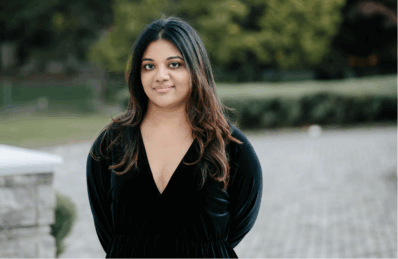
Sonali Gupta
When I was diagnosed with muscular dystrophy twenty years ago, I had no idea what kind of life awaited me. At the time, I was a senior about to graduate from New York University. I had spent my college career securing prestigious internships at entertainment and music companies, catching the subway after class to spend hours inside fancy offices, hoping to climb the corporate ladder and own a record label of my own one day, and then rush back home to study. Muscular dystrophy was only a label for me – at that time I didn’t need mobility aids or caregivers and I wasn’t yet experiencing too many symptoms. But the more I moved around, the stronger my instinct was that there was something wrong with my body.
New York is a pedestrian city, so I walked and took subways and buses everywhere. In time, I started noticing how unstable I felt in my legs. It was becoming harder to climb up stairs without having to pull myself up the railing. And sometimes when I’d walk down the street, my knees would buckle and I’d crumble to the ground in a pile, struggling to get up on my own. I had weakness in my arms too though that didn’t impact my day-to-day life as much as my legs did. It was terrifying not knowing what was causing this sudden impairment in my abilities and there was a lot of self-blame that occurred too. I used a cane for many years – it had been my companion, travelling around the world with me. From ancient ruins in Istanbul to the Indian Ocean, my cane supported me as long as it could until I needed a walker and now a wheelchair. At twenty, I was headstrong and stubborn, certain that my diagnosis would not impact my goals – and maybe a little naïve that it would not impact my life.
I learned that I have a genetic mutation that causes something called limb-girdle muscular dystrophy (LGMD). I only told a few close friends and my supervisors at work about my health; fearful they’d think less of me, that I was making some sort of excuse to get out of doing work. I avoided Googling my diagnoses for a few months – until I caved one day and saw images of wheelchair and walkers. I called my mother, crying into the phone, scared that the images on the screen were what my future held for me instead.
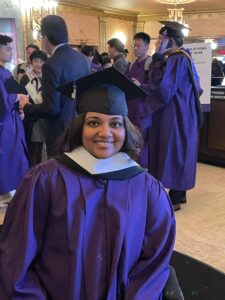
Sonali at her college graduation.
I also worried about my relationships – friends, potential partners, anyone I’d be around. I’ve always been a social person, I still am. From the friendships I fostered during college or people I met out in the real world, to the caregivers (I eventually needed 24-hour care) who turned into friends, my relationships became more meaningful over time. I’m fortunate to have developed deep connections with people around the world. Those bonds carried over as I lived in India for many years, returning to the US during summers.
And yet, even in the safety of those connections, there was always something I couldn’t quite name—a small distance, a quiet gap. It wasn’t a lack of care or love. It was something subtler: the difference between empathy and living this life day-to-day.
For years, I was constantly explaining why my body moved the way it did. Whether it was to strangers or friends, I laughed off some tougher moments to hide my pain. I struggled to keep up with my able-bodied friends, pushing myself to show up at dinners and parties, sometimes spiraling in anxiety with the planning and strategy involved with every move. Though I knew my friends and family understood my challenges, I often felt alone even when surrounded by my loved ones.
It wasn’t until I learned to balance valuing my own independence and leaning on my community – finding and feeding a variety of relationships – that I was able to feel a true sense of belonging.
Making my own way in Mumbai
When I moved to India in my twenties, I thought I was going for a few years of holistic treatment. I ended up staying through most of my twenties and thirties, working and exploring my roots on my own terms. Living in India with muscular dystrophy was its own education and adventure. Mumbai is a vibrant city—packed with people, markets, traffic, it’s the city that never sleeps—and I loved being swept up in all that energy. But it also meant navigating buildings with large steps and no ramps, broken streets with no sidewalks and enduring long stares from strangers on walks when my body moved differently than theirs.
My disability was progressing during those years, which meant that every few years I had to relearn how to move through a complex, multi-cultural city and my life. And I met two wonderful caregivers who learned alongside me for years to come.
There were moments of deep frustration—not speaking the language, feeling invisible when infrastructure excluded me (but usually finding a way around it!)—but there were also many moments of unexpected kindness. Like shop owners who would bring their products to my car when they knew I couldn’t enter their shops or friends who would instinctively stand close to me or hold my hand tightly to guide me through a crowd.
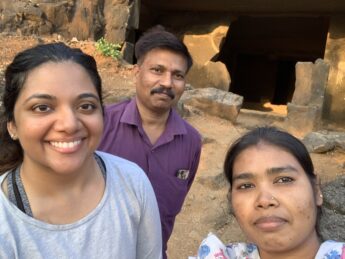
Sonali in India with two of her caregivers, Balu and Martha.
I eventually began working with non-profits dedicated to fostering inclusivity like Point of View and Change.org, connecting with disabled and other marginalized communities. I wanted to support those communities in the best way I could while also experiencing what it felt like to be in community with other disabled folk. My writing career developed during those years as I worked to shed more light on accessibility in Mumbai and create more awareness/acceptance around the importance of having an inclusive culture, especially for younger people with disabilities. People with disabilities in India must often prove their worth time and again and often what is meant to be empathy looks and sounds a lot like pity.
In India, I didn’t have a built-in muscular dystrophy community nearby, but I eventually found close connections with friends throughout the city. That community wasn’t always disability-specific, but it was real, and it helped me grow into adulthood in a country that challenged and changed me in every way.
Connecting with others like me
When I eventually returned to the U.S. in 2024, to my hometown in New Jersey, I carried both the resilience I had built abroad and the awareness that something was still missing for me. After so many years of living with this disease, I still didn’t have a full sense of what being disabled meant to me.
Did living in America mean more wheelchair accessible pathways? That I had more rights as a person with a disability? That I would have more opportunities? I already knew that it meant more out-of-pocket expenses for my care. I had become frustrated with the healthcare system here and was also experiencing more limitations in my mobility as my disease progressed. By this time, I was using a power wheelchair and learning to navigate life with that.
It was the first time I acknowledged to myself that I needed to be around people who moved (or didn’t move) like me. Who knew what it was like to feel like your body isn’t your own, to know the creative energy that goes into finding solutions to open doors alone or using my core to reach down to pick up a stray sock. I was looking for people who knew firsthand what it meant to live in a disabled body.
After posting an ad looking for a caregiver in my building Facebook group, I got a message from a young lady named Carly who I learned lived across the hall from me. Her door is literally three steps away from mine. She had a spinal cord injury, and we bonded quickly, we talked about the realities of being a younger person with a disability: the logistics that shape every decision, the way people either underestimate us or put us on pedestals.
What struck me was the ease that we had with each other. With Carly, there was no need to explain or translate. I didn’t have to pause to define what accessibility meant in practice, or why something that looked “simple” from the outside carried ten layers of planning behind it. She just knew. And in turn, I knew when she talked about her own frustrations or victories.
Our first meeting was a unique one – I was alone in my apartment laying down on my bed with a heating pad. We had been messaging about meeting up until finally one evening we were both at home. I told her my front door was open and to come on into my bedroom. I didn’t have a caregiver so I couldn’t get out of bed, but I was also just way too comfy! I told myself, whoever she is, she’d better get used to this. She walked into my bedroom, laughed, and sat down on my bed with me. Of course she understood. She’d been there too. We talked about doctors, family, friendships, about the strange mix of grief and gratitude that comes with disability. I remember feeling a new sense of connection that I hadn’t felt before. Carly wasn’t just a new neighbor. She was someone who recognized my reality in a way no one else quite had.
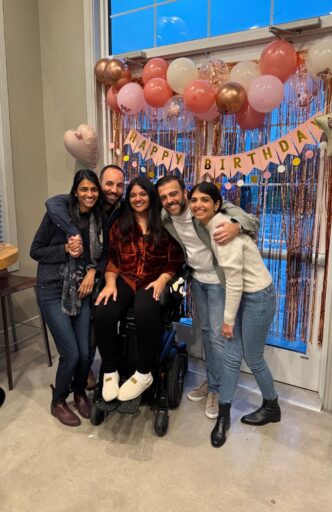
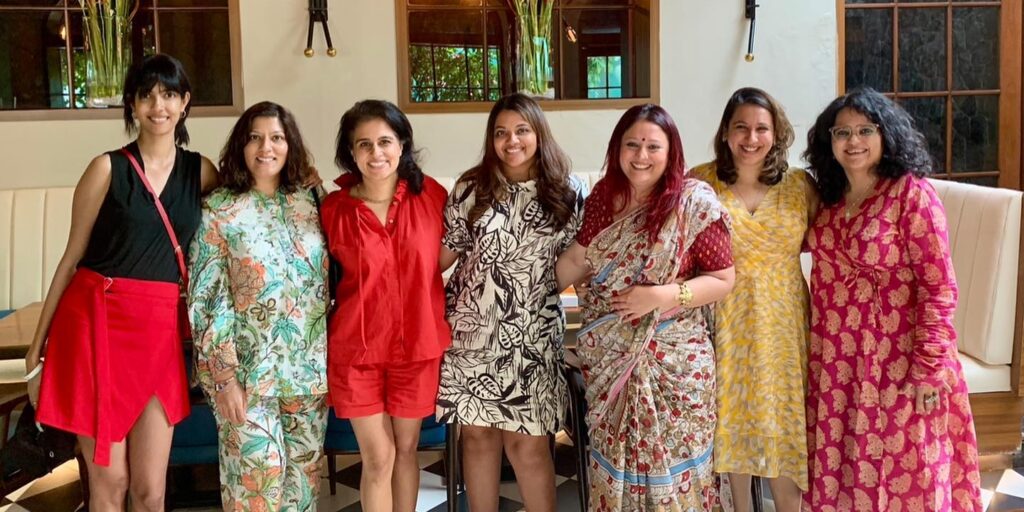
Sonali celebrates a birthday with friends and family.
I met another resident in my neighborhood who also uses a powerchair, Samuel. I saw Samuel coming home from high school one day on the bus. He came down on a lift and I drove right up to him and his mom to find out more. ‘Hey!’ I almost said, ‘I have a powerchair too!’ We chatted about our health and lives. He told me about where he goes for physical therapy. I followed his lead and started going to therapy at the same center with the same therapist – who I’m very happy with!
Another friend Nikhilesh and I have spent hours talking about Medicare, insurance, and the endless maze of paperwork that comes with managing a progressive condition. With him, I can vent about the frustrations of coverage gaps and celebrate small achievements when a claim finally goes through. These are not glamorous conversations, but they are profoundly gratifying. They remind me that I am not navigating this system alone.
Making space for belonging
Each of these relationships is different, but all are essential. They don’t replace my long-standing friendships; they add another dimension. It’s like speaking two languages fluently. With some friends, I share the language of memory and history. With others, I share the language of lived experience in a body with a disability. Both languages are vital. Both make me whole.
I was 20 years old when I was diagnosed. I’ll be 40 next year. Twenty years of navigating a life where care was essential to my every day, learning how to depend on others for help (a real challenge for me), and finding my community. Twenty years later, I see community differently. It’s not one circle, but many—overlapping and interwoven. Some friends hold my history. Others hold my present. Finding this balance has been one of the greatest gifts of my life. Twenty years later, I no longer ask whether I’ll “find my people.” I know I have—and they come from different corners, each one offering something distinct and irreplaceable.
If there’s one lesson I’ve learned in these twenty years, it’s that connection doesn’t always look the same. My long-time friends who have walked beside me through every chapter are just as precious as the intimacy of those who understand my reality through their own disabilities.
Community, I’ve learned, is less about finding one perfect fit and more about allowing space for multiple kinds of belonging.
Next Steps and Useful Resources
- Check out more of Sonali’s writing on her Substack, Caregiving Chronicles.
- Stay up-to-date on Quest content! Subscribe to Quest Magazine and Newsletter.


Disclaimer: No content on this site should ever be used as a substitute for direct medical advice from your doctor or other qualified clinician.