MDA Ambassador Guest Blog: Pursuing My Dreams While Living with a Rare Disease
By Gabrielle Runyon | Wednesday, February 4, 2026
5 Second Summary
MDA Ambassadors play an essential role in furthering MDA’s mission while representing and empowering the neuromuscular disease community. Quest Ambassador Guest Blog series provides a platform to share their personal stories, perspectives, and experience.
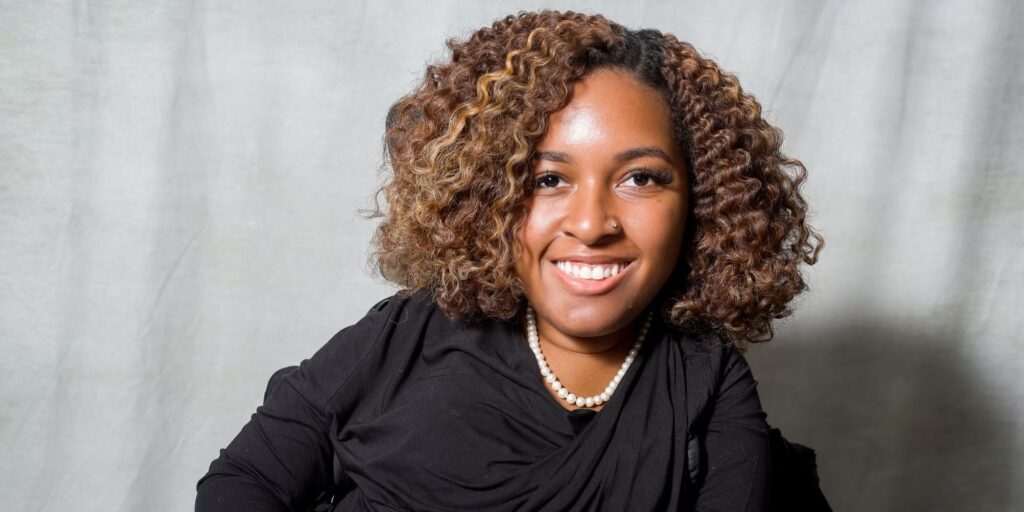
Gabrielle Runyon is a graduate student in the Master’s Counseling Program at the illustrious Tennessee State University. She is from Louisville, Kentucky. Gabrielle was diagnosed with spinal muscular atrophy (SMA) when she was one year old. Her fun fact is that she can play three instruments.
Living with a rare disease, I learned early on that I wouldn’t just have to fight against my own body, but against the world I live in, too. As a Black disabled woman in America, that fight extends far beyond my diagnosis. It shows up in the systems not made for people like me that I have to navigate and in the assumptions people make about my worth and ability. But within that reality, resilience wasn’t something I discovered by accident or in spite of my circumstances – it was something I developed because of them. Navigating healthcare systems, inaccessible spaces, and rigid stereotypes forced me to learn perseverance early, shaping how I move through the world and pursue my goals with intention, determination, and strength.
Persevering with intention

Gabrielle on a plane as she prepared to go skydiving, a dream she had since she was 10 years old.
Pursuing my education and career has never been just about talent or motivation; it has required constant recalibration. Living with a rare disease means my capacity isn’t fixed; it changes day to day, sometimes hour to hour. Deadlines don’t pause for my chronic pain and academic or professional spaces rarely account for bodies that need flexibility to function. I’ve had to learn how to plan further ahead, advocate more clearly, and push back against systems that equate worth with constant productivity. The cost of ambition, for me, often looks like exhaustion that others don’t see, extra time spent explaining my needs, and the emotional labor of proving, over and over, that my disability doesn’t negate my work. It’s through navigating these challenges that I’ve learned how to persevere with intention, finding ways to keep moving forward without abandoning myself in the process.
One of the most persistent misunderstandings about ambition and disability is the belief that determination should look the same for everyone. In academic spaces, this often shows up as rigid expectations that leave little room for adaptation, even when those expectations actively exclude disabled students. When accommodations are treated as exceptions rather than necessities, disabled ambition is framed as a problem to be solved instead of a reality to be supported.
I encountered this mindset firsthand during my undergraduate studies as a music therapy major, a field that allowed me to integrate two things I’ve always loved: psychology and music. Music has been a part of my life for as long as I can remember. My mom says I was singing before I could talk, and I saw music therapy as a meaningful way to connect with others. That path began to unravel in guitar class. Because my disability causes muscle weakness, pressing down on the strings of an acoustic guitar with enough force to produce sound was physically difficult, and the instrument itself was larger than my body. As my video assignment grades declined, the impact of my disability became increasingly visible. Still, when I explained my limitations, my professor insisted that I prove my disability was the reason I could not perform. After escalating the issue to the department head, I was offered a digital guitar as an accommodation. When I brought it to class, the professor refused to allow its use, citing a syllabus requirement that only acoustic guitars were permitted. In that moment, it became clear that the issue was not my willingness to work or adapt, but an unwillingness to recognize that success might look different for me. The stress of watching my grades fall, and fearing the loss of my scholarship, took a serious toll on my mental health, leading me to seek emergency counseling on campus.
Redefining resilience and redirecting your path

Gabrielle joyously celebrating at her graduation from the University of Louisville in May of 2024.
I eventually changed my major and had to come to terms with the fact that this was not a failure of ambition or giving up, but an act of perseverance and self-respect. That experience forced me to redefine perseverance, teaching me that resilience does not always mean pushing through harm at all costs. Sometimes, it means redirecting your path while holding onto your purpose. I went on to graduate with a degree in psychology and a minor in music, carrying forward the parts of myself that mattered most, even when the original path was no longer accessible.
I am now pursuing a master’s degree in counseling, a field that allows me to integrate my passions for psychology and music while helping others navigate the challenges that often feel invisible to the world. My path has not been linear, and it has required recalibrating my goals, navigating unwelcoming systems, and redefining what success looks like on my own terms. Yet these obstacles have not diminished me or my determination, they have sharpened it, teaching me perseverance that is intentional, embodied, and rooted in the realities of my life. Living with a rare disease has not only shaped the ways I persist, it has given me the resilience to pursue my dreams fully, in ways that are authentic to who I am.
Next Steps and Useful Resources
- Learn more about Spinal Muscular Atrophy (SMA) here.
- Browse MDA’s Mental Health Hub.
- MDA’s Resource Center provides support, guidance, and resources for patients and families. Contact the MDA Resource Center at 1-833-ASK-MDA1 or ResourceCenter@mdausa.org
- Stay up-to-date on Quest content! Subscribe to Quest Magazine and Newsletter.


Disclaimer: No content on this site should ever be used as a substitute for direct medical advice from your doctor or other qualified clinician.