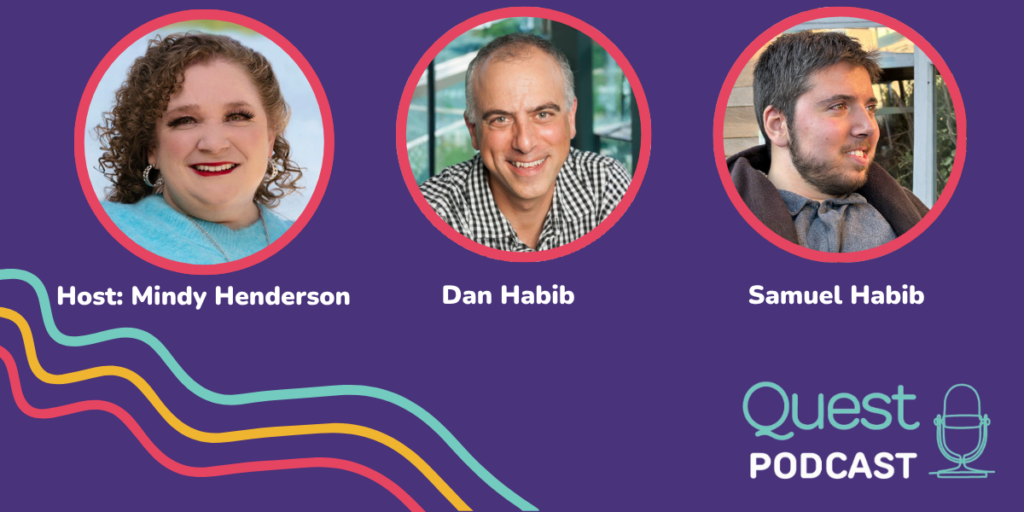
Quest Podcast: From Roadmap to Emmy: Samuel and Dan Habib on Filmmaking, Family, and Disability
By MDA Staff | Thursday, April 9, 2026
In this Quest Podcast episode, we chat with Emmy Award-winning filmmaker and disability advocate Samuel Habib and his father and longtime collaborator Dan Habib, the creative duo behind the extraordinary documentary The Ride Ahead. In the film, Samuel opens up about his personal journey into adulthood — navigating housing, employment, relationships, and higher education while living with a rare neurodevelopmental condition — and how connecting with the disability community helped him find confidence, purpose, and his own powerful voice. Dan reflects on two decades of disability filmmaking and what it meant to finally put a person with disability in the director’s chair. Together, they share the honest, often humorous, and deeply moving story behind the making of the film, the mentors who shaped it, and why authentic representation in storytelling matters now more than ever. Samuel and Dan offer their experiences, expertise, and heartfelt advice on self-advocacy, finding community, and what it really looks like to live a full and meaningful life with a disability.
Read the interview below or check out the podcast here.
Mindy Henderson: Welcome to the Quest Podcast, proudly presented by the Muscular Dystrophy Association as part of the Quest family of content. I’m your host, Mindy Henderson. Together, we are here to bring thoughtful conversation to the neuromuscular disease community and beyond about issues affecting those with neuromuscular disease and other disabilities and those who love them. We are here for you to educate and inform, to demystify, to inspire and to entertain. We are here shining a light on all that makes you, you. Whether you are one of us, love someone who is, or are on another journey altogether, thanks for joining. Now let’s get started.
Today, I’m joined by Samuel and Dan Habib, the creative force behind the extraordinary featured documentary, The Ride Ahead. This film isn’t just a coming-of-age story, it’s a redefinition of what adulthood, independence, and identity can look like when the world wasn’t designed with you in mind. Samuel Habib is an Emmy award-winning filmmaker, speaker and advocate whose work is already reshaping how we think about disability, voice, and storytelling.
In The Ride Ahead, Samuel brings us along on a journey that is as honest as it is groundbreaking, navigating the transition to adulthood while living with a rare neurodevelopmental condition. Joining him is his father and longtime collaborator, Dan Habib, an acclaimed filmmaker and disability advocate whose work has influenced national conversations on inclusion and equity for years.
Together, they’ve created a film that doesn’t just tell a story, it opens doors, challenges, assumptions, and invites all of us to think bigger about possibility. In this conversation, we’re diving into The Ride Ahead, the making of the film, and the truths it reveals about independence, community, and what it really means to live a full life. Samuel and Dan, thank you so much for being here.
Samuel Habib: Thanks for inviting us, Mindy. I’ve been looking forward to it. For accessibility purposes, I’ll do a visual description. I’m a 26-year-old white man with brown hair and a beard sitting in my wheelchair. I am the co-director of two documentaries, My Disability Roadmap and The Ride Ahead. I work part-time at the Westchester Institute for Human Development and LikeRightNow Films. It’s awesome to be here.
Dan Habib:Thanks, Mindy. And I’m Dan Habib. As you said, Samuel’s father and co-director. I guess, I should also give my age, Samuel, since you gave yours. I’m a 60-year-old man with not much hair. He’s got a lot more than I do and a lot more on his face as well. And I’m sitting here in Samuel’s home in Concord, New Hampshire where we both live. So, it’s really great to be with you. Thanks for having us.
Mindy Henderson: It’s wonderful to meet you. I am not, on the other hand, going to tell you how old I am, but I will follow your lead and give my own visual description. I am a white woman with curly brown hair and thrilled to be here with both of you. So, let’s dive in. There’s so much to talk about here.
First of all, Samuel, I’d like to start with you. Before we get into the film, I would love to start with what a good day looks like in your life right now.
Samuel Habib: A good day in my life with traveling. Like going to the Bay Area, like we are this June for a film screening and a Giants game.
Mindy Henderson: Oh, so fun.
Dan Habib: We asked him earlier what his idea of a good day was. He said being on the road and experiencing new places.
Mindy Henderson: That’s a great answer. There’s so much to see out in the world and I’m a little bit jealous that you’re going to see that game. So, what are the greatest obstacles in your transition to adulthood, would you say, and how have you learned to problem solve for new challenges and new daily living scenarios? As a person living with a disability myself, I know that there’s no shortage of daily living challenges to cross over each day.
Samuel Habib: A big challenge for me is getting into the homes of my friends and family members. Sometimes, I also get too tired to stay up late, so I miss out on going to bars, parties and dates at night. But the biggest obstacle is definitely ableism. People don’t always see me as a potential friend or as a potential boyfriend so that can be frustrating. At times, it’s also been hard to have direct support professionals leave for another job. I’m really glad that I have a great team of direct support professionals right now.
I stay motivated by having a positive attitude. I know this film is doing good for other people with disabilities. My family and direct support professionals motivate me with good thoughts about my present life and my future.
Mindy Henderson: That’s fantastic. And I can certainly relate to the challenges that you mentioned. And I know that with the work that you’re both doing, it’s going to make the world more friendly for people living with disabilities, and of course, perceptions and education about disability. Dan, I’d love to bring you into this. How did the two of you first start talking about turning this chapter of Samuel’s life into a film? And do you mind, actually, just for a few listeners who haven’t had the opportunity to see the film yet, just give us a brief little description of what the mission of the documentary is or what it’s about.
Dan Habib: Sure. Yeah, thanks for that. I mean, I’ll say a little bit about the film and the motivations, and then Sam, I know, can add some really interesting points from his own point of view. I’ve been doing films for 20 years, and for most of my films, it’s me filming and directing, and I’m photographing people or filming people I don’t know very well, but that I get to know over the course of the filming, but letting them tell their own stories over time.
But as I’ve gotten farther and farther into my career, a couple things happened. One was that Samuel kept getting older, thankfully, and becoming more and more interested in the work and the film work. But also, I realized that to tell stories about disability, people with disability should really be in the forefront, in the leadership of the process, meaning they should be co-directing like Samuel. They should be helping to do the animation, the music, the filming, and certainly be the people telling their own stories.
So, I had just finished a big project called Intelligent Lives, which came out in 2018, ’19, and was broadcast on PBS. And, really, Sam and I just started talking. He was graduate from high school, he was starting to go to college, and it would just seem like the right time to do something together. And our first film, my first film was called Including Samuel, and it’s the film that put me into this whole career. And it was about Samuel’s elementary school years. And you were too young at that time, Samuel, to really be a co-director when you’re five years old, you’re a little young, six years old. But that film has always meant so much to our family and we feel so good about it.
So, this just felt like the right time for Samuel to be a partner. And the film, as people will know as they see it, I hope soon, is about Samuel’s transition into adulthood. His journey into adulthood and how to figure out all these big questions in life about transition, housing, employment, relationships, higher education, all these huge issues, healthcare. And Samuel decided the best way for him to figure these things out were to reach out to mentors around the country. And we decided to document both his conversations with the mentors and his own experience of transition, and that became the film. And Samuel could probably say a lot more about it if you’d like him to jump in.
Mindy Henderson: Absolutely, please.
Samuel Habib: Disabled people should have their voices heard and we should be able to tell our own stories. I don’t like that movies and stories about disabled people are often about curing or saving or even killing the person because they have a disability. Or you will see someone with a disability have an average talent at something and people will be “inspired” and respond to the talent in a way they might not to someone that doesn’t have a disability.
We created this documentary and our impact campaign so that young adults with disabilities will feel more seen and heard and find their own mentors. As someone who struggles to communicate, this film is incredibly meaningful to me because it is making my experience visible and it is getting my voice and others’ voices heard. Now that the film is being shared across the country through POV and PBS and through our community screening campaign, I think it’s going to help improve the world for disabled young people.
I learned from my mentors that it’s not easy to be an adult with a disability. Connecting with the disability community has helped me feel much more confident in myself and more confident in my advocacy.
Dan Habib: Samuel has, I think, really thought a lot about why he wanted to make this film and with the structure that we made and this whole idea of reaching out for mentors, I think, is so critically important to find mentorship when you’re a young, disabled adult. So, Samuel, maybe you might want to add a little bit about that whole decision process.
Mindy Henderson: Yeah.
Samuel Habib: I’ve lived in Concord my whole life and the schools are very inclusive for students with disabilities. I was in general education classes all the way through school, and I had a lot of friends and was part of clubs and sports. But things felt confusing after I graduated. I wanted to go to college, date, find a girlfriend, get a job, live on my own but no one tells you how to be an adult, let alone an adult with a disability. I suggested an idea to my dad who is a filmmaker. How about I interview badass adults with disabilities about their transition to adulthood?
I decided to start by interviewing people I already knew, like Judy Human, Bob Williams, and Keith Jones because they are people I look up to. They are great advocates and role models for kids and young adults with disabilities. I wanted to ask them and other people I admired about their transition to adulthood to help me and others be successful. These are people I wanted to have as mentors. We wanted to focus on people who would be honest and tell it like it is.
Mindy Henderson: Yeah, you read my mind. You had some absolutely incredible people as part of this documentary other than yourself. And may I say, you are also a badass adult. And if you haven’t already, you’re going to have people coming to you very soon asking you to mentor them, but I’m glad that you covered the names of some of the individuals that were included in this documentary. And I think that you struck a really interesting balance between sharing your own story and showing the world sort of through your eyes, which was really well done, but then also interviewing other people in the disability space who have perspectives and advice to give. It was just so, so well done.
What was your mission in making The Ride Ahead? What did you hope that viewers would take away from it?
Samuel Habib: My goal for the film is that people won’t talk down to disabled people. I want everyone to know that disabled people demand respect and rights. And I want other young adults with disabilities to have the same opportunities that I’ve had for healthcare, inclusive education, college, assistive technology, jobs, making friends, advocacy, and independent living. I hope parents who will watch this film will see that they should include their kids in everything like my family has done. And I hope schools and colleges who watch this film will commit to include disabled students alongside their non-disabled peers. All of my schools have been inclusive and that made a big impact on my education and led to my life now as a filmmaker.
Our film will let people learn from disability role models about how to live a full life with a disability as they transition to adulthood. This film will help people understand how to talk to me and other people with communication challenges. Young people with disabilities who have seen the film so far have told me that they have the same questions as I do about dating, sex, moving out of their own family’s home, how to respond when people talk down to them, work and college. That means a lot to me.
Mindy Henderson: Everything that you say, I’m just sitting here going, “Oh my gosh, me too.” I wish I were kidding when I tell you that, and there’s a scene in the documentary that’s coming to mind where somebody was kind of speaking to other people instead of speaking to you, Samuel, and that vulnerable moment, I think, a lot of us can really relate to. I’ve had people pat me on the head like a puppy. It’s really kind of disturbing how people think that it’s okay to approach people with disabilities.
And let me just say, if you haven’t already started conversations around this, I personally think this is a documentary that should be shown at every high school. It’s so educational and informative about someone else’s point of view and lived experience. You guys should think about it.
Dan Habib: I mean, Mindy, just while you bring that up, that’s why we’re doing this whole initiative with you and with other groups, the MDA and others, around getting it to camps this summer because we want to make sure this film is in the hands of the people that will be most impacted by it. And we think that getting it into summer camps and programs is a really powerful way to shift mindsets, to empower people, to expose them to the incredible mentors that Samuel got to meet through the film. So, I’m sure you’ll mention this in other ways, but I know that MDA’s going to get the word out, but we’re making the film available for free to every nonprofit camp in the country this summer that wants it.
Mindy Henderson: That’s incredible.
Dan Habib: Along with discussion guides. So, we got a wonderful grant from Mitsubishi Electric American Foundation just recently to support this effort, and we’re really excited to get into the hands of your whole network.
Mindy Henderson: Absolutely. And we appreciate you giving us the opportunity to make it available to our community. I am probably the poorest example of a filmmaker that someone could possibly be. So, I can only imagine what making a documentary like this would be like, but what were some of the challenges in making the film?
Samuel Habib: Setting up and getting all of the interviews done was the most challenging part of creating the film. We had a lot of misadventures during our travels. On our flight to Indianapolis to interview Andrew Peterson, they turned my power wheelchair on its side both ways, and it got damaged both ways. On our New York City trip to interview Keith Jones and Maysoon Zayid, I had a seizure, but we still got the filming done on all the trips.
Dan Habib: Just the way we set up the camera work was challenging. We had two GoPro cameras, one facing out from Samuel’s perspective that he could show the world as he sees it, and then one facing in towards him. And that was a challenge to keep all the camera work. Just think about that.
Mindy Henderson: Yeah.
Dan Habib: Samuel has a question though. Go ahead. There’s something you want to say.
Samuel Habib: [inaudible 00:16:13].
Dan Habib: We …
Samuel Habib: [inaudible 00:16:21].
Dan Habib: … will …
Samuel Habib: [inaudible 00:16:26].
Dan Habib: … always …
Samuel Habib: [inaudible 00:16:30].
Dan Habib: … fly …
Samuel Habib: [inaudible 00:16:36].
Dan Habib: … big planes?
Samuel Habib: Mm-hmm.
Dan Habib: Right. So, Sam was saying, now we always research the planes we’re going to be flying on to make sure the wheelchair can fit in the cargo hold. So, we have to talk to them and get the measurements on the cargo hold. So travel, as you probably know, the experience of travel is very different when you’re traveling in a wheelchair and all the things you have to plan for. Yeah?
Mindy Henderson: It really is. We talked about some of the challenges, and actually, let me ask you, how long, start to finish, did it take to create the documentary?
Dan Habib: It was about four years. It took about six months or more of research. It took about almost two and a half to three years of filming, but COVID happened right in the middle of that so we had to take a pause from on the road filming, but we did some Zoom interviews and preliminary interviews. And then, we did another year of filming, and then we did about a year and a half of editing of the film. And then, of course, there’s all the promotion distribution, which continues. So we started in 2019, and it’s now 2026, and we’re still getting it out there. So, a film has a long life and a lot of work.
Mindy Henderson: No kidding.
Dan Habib: A lot of stages.
Mindy Henderson: Yeah. I mean, honestly, I feel like a broken record, but it’s so good. And if you all never did anything else for the rest of your lives, this project would be your crowning jewel.
Dan Habib: Thank you.
Mindy Henderson: And by the way, air travel, we could have a whole separate conversation about that. I agree with you, Samuel. It’s a challenge with a chair. So, what were some of the highlights, then, highlights or favorite moments from making the film?
Samuel Habib: The interviews were awesome. They blew my mind. I reviewed the best sections from the interviews with my dad and we picked out the most powerful lines. I wanted to have lots of humor in the film, so we included some hilarious lines from interviews, especially Keith and Maysoon. But Judy Human was pretty funny too.
Mindy Henderson: Yeah.
Samuel Habib: My favorite line in the film is Keith telling me his advice for sex. He said rule number one, rule number two, all the way down to 100, bag it up.
Mindy Henderson: No, he didn’t.
Samuel Habib: That really cracked me up.
Dan Habib: He did. And I should add that for the camp distribution, we’re creating a G-rated version of the film. So, we’re going to make two versions available, the PG version or PG-13 version and the G-rated version. And we do have to cut out some of the very candid conversations around sex and relationships, which are very important to have, but maybe not for 10 and 11-year-olds. We don’t want to necessarily impose that on people.
Mindy Henderson: Yeah, no, but it’s amazing that you’re willing to do that because you’re right, there’s different content for different groups and ages, and you’re expanding it even further by making that G version. So, Samuel, that was a perfect transition into my next question for you. I can’t imagine myself making a project quite like this, quite with the content that part of it covered with my own parents. Was it awkward for you digging into such, I mean, your dad seems very cool, but was it awkward at all digging into those personal issues for the film with him so heavily involved?
Samuel Habib: It has not been awkward at all. My life is very intertwined with my parents, so they are very aware of most of my deeply personal things. And even talking about sex and dating, we are pretty open about those conversations in our family, but some of the medical stuff was uncomfortable to share publicly. I’ve had trauma from a lot of blood work and IVs starting when I was a baby. It’s difficult to get my blood drawn, and I get nervous when I have to go into the ER, so it doesn’t feel good to talk about that. But I also wanted to show my strength that I’ve gotten through some very tough things in my life. Same for a lot of other people with disabilities and health issues.
Dan Habib: Yeah. And I mean, Samuel talked about this issue with the health showing some really big health crises in his life in the film. Jim LeBrecht, who’s our executive producer who produced Crip Camp and directed Crip Camp with other people. And Jim asked Samuel, “Are you sure you’re ready to share these really personal moments?” And Samuel said, as he just did, “People need to see that I’m strong too, that I’ve gotten through some tough stuff.” He didn’t want to sugarcoat the realities that he’s experienced.
And I think as he said in terms of the awkwardness, people assume it’s maybe awkward the things he’s talked about, but I think, part of it is that we have a pretty open relationship and family. But part of it is when you have a complex disability and have a lot of support needs, for better or for worse, and maybe it’s not always a good thing, you don’t have as much privacy. You don’t have as much confidentiality. It is tough because your communications are often supported by other people, all your support needs, your personal care needs are supported by other people. So, I think, Samuel is expressing a reality of a lot of disabled people that you need to share a lot more of your life sometimes than other people do.
Mindy Henderson: It’s true. And it’s hard. I could not agree with you more. I think one of the most powerful things that we can do is sharing our stories. Storytelling since the beginning of time has been a powerful way that people communicate and share pieces of themselves. And not everyone is cut out for it. And I think that it’s a gift if you are not only willing but able to share like you did.
There were some tough moments in the documentary and you weren’t picking and choosing specific parts of yourself to share with people, it felt like to me. It felt like you really stepped out and embraced the whole experience and didn’t hold back. And I think that that just makes it that much more powerful so I applaud you.
Dan Habib: I just want to add to that quickly that a lot of disabled people, we’ve shown this to a lot of adults say, “Wow, it’s like my life story is on screen and I’ve never seen such authentic representation.” And I think that’s because Sam was willing to share so much and be so honest because you can’t deceive people who live the experience. And one thing we’re really proud of is that the majority of our production and outreach team are disabled people. And I think that also really influenced the truthfulness of the film.
Mindy Henderson: Yeah. Yeah, it’s amazing. So, you’ve already mentioned a lot of the amazing mentors. You had some incredible voices that you added into this documentary. I wanted to ask you a few different perspectives with this next question, because you covered a lot of territory with the different mentors that you interviewed. So, after interviewing the people that you did and making this film, what is one or two pieces of advice that you heard from them? Let’s start with maybe for children, teens, and young adults with disability.
Samuel Habib: My advice to children, teens, and young adults with disabilities is to be proud of yourself. And if someone talks down to you, stand up for yourself. My advice to parents is to include your kids in everything like my family has done. My advice to schools and colleges is to be inclusive. All of my schools have been inclusive and that made a big impact on my education. Find new ways to help people with disabilities, especially for employment and social life.
The advice I got from one of my mentors in the film, Maysoon Zayid was, “You are not alone. Find your community.” That was powerful advice because I’ve always had a strong community, starting with Beaver Meadow Elementary School and right through Concord High School. I’m continuing to find my community at my summer job at a concert venue and work at the Westchester Institute for Human Development in the Disability Justice Community and in my hometown of Concord, New Hampshire.
Mindy Henderson: Amazing. So, you read my mind, you talked about a lot of different audiences, so to speak, and the advice that you wanted to give them, and it’s certainly a sage advice. It’s also dawning on me that I’m sitting here speaking with an Emmy Award winner, which I have actually never done before. Tell us about that win.
Samuel Habib: Our short film, My Disability Roadmap, which was in the New York Times in May of 2022, won a 2023 National News and Documentary Emmy Award in late September 2023. The award ceremony was in Times Square in New York City, and I was able to give an acceptance speech. The Emmy Award definitely exceeded any expectations I had as a multimedia professional. Plus, I’m pretty sure it’s the first time someone used a communication device to give an Emmy acceptance speech.
There were like 600 multimedia journalists in the audience from all over the country. It was awesome.
Dan Habib: Yeah, truly a peak life moment. And it’s on our Facebook page is the video of Samuel giving the speech, so people want to go to The Ride Ahead on Facebook. And right as the announcement’s made, you hear two women screaming really loudly, and that’s Betsy, my wife, Samuel’s mom, and one of his direct support professionals, Molly, just yelling.
Mindy Henderson: Oh, wow.
Dan Habib: And then Sam and I, we just couldn’t believe it going up to the stage. And it was a real proud moment to see him accept it. And just a little bit of backstory on that, we had always intended to just make a feature-length film, which became The Ride Ahead, which is like a 90-minute film. But along the way, we created a short, what we call a sizzle reel. It’s like a little promo reel so that we could do more fundraising and get the word out for the feature. And we shared it with some filmmaker friends and they said, “Boy, this really holds up as a short film.”
So, we sent it to the New York Times. They really loved it and they helped us develop it into this short film that was part of their Op-Doc series that became My Disability Roadmap. So, we never really intended to make a short film but it just took on a life its own. And that film is still for free available on the New York Times YouTube page. Anybody can just Google My Disability Roadmap and they can watch that short 23-minute film that won the Emmy.
Mindy Henderson: Wow. So, I can’t even begin to imagine how thrilling a moment that must have been. What are you all up to now? And do you have additional film projects on the whole horizon or what are you working on?
Samuel Habib: I continue to work part-time at the Westchester Institute for Human Development doing film work, presentations, and interviews like this. For a few years after high school, I attended college at NHTI, the local community college near my house in Concord, New Hampshire and Southern New Hampshire University, a four-year college. I had some health challenges this fall, so I’m taking a break from college for now. I just finished a career exploration course called Major Choice. I also have a regular summer job at Bank of New Hampshire Pavilion in Guilford scanning tickets. I get to see the shows for free when my shift ends like Chris Stapleton, The Pixies, Train, and the Zac Brown Band, and it feels good to make money.
I’m also planning to start belonging about accessible adventures in New Hampshire and accessible bird watching. Through all of this work, I am hoping to continue to make new friends and find a girlfriend.
Mindy Henderson: That’s fantastic. So, what you’re telling me is that you have a lot of spare time. It doesn’t sound like you do much.
Dan Habib: Well, I mean, the film work was really intense for six years we worked all that. But everything kind of has its cycle. And we finished the film, we did a pretty intensive tour, film festivals and screenings. And then things have slowed down some, although we still have a lot of ambitions to get the film out there in the world, it’s not as labor-intensive as making the film and going on the film festival circuit.
So, Samuel is now, as he said, doing vlogging and he has this new project that he’s working on with his DSPs around showing what it’s like to navigate New England in a wheelchair and making short reels and videos. Maybe doing some work with the Audubon Center on accessible birding. And then the summer concert job, which is so much fun. So, he’s definitely got some things going on.
And I’m also doing some new things. I actually just launched a national disability leadership series that we have our first cohort starting in May. And it’s 110 people from all over the country, 65 of whom are young, disabled adults going through an intensive leadership and advocacy training with incredible mentors and presenters over the course of a year. So, people who want to learn more about that, contact us through our social media for next year. We’ve already selected this year’s class, but we’ll be doing this year after year.
So, we’re not doing more film work right now. We decided, as you said earlier, we kind of created the film we wanted to create and we’re at different points of our career now. We probably will just do different kinds of work.
Mindy Henderson: I love that. I love that. And of course, I was joking. It sounds like you’ve got your hands full and you’re an incredibly busy person. I’m also glad to hear that you’re taking care of your health. But it sounds like you’ve got some great things ahead of you that you’re already working on. And the other thing that I just want to mention quickly before I ask what sadly is our last question, but I just want to mention that all of the web links and social media links and handles, we’re going to put all of that in the show notes and make sure that everybody can find all of the incredible work that you’ve all done.
So, let me leave the conversation with this, how can we host our own screening of The Ride Ahead for anyone who is listening? And what are some of those resources that are available to help support a screening event?
Samuel Habib: Thanks for asking about that. On our website, www.rideaheadfilm.com, we have a host a screening page. You can find information there about how to host a screening with our education kit, which has an awesome discussion guide. And we also created a life planning tool. We also created a watch party toolkit. Definitely check that out and have a watch party in your own community.
Dan Habib: Yeah. So as Samuel said, we have a host screening page on the website. And we’re also going to be making sure that the whole MDA network knows specifically, especially how anybody can host a screening, as Samuel said, but specifically for the camps and summer programs for youth, we make the film available for free to everybody. So, we want to make sure people take advantage of that and we’ll make sure we work with you to get the word out.
Mindy Henderson: Incredible. Well, I know that those conversations have already started and I hope that everyone within earshot of this podcast and beyond will watch the documentary. I think it’s heartfelt, but it’s also just entertaining and it’s funny and your charm comes through. So, thank you for creating such an important piece of work for the disability community. And thank you for being here. It’s been such a pleasure to speak with you.
Samuel Habib: It was great to be with you today. We’ll keep you posted on The Ride Ahead.
Dan Habib: Yeah. Thank you, Mindy. This is a really great opportunity to let more people know about the film and we so appreciate it. And as you said, it’s a fun film to watch too. There’s a lot of humor. There’s a lot of fun animation, so people should see it and expect to enjoy it too.
Mindy Henderson: Thank you. Thank you for listening. For more information about the guests you heard from today, go check them out at mda.org/podcast. And to learn more about the Muscular Dystrophy Association, the services we provide, how you can get involved, and to subscribe to Quest Magazine or to Quest Newsletter, please go to mda.org/quest. If you enjoyed this episode, we’d be grateful if you’d leave a review. Go ahead and hit that subscribe button so we can keep bringing you great content and maybe share it with a friend or two. Thanks everyone. Until next time, go be the light we all need in this world.


Disclaimer: No content on this site should ever be used as a substitute for direct medical advice from your doctor or other qualified clinician.