Quest Podcast: Your Difference Is Your Superpower: A Conversation with Cerys Davage
By MDA Staff | Wednesday, July 22, 2026
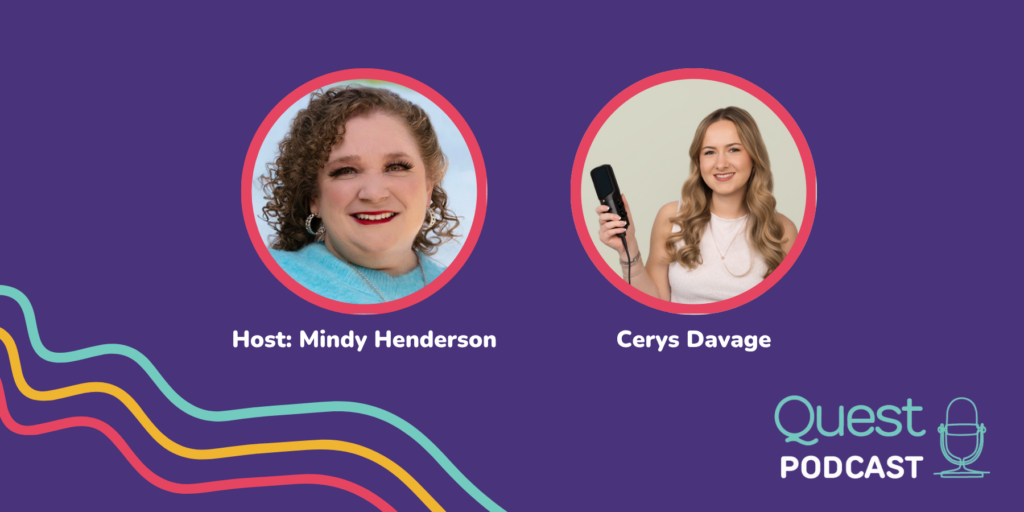
In this episode of the Quest Podcast, we chat with Cerys Davage, a Welsh podcaster and content creator living with limb-girdle muscular dystrophy (LGMD), who has turned her diagnosis into a platform for connection and representation. Cerys opens up about growing up in a family that chose openness over silence, the moment in university when she stopped hiding her disability, and how that shift led her to launch her podcast, Unbalanced with Cerys Davage. She speaks candidly about the ongoing need for greater disability representation, the promising research on the horizon for her specific condition, LGMD2i/R9, and what it has taken to build an independent life — from adaptive driving to the everyday problem-solving that rarely gets seen behind the scenes. Cerys shares her experiences, expertise, and heartfelt perspective on identity, independence, and why she believes your differences are your superpower.
Read the interview below or check out the podcast here.
Mindy Henderson: Welcome to The Quest Podcast, proudly presented by the Muscular Dystrophy Association as part of the Quest family of content. I’m your host, Mindy Henderson. Together, we are here to bring thoughtful conversation to the neuromuscular disease community and beyond about issues affecting those with neuromuscular disease and other disabilities and those who love them.
We are here for you to educate and inform, to demystify, to inspire and to entertain. We are here shining a light on all that makes you, you. Whether you are one of us, love someone who is, or are on another journey altogether, thanks for joining. Now let’s get started.
Today, I’m excited to welcome Cerys Davage, a Welsh podcaster and content creator who is passionate about showing what life is really like as a young person with a disability, specifically limb-girdle muscular dystrophy 2I/R9. Through her podcast, Unbalanced with Cerys Davage and her work on social media, she explores the experiences and challenges young adults face while sharing perspectives from people living with all kinds of life barriers. At the heart of her work is a powerful message, disability is part of your story, but it doesn’t define who you are or what’s possible for your life. Cerys, thank you so much for being here.
Cerys Davage: Thank you so much, and thank you for that lovely introduction.
Mindy Henderson: Absolutely. Let’s just start at the beginning if that’s okay. For listeners who have been living under a rock and haven’t met you yet, what is your story? If someone had to understand who you are, of course beyond your diagnosis, which could probably be a whole episode in and of itself, there’s a lot to you, what would you want them to know first?
Cerys Davage: Wow. Okay. So hello, I’m Cerys and I’m 24, almost 25. It depends when this episode comes out. I may be 25 by then. And like I said, I’m Welsh, which is a big part of my identity. So born and bred in Cardiff, the capital city of Wales. And if you don’t know where Wales is, it’s right next to England as a part of the UK. So I am the oldest of three sisters who we all have limb-girdle muscular dystrophy type 2I, otherwise recently known as R9. And I also have celiac disease, and that’s another random thing, and it’s kind of a part of my diagnosis story.
So I was diagnosed with celiac disease when I was seven years old and it was a condition I was born with, but didn’t get diagnosed till I was seven. And then they also, whilst they were doing the test for that and looking at my bloods, they noticed high CK levels, which is related to the muscle enzymes. And that kind of led them down the route of diagnosing my LGMD through a genetic test. And they’re not linked at all, they’re not related in any way. It was just kind of by chance. And I wasn’t showing any symptoms back then.
So I was eight when I was diagnosed with LGMD, but I have a homozygous version of LGMD, which is basically the later onset. You can have a heterozygous version, which is an early onset, but the later onset is the one that I and my sisters have. And I started my symptoms around 12 years old in my teen years when I noticed that I was always getting a bit slow in school and I was the last one to finish the race on sports days and my symptoms kind of progressed from there.
And I guess even though it doesn’t define me, it’s definitely changed the trajectory of my life in a lot of ways. I went to study theater in university after school, so I wanted to be an actress. I wanted to do some kind of presenting in some way, but COVID hit when I was in university. So I ended up going from doing live performances to online kind of short films. And I fell in love with editing and I always knew I had a passion for interviewing other people. I did a lot of radio things in school. So I looked at my degree and I looked at my life with LGMD and I though, well, if I’m not going to be going into acting, I can certainly use my voice. My body might change, but my voice is going to stay the same. So that’s kind of me in a nutshell.
Mindy Henderson: Yeah, I love it. That’s really interesting. And you and I were chatting before we got started here today, and you told me a little bit more about the nomenclature of the condition that you live in. Would you mind describing that? I know there are a number of, you already mentioned this, but there are a number of different kinds of LGMD. Would you talk about the numbers and the letters that make up yours?
Cerys Davage: Of course. So there are over 30 subtypes of limb-girdle muscular dystrophy. You have the recessive limb-girdle muscular dystrophy and dominant. So in the old style and the [inaudible 00:05:40] that was there when I was diagnosed years ago now, dominant types were type one and recessive types were type two. And my genetic subtype was 2I, so the latter I. But recently they realized in the past few years that they were running out of letters, so they had to change the letters into numbers because of course there’s an infinite amount of numbers, so they had to change the one and two to D for dominant and R for recessive, which makes sense. So I is the ninth letter of the alphabet, so I am from 2I to R9, R being recessive and nine being the ninth kind of subtype that they found. But within 2I/R9, you also have, like I said, heterozygous and homozygous, heterozygous being the early onset, so symptoms would start from very early childhood, maybe even one or two years old. And then homozygous version would be a little bit later in life, so maybe teens or early 20s.
Mindy Henderson: That’s so interesting. And I’ve learned a lot about genetics over the last few years working for MDA. And it’s fascinating to me how they keep discovering new versions and subtypes of lots of different neuromuscular conditions as genetic testing gets more and more sophisticated and advanced. So thank you for that explanation. So growing up, I know you have two sisters also with LGMD.
Cerys Davage: Yes, that’s right.
Mindy Henderson: So growing up then, what sort of conversations did your family have about disability? I know me, I live with spinal muscular atrophy and it wasn’t something that we talked about every day, but I’m curious, looking back, are there conversations that you had that were helpful or that you didn’t have that you wish maybe that you had had or things that you wish people had understood earlier?
Cerys Davage: It’s a really interesting question actually, because when I was diagnosed, I wasn’t showing any symptoms. So my parents had the impact of the diagnosis, but they also had the dilemma of whether or not to tell me or when to tell me because they didn’t want me to worry about it before I’d even started showing symptoms. I had a relatively normal childhood apart from being a bit slow. So they were kind of battling this, “How much do we… Do we just kind of introduce it to her as she gets a bit older and starts to get symptoms?” And my sisters were diagnosed because I was diagnosed. The doctors recommended getting them tested as well. And they’re both younger than me, so they weren’t showing symptoms either. They also had the dilemma of whether or not to test my sisters because they weren’t showing symptoms, but they thought, “Well, if Cerys is getting all this care and she’s going to be checked annually, we want her sisters to have the same care if they do have it.” And it turned out that the three of us did have it.
So I knew that there was something going on with my muscles because I would go to London, to Great Ormond Street Hospital annually to have my checkups. And my parents were very good at answering any questions that I had, but because I would pass all the tests with flying colors, I never really had any questions because it was just something that I never really thought of. It wasn’t affecting me and I didn’t really understand the impact of what my future would look like, whereas my parents did. And I guess maybe a few generations ago, families wouldn’t be very open to talk about niche or taboo topics, topics that maybe they’re not quite sure how to engage with. So my parents wanted to make sure that we weren’t one of those families that everything was out in the open and we could discuss uncomfortable things and work through them together.
And as we got older and as my symptoms started to progress, they were very open with the name of the condition, which they didn’t share with me at the beginning because I was a bit of a hypochondriac. So if I’d Googled it, I would’ve looked out for the symptoms and I was a bit of drama queen, still am probably. So I think they were very hands-on with this topic and just wanting us to get all the experiences that we may not be able to in the future. So we went skiing one holiday a good few years ago now but I definitely wouldn’t be able to ski now, unless it was sitting skiing, which I have yet to try. And we’ve climbed up mountains, we climbed the tallest mountain in Wales together as a family, and they were really good at trying to create memories for us to cherish before it was too late, I guess.
But they’ve always been such a good sounding board. And even though they don’t have the condition and they sometimes feel guilty for that, my mom always says, “I would take your condition if that meant that you didn’t have it,” which is just bless her. We’re all very open about it. So I think they kind of opening up that space and my parents inviting us to talk about it openly made it more of a comfortable situation and we didn’t shy away from complaining when it got hard or things like that. Yeah.
Mindy Henderson: Oh, it sounds like you have a lovely family. I’m curious, was this the first incidence of this in your family or have you traced it back to anyone else?
Cerys Davage: Good question. So my parents are both carriers of the gene. So unlike a dominant condition where a carrier would be affected because it’s a recessive condition, both carriers, so my parents aren’t affected. So they didn’t actually know that they carried those genes until I was diagnosed. So I just happened to get the bad gene from both of them. Bad gene, I call it that, the LGMD gene, and so did my sisters. It was quite a rare chance for all three of us to get it, but we did.
Mindy Henderson: Okay. Well, you share your life so openly online, which is such a gift to the world. Was there a moment where you decided, I know that you said that you always wanted to do something related to the work that you do now, but was there a moment when you decided, “I’m going to stop filtering and just let people see what life is really like?”
Cerys Davage: There was actually, and that’s where the podcast comes in. So when I was in school, I didn’t really tell people about my condition. I was getting symptoms, but it wasn’t to the point where it was really obvious immediately. So only my close friends knew about it. They would be the ones to help me up the stairs when it got tough or to walk with me to the elevator that no one else was allowed to use in school. And maybe people had questions or were whispering unbeknownst to me, but I didn’t talk about it. I never really talked openly about having a disability because I didn’t really feel fully disabled in school.
And then when I went to university and met a lot of new people, I realized that these people actually might need to help me. If we go on a night out, they might need to help me walk up the stairs or maybe just look out for me if I fall or whatever. So I tried to be a little bit more open then. And I was really nervous about that because I didn’t want to be defined by that. But the love I received back from my flat mates, and actually one of my flat mates felt comfortable enough to share that she had endometriosis and she was really struggling with that. So it was really nice to be able to have that connection straight away. And I realized actually, I feel like people won’t know that I’m disabled if they just look at me. And that’s something that people need to be aware of and there should be more awareness around it.
And over COVID, I was back at home and I was really getting into podcasts and podcasts were becoming a huge thing. And there were a lot that I was listening to that I could relate to, but not on that level of having a disability as well. So after a lot of thinking and just putting it off, talking about, “Oh yeah, I want to start a podcast,” and then not actually doing it. I decided in 2023 to set it as a new year’s resolution to start a podcast. And I didn’t really have a topic, but this just really stood out to me even though I didn’t want to be defined by having a disability. It was just something I was really passionate about. And that was kind of my coming out to a lot of people in my life who didn’t know previously that I had a disability.
And I thought, “You know what? What better way than to just lay it all out there? If people want to know more about it, they know where they can find the information.” And its kind of just snowballed from there really. So now everyone knows I’ve got a disability, there’s no hiding now.
Mindy Henderson: Yeah. Well, and it’s a really generous thing to do, I think, to share your story in that way and let people know you and see parts of you that people I think generally can be sort of inclined to try to hide because it’s not easy to share those more difficult parts of your life and yourself. I’m curious, in listening to your talk, I’m just thinking, and I grew up with a disability as a wheelchair user, and so I knew firsthand how hard it was to be different. And I’m wondering what your thoughts are for anyone that might be listening about how to maybe encourage their kids to embrace what it is that makes them unique and not feel the… I mean, you can’t not feel the stigmas and things that still exist in the world, but how to maybe be more okay with the harder, more different parts of themselves when all you want to do is be like everybody else growing up.
Cerys Davage: This is something I struggled with in school. I just wanted to be like everyone else. I’m such a people pleaser. I wanted to be liked, and it was a huge thing in school and I never would’ve talked about it to people because I didn’t want to be different. But also I didn’t have that representation. I didn’t see anyone else like me. I always connected using wheelchairs to, if you’ve broken your leg or older people that were maybe reaching the later stages of their life. And if someone had broken their leg in school and they would be on crutches or in a wheelchair, they’d get so much attention. And I was like, “I don’t want that. I’m not getting that kind of attention,” because it’s not a get well soon sort of situation. It’s not a temporary thing.
But for me, it really was the lack of representation. I think if I’d seen someone else like me, I would’ve felt a little bit less alone and I maybe would’ve come out of my shell a little bit more and felt more comfortable with that. But because I wasn’t aware of the younger disabled community back then, I was just so ashamed of it.
So I would say to anyone now who’s maybe struggling that there is a community out there. There are people that’s going through the same things as you that are just embracing life despite what life throws at them. And if I’d known that maybe, and if I’d seen that representation and seen that mobility aids can look cool and you can still live your best life with a disability, I wouldn’t have minded talking about it or showing that side of me a bit more. And maybe not resented mobility aids so much back then. I didn’t want to know about it.
Mindy Henderson: Yeah, I love that answer. I think that you nailed it. And disability representation is such a big thing. I think that you’re absolutely right. It would make it so much easier. I suspect probably I’m a bit older than you and I certainly didn’t grow up in a time when disability was embraced or accepted. And I certainly didn’t see people in wheelchairs on movie screens, on television, and magazines, things like that. And you’re right, I think that when you don’t see someone who looks like you ever in those types of situations, you almost start to feel like that part of you must be wrong for it not to be portrayed anywhere in media or entertainment. And I love that we’re talking about this during Disability Pride Month, which we’re recording this interview during. Tell me about Disability Pride Month and what it means to you.
Cerys Davage: I think Disability Pride Month is such an important month. And maybe it’s because it’s still relatively new, I don’t know, but I’m just not seeing anything about it only within the disability community. I didn’t know about Disability Pride Month until a couple of years ago.
So to me, it’s important because we need more representation. We need to just be heard by society. We need accessibility barriers removed. We need other people to show that they care and want to prioritize accessibility. Accessibility benefits everyone, not just the disabled community. And I think there’s still such a long way to go to break down these barriers and also just attitude barriers as well. I’m still getting so much judgment for using a handicap spot or using the accessible bathroom when I do actually have the right and I have the needs for it. There’s just not enough representation. I don’t know what more we can do. I feel like we as the community are shouting about it, but the rest of the world needs to as well, not just us.
Mindy Henderson: Yeah. And I think that that’s yet another really good point because there are so many people, one in four people living in the United States anyway, lives with a disability and so many are non-apparent disabilities. I’m glad that you brought that point up and that piece of your life, not because I love that you get the judgment, but I think people really need to hear that because you just don’t know what somebody under the hood is dealing with in their life and what their real situation might be. And so I think that we could all reserve a lot of judgment that we tend to inflict on each other.
Cerys Davage: Definitely.
Mindy Henderson: So I’m going to pivot back and talk a little bit more again about LGMD2I/R9. Primarily, if I’m not mistaken, I think that it’s sort of focused on managing symptoms right now, but there are promising new therapies and clinical research on the horizon. What gives you the most hope and what do you hope that researchers and clinicians continue to prioritize for people living with your condition?
Cerys Davage: Yeah, so there’s a lot of really exciting treatment happening for LGMD2I/R9 at the moment. This dates back a few years ago and I’m very fortunate to have the LGMD subtype that has a lot of research behind it at the moment. There’s a treatment that’s about to be approved on the FDA this autumn, or you guys say fall this year, which is really exciting and it’s just kind of waiting for that to translate to the rest of the world now. So I want clinicians and researchers to know that it is a global condition and that there are a lot of countries. I’ve been to conferences recently where I’ve met people from countries all over Europe and it’s so varied, the care that exists within each country. Some countries are really on the ball with muscular dystrophies and LGMDs. They have the charities, they’ve got all these specialist centers, and there are some countries who have nothing at all and don’t even know anyone else with that condition. And it’s such a lonely road.
And I want the clinicians and the researchers to know that this is a global need, this treatment or just care for people living with LGMD. It’s needed in some countries where you don’t hear much from them because they don’t have any resources. So that’s one thing, but also translating to other LGMDs, hopefully that we can keep this momentum going and we can find treatments for all the subtypes of LGMD eventually. But I guess it’s difficult because the subtypes are different, it’s because of the different genetics in different places. So one treatment for 2I/R9 is not going to treat someone with 1A, for example, or I guess the new one would be D1. I just hope that this kind of momentum continues and it just brings so much hope to the patient community.
Mindy Henderson: That’s so well said. And I think that the momentum actually happening right now in the neuromuscular community with respect to research and the science, it really is… You’re starting to see, I think, how a treatment for one condition can actually benefit people with other conditions in different ways, or you can utilize a technology that’s created for one condition for another. So very well said, and I love how you just put that.
Let’s talk about independence and living independently. For anyone, it’s a huge milestone, but it looks different for everyone living with a neuromuscular disease. What were some of the biggest surprises for you, both the challenges and the victories after you moved into your own place?
Cerys Davage: Yeah, so I lived with my family, with my parents up until three years ago, I want to say. Yeah, three years ago. And I live in my own place now, my own ground floor apartment with my fiancé, not too far from my parents. So like a 10, 15-minute drive, which is great. And it was a challenge to find an accessible place, which it is for anyone. So we were very fortunate when this came on the market. Ground floor apartment, completely step-free. That was really exciting being able to be independent. But sometimes it is scary to be independent as someone with a progressive disease.
And my parents, I think, struggled as well when I moved out because usually the trajectory of your life is the younger you are, the more dependent you are on your parents. And then the older you get, the more you detach from them and you become more independent. But for someone with a progressive disability, you become slightly more dependent as time goes on, on other people, including your parents who know you the best. So I’m really fortunate that I’m living with obviously a partner who knows me better than I do and knows how to ground me if I’m pushing myself too far or to reign me in and help me if I’m just really tired. So it’s great to share household responsibilities in that way. So I’m not living completely alone, which I imagine is a lot more difficult.
But sometimes I am alone in the house and if I have a fall, then I can’t get back up and I really struggle with that. And I don’t want to have to depend on my parents or my partner to have to come to my rescue all the time. But that is just the harsh reality sometimes. If I struggle with something, if I’m cooking a meal for when my partner comes back home and I struggle to open a jar, I have to wait for him to come back, which will stall dinner. And it’s just those little things. It’s not a massive thing. I’m really, really lucky to be living with my partner and to be able to fund that kind of life. But it’s just those little things that I’ve had to get used to as I’m living independently and just accept that some things are beyond my control. If I fall in the shower, I fall in the shower, I just have to get some help. That’s okay.
Mindy Henderson: Yeah. And I have so many thoughts about what you just said. You also shared with me, because I think people oftentimes see the finished product, whether it’s driving, which we’ll talk about in a second, or living independently on your own, but they don’t see all of the problem solving that goes on behind the scenes. And to your point, I’ve experienced it too, where you’re just kind of problem-solving as you go and figuring it out. And even 20, 30 years later after you move out of your parents’ house, these things still come up that you have to figure out. I know that you said that you worked with an occupational therapist when you moved into an apartment. Can you talk about what that was like?
Cerys Davage: Yeah. So here in the UK, we have the National Health Service, which has just saved my life over and over again. So in that kind of care package you get from the NHS, you get occupational therapists come to your home and assess your home and how you live within that space and help you get the right support to adjust things within your home.
So my flat apartment was accessible, it was set free, but it didn’t have the tools I needed within the home. So since I’ve moved in, I’ve been able to get some grab rails for the bathroom because my shower is in the bath, so I need to climb in and out of the bath. And so those grab rails are great. They’re great for the bath anyway. They helped me get a seat for the shower so that I don’t have to be on my feet all the time. They help me cover any trip hazards within the home, in between rooms, just any little thing.
And because my disease is progressive, it’s something I’m going to have to keep revisiting. “Okay, are there some things I’m finding difficult in the home that I need extra support with?” They can come again and help provide that support. So those are the adaptations I got when I first moved in, but there are a lot of things I do and have figured out myself. We’ve got our own sofa, or as you guys would call it, couch, but I struggle to get up from it, but I find my own ways rather than just getting up from the front, I turn around and I push from the back, which maybe a lot of people listening will be able to relate, or my partner would lift me from the sofa. So there’s just a lot living with LGMD or any kind of neuromuscular disease, you just learn to adapt as you go on.
Mindy Henderson: Definitely. And I thought that was a really smart idea that I hope will be helpful to some other people listening just to incorporate specialists and people like occupational therapists who I will say I think are geniuses. I’ve worked with a few occupational therapists and their capacity to solve problems and think outside the box is amazing.
Cerys Davage: It’s crazy. They’re so talented.
Mindy Henderson: Yes. Yeah. So let’s talk about driving. You’ve got an adapted car. For someone who, again, might be listening and dreams of driving, but isn’t sure it’s possible, what would you want them to know? And what has having that kind of independence meant for your life?
Cerys Davage: I passed my test on a normal manual car in 2019. So I was 17 years old and I drove that car for about a year and a half, and then I went to university where I didn’t need a car. And in that time I progressed quite a lot. And then I tried to drive a manual car again, and my legs were so weak that I was picking my legs up with my hands to put on the pedals, which is obviously not safe, especially in an emergency. So the doctors told me that I had to stop driving. So I didn’t drive for a year and a half, and that was the longest year and a half of my life because I had to depend on other people, which I hate. I love my independence.
But then I came across the Motability Scheme. Again, a scheme here in the UK that helps disabled people find cars that are adapted to their needs. So I tried out lots of different hand controls and eventually took some lessons and passed a test using hand controls, which took some time to get used to, but now it’s second nature. And then I was able to get an automatic car through the Motability Scheme that I lease every three years and pay for the adaptations. So my left hand is on a ball on the wheel where I can do a full 360 turn. And then my right hand, I guess I’m on the other side of the car as you guys would be.
Mindy Henderson: Oh, right, right.
Cerys Davage: This would be the other way around for you. And then my right hand is on the accelerator and brake and lever. So it’s really cool how it works and I’m so impressed by it, but it really has saved my life. It’s allowed me to continue working because I need to drive to get to work. It’s allowed me to have a social life. I couldn’t see my family if it wasn’t for my car. It’s allowed me to just have my independence and not have to rely on other people to get my groceries or run some errands for me. I can just do anything I want. I can keep fit by going to the gym or going swimming, which I really value as a disabled person to keep my muscles going as much as I can. And again, I couldn’t do that without my car, so I couldn’t rave more about the Motability Scheme if I tried. They really have saved my life.
Mindy Henderson: That’s incredible. And again, we talked about science, but technology is another area where what they can put into a car these days, I have a car that looks like a cockpit of an airplane with touchscreens and hand controls and things. It’s really cool. I love that you have that as a tool in your life. And I would just encourage anyone who’s listening, don’t take it for granted that it’s not something you’re going to be able to do. There are a lot of things that can be done and a lot of creative ways to set up a car. So I’m excited that you’ve got that.
Now your podcast, Unbalanced, is celebrating its third anniversary, and congratulations, and entering a new chapter with a rebrand. Can you talk a little bit about where Unbalanced is going and how it’s evolving or has evolved over the years?
Cerys Davage: I guess, well, I started Unbalanced because, like I said, I wanted to be the voice that I wish I had growing up. That’s the whole point of the podcast, but also to help people feel less alone. And I started it as a sort of hobby. I didn’t think much of it. I think when I started the logo, I was just sat with my youngest sister at the dining table and created a quick logo. Didn’t even save the project file, which if you are in that world, you know that is just a nightmare. But I didn’t think anything of it. I just started posting things and it gained a lot of traction. And over the years, over the past three years, I’ve met some incredible people who have shared their stories, and some well-known people, some people who may not usually have the opportunity to have a microphone and it’s just been so interesting and educating for me as well to learn of all these different stories.
And I’m really passionate about that. I’m passionate about raising awareness and just learning more as we go along. And I believe that my podcast has something for everyone. It will either educate you if you don’t know much about these topics, but it’ll also make you feel less alone, hopefully, if you can relate to any of it. And what is the most rewarding thing is when people send me messages saying that listening to me feels like listening to themselves and that they’ve never come across anyone else with LGMD or that’s saying things that they can relate to. And I’m so passionate about this community, not just the LGMD community, but the wider muscular dystrophy community and the disabled community.
I’m sharing my own experiences, but it’s so much bigger than that. We’re talking about a lot of topics that young people go through, but with additional life barriers. So I guess for the future and with this rebranding, I’m able to travel a lot more and to meet people in person to hear their stories. Obviously continue doing interviews online from all over the world, but hopefully just reach more people. And it’s already reached over 60 countries, and I’m so grateful for that. And I’m honestly mind blown, I never thought that this would be more than just a hobby, but now it’s a passion project that I’m putting all my extra hours into outside of my normal job, and I’m working on making it a full-time job eventually.
Mindy Henderson: Amazing. Well, and you’re clearly very talented, so I don’t think it’s by accident that it’s become such a success. I am passionate about storytelling. I’ve really, I think in the work that I have the good fortune to do now, I get to hear people’s stories all the time. And I think sharing our stories is one of the most powerful things that we can do. In your work, what have you learned about what people with disabilities most need to hear from one another?
Cerys Davage: Ooh, I think that they’re not alone. And I say this so much and take a shot every time I say that, but it is so important. And I think in sharing my stories and in helping people share their stories on my podcast, and it helps so many people, in return, that helps me as well. So I want people to know that if my podcast helps them, it helps me feel less alone. I’m not just talking into a mic and thinking, “Ooh, is anyone going to be able to relate to this?” But also I want people to know that there are resources available. There are some amazing organizations like the MDA who have so many resources, so many connections with people who may be able to help or just relate to. I think that’s just so important. So yeah, there are lots of things available now. We’re very fortunate to have that kind of support system available in person and online.
Mindy Henderson: I love that. What I’ll add to that is I think people living with disabilities are some of the most gifted life hackers in the world. And so I think that our ability to share and show up for each other and help them problem solve. We said earlier that things come up every day that we have to problem solve through. And I have heard some of the most genius life hacks from people that I’ve gotten to speak to in this community. So I love how the neuromuscular community shows up for each other.
Now, imagine that someone listening today was maybe just diagnosed, or maybe they’re a parent whose child has been recently diagnosed. What would you want them to know during those first overwhelming days?
Cerys Davage: I guess something similar to what I’ve said, but that there are resources and people out there. That’s something my parents wish that they had known when I was first diagnosed. And there are a lot of patients who grew up, I guess we’re not allowed to say patients anymore, individuals living with our conditions who grew up alone and not knowing anyone else or not having any resources to help them. So I wish that that connection is made more often now. And I hope that that is the case. I hope that’s continuing to be the case.
But I just want people to know that, especially parents of children who are getting diagnosed, to know that the child won’t have a bad life. They’ll still live a good life despite what life throws at them. If anything, it’ll make them more resilient. And like you said, we problem solve and that translates into life. I say this in job interviews or anything… If I have a problem that’s coming up that other people may not be able to solve, I think I’m pretty good at that because I’m used to having changes thrown at me and having to redirect where I’m going in life. And what I’m doing that day, I think all these skills will come in so valuable in life in general, but support is always out there.
Mindy Henderson: Absolutely. Absolutely. So looking ahead then, we’re almost out of time. I wish I could talk to you for two more hours. We talked about the rebrand of Unbalanced. You’ve clearly got a lot to be excited about right now. What are you most excited about, whether it’s the rebrand, a personal goal, or whatever might be next for you.
Cerys Davage: So the rebrand, for anyone who doesn’t know, it’s just a little tidy up of my logo. It just looks a bit more pristine and it has my face on it now, which most podcast logos do, I guess, if it’s a solo host and just better graphics and things like that. Nothing crazy. The content is still going to be pretty similar, but I’m just excited to be able to just professionalize it a little bit more because it’s not a hobby anymore, it’s something that I’m really passionate and want to work hard towards. And I’m so serious about this podcast, but also my own content creation.
So in the past few months, I’ve shared a lot more of my own life outside of the podcast on my social media. My work is in social media. I work as a social media strategist, analyst, marketing. Literally, I wear many hats in that kind of world. That’s kind of my day-to-day job. So I had the tools to be able to do this myself. So I thought I’m just going to go all in and share my life on social media.
Again, the response has been mind-blowingly amazing, and I am starting to be able to work with companies and charities that I’m really passionate about. And my only goal in life is to hopefully help the community, whether that’s bring resources to them that they may not know about or help amplify their voices. I just want to continue doing that. I’ve been fortunate to go to a lot of different conferences recently, and being able to meet people in person and hear their stories is just so powerful. And it drives my needs and wants to do this full-time.
So I’m hoping one day to be able to do this content creation, this podcast, this advocating full-time. There’s also a very exciting announcement that I have launched a charity, an organization, which is an extension of the charity CureLGMD2i Foundation-
Mindy Henderson: Oh, wow.
Cerys Davage: … started by Kelly Brazzo in America. She was such a great resource to my parents when I was first diagnosed when they had no one else. And CureLGMD2i has expanded into Canada and now they’re expanding to the UK. So me and my mom are starting the UK version of that charity. We’re still waiting for the approval right now, but that’s something that, again, is going to be something I’m really passionate about, something I really want to grow. And so I have high hopes for that organization as well.
Mindy Henderson: Wow. Oh, that gave me goosebumps. I love that. Wonderful. Well, I’m going to finish with just a couple of quick hit questions for you. So first, what’s one accessibility product that you cannot live without?
Cerys Davage: My wheelchair. I know it’s a really obvious one, but I’ve been able to do and take so many trips because of it. So yeah, I’m grateful for that.
Mindy Henderson: Fantastic. What’s one thing that people are surprised to learn about you?
Cerys Davage: So I am a musician. I come from a very musical family. I played the piano and the harp, which is a very popular instrument here in Wales.
Mindy Henderson: Wow. Okay. And we talked about life hacks. What is one accessibility life hack that you figured out for yourself that everyone should know?
Cerys Davage: I can’t say I figured this out, I have definitely found a way to do it myself, but I did see it on TikTok first. Heatless curls, and this is what I’ve got right now. I know a lot of people use leggings or those heatless curl tools. I just use the belt of my dressing gown, my dressing robe, and I just curl my hair around it and it saves time curling my hair. I just take it out in the morning and I’m good to go. And it’s transformed my morning and evening routines.
Mindy Henderson: Oh my gosh. Well, your hair is adorable, so everyone needs to look that up. That’s genius. And then last, if the listeners could remember just one thing after today’s conversation, what would you hope it would be?
Cerys Davage: I hope that you take away that firstly, you’re never alone. And secondly, that your differences is actually a superpower. It makes you who you are, and you should use that to your advantage because that comes with talent, it comes with skill, and I guess everything happens for a reason, so don’t be afraid to embrace it.
Mindy Henderson: I love that. Cerys, thank you so much for being with me today. I know that this will not be the last time that we get to talk. I hope that you’ll come back. And everyone, if they haven’t already, they need to check out your podcast, and we’ll put all of that information as well as your social media information in the show notes so that people can find you.
Cerys Davage: Thank you so much, Mindy. You are honestly such a bright light to this community, and I really, really appreciated this talk.
Mindy Henderson: Oh, I can say the same for you. Thank you for sharing your time.
Thank you for listening. For more information about the guests you heard from today, go check them out at mda.org/podcast. And to learn more about the Muscular Dystrophy Association, the services we provide, how you can get involved, and to subscribe to Quest Magazine or to Quest newsletter, please go to mda.org/quest. If you enjoyed this episode, we’d be grateful if you’d leave a review. Go ahead and hit that subscribe button so we can keep bringing you great content and maybe share it with a friend or two. Thanks everyone. Until next time, go be the light we all need in this world.


Disclaimer: No content on this site should ever be used as a substitute for direct medical advice from your doctor or other qualified clinician.