Making the Impossible Possible: One Man’s Journey on the Camino de Santiago de Compostela
By Rebecca Hume | Tuesday, January 27, 2026
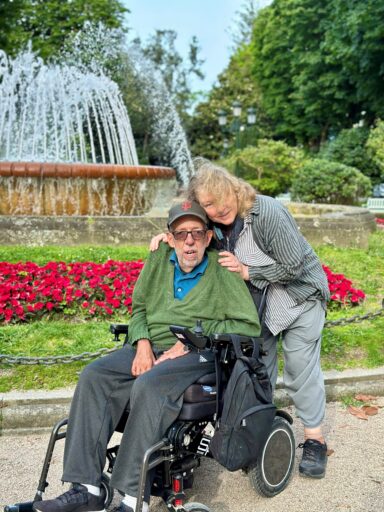
Kurt Aguilar and his wife, Cathryn Domrose, in Vigo, Spain, before starting on the Camino de Santiago de Compostela. (Photo by Rebecca Taggart)
Every year, hundreds of thousands of people embark on a challenging journey to traverse the Camino de Santiago de Compostela, traveling days and weeks on foot to arrive in Santiago, Spain. The pilgrimage, which consists of multiple trails leading to the burial site of Jesus Christ’s disciple James, serves as a spiritual journey for many. The trek provides the opportunity to challenge oneself while immersed in the beauty of the Spanish countryside and the tranquility of nature. With journeys ranging all the way up to 600 miles long, a variety of routes lead travelers through Spain’s beautiful towns and villages with many rural miles between.
While some portions of the trail include paved roads, large sections of the journey consist of narrow footpaths and uneven terrain. The nature of the journey creates accessibility barriers for people with physical disabilities. As a full-time power wheelchair user, Kurt Aguilar hadn’t considered that completing the Camino was even a possibility for him – until a friend made him realize that it was possible and he learned of a non-profit helping people living with disabilities to do just that.
Making dreams a reality
Kurt, a 72-year-old retired journalist who lives with congenital myopathy, splits most of his time living between San Francisco, California, and Valencia, Spain. When a close friend in Spain, whom he affectionately refers to as a “Camino-nut”, heard about wheelchair users completing the Camino on one of her own treks, she learned that there are organizations helping wheelchair users make the incredible journey.
Kurt did some research and found DisCamino, a non-profit based in Vigo, a port town in western Spain, that is dedicated to assisting travelers with disabilities to travel the Camino. The agency helps to plan the route, coordinate hotel rooms and stopping points in towns along the path, and provides volunteers to travel side-by-side with adventurers with disabilities on the journey, offering hands-on assistance as needed.
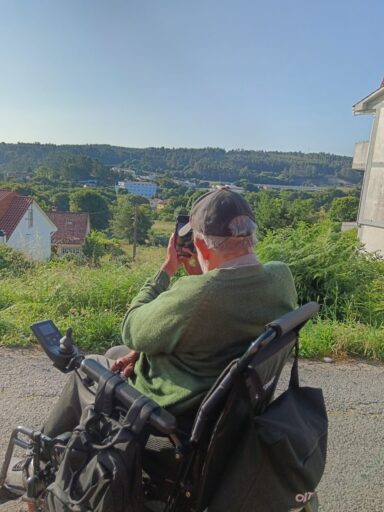
Kurt taking photos of the scenery on his journey.
“They have volunteers who will go along with you every step of the way on the Camino” Kurt says. “They’ll transport you, they’ll take your luggage, they’ll do it on your time. And they do all of that and won’t take any money for their services. They are just amazing.”
The organization, founded by a man named Javier Pitillas, started eighteen years ago when Javier met a man who was deaf and blind and wanted to complete a pilgrimage on the Camino. Javier learned to communicate with him through touch and accompanied him on the journey in order to help the man realize his Camino dreams. By the end of the trip, Javier was inspired to make it his mission to help other people living with disabilities to access the beautiful adventure.
“Since then, DisCamino has taken more than 600 people on over 150 different trips,” Kurt shares. “They’ve assisted people using wheelchairs or adapted tricycles on trips to the top of the two highest peaks in Spain. They did a trek from Rome to Santiago with disabled people and another one that circumnavigated Spain – from Vigo all the way down to the south and then around the country. They do more than just the Camino, they will do whatever someone dreams up.”
An incredible journey
For Kurt, that dream became completing a 12-day, 60-mile trek on the Camino with stops to explore small towns along the way. He and his wife partnered with DisCamino to plan their route and in June of 2025, they embarked on the journey of a lifetime.
“Normally the stages for this Camino are 15 miles each, but most electric wheelchairs can only go about 9 miles on a charge. They had a van that took us to the starting point of the Camino and then the van would pick us up after the 9 miles and take us back to the previous accessible hotel. The next morning, they would drive us to where we stopped off and we would continue that way,” Kurt says. “Every day they had two to three volunteers going along with us. They also gave me lists of hotels to contact because there are not a lot of accessible hotels out there, so they helped us to find towns with accessible hotels and book rooms there.”
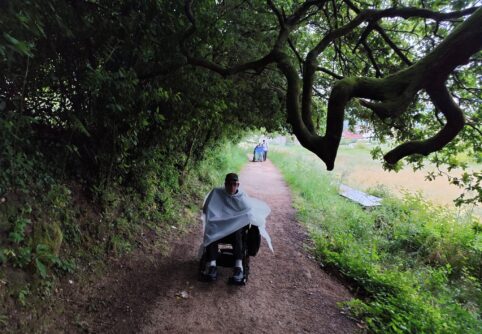
Kurt traveling through the rain on the Camino. (Photo by Javier Pitillas)
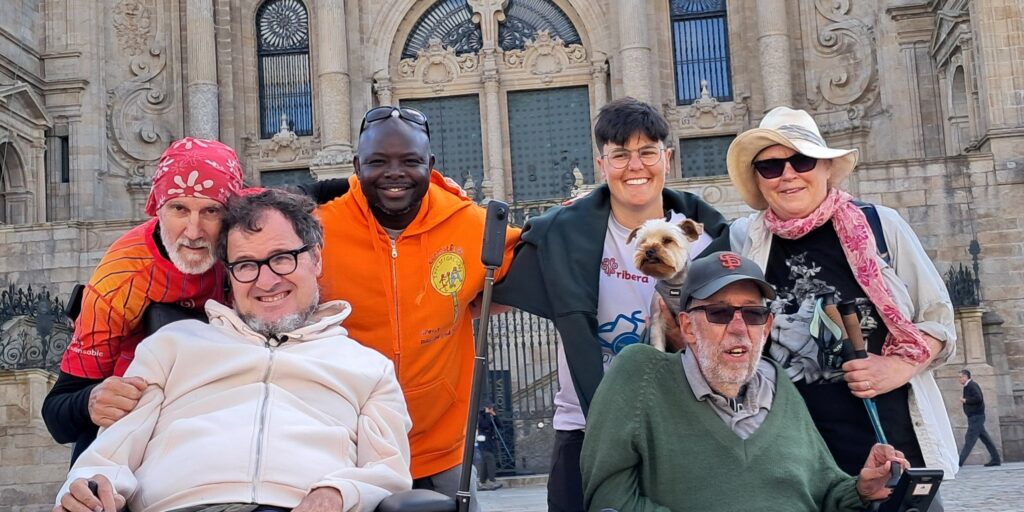
In addition to his wife and the DisCamino volunteers, another traveler with a disability named Dabiz joined the group on their pilgrimage. Dabiz, a former research scientist living with amyotrophic lateral sclerosis (ALS), is also a disability rights activist. The two men bonded on their journey, overcoming obstacles and barriers, celebrating victories, and soaking in the beauty of the incredible landscape.
The volunteers provided both men with assistance on the trail, walking alongside them and advising of upcoming muddy areas or uneven ground. Dabiz’s full-time assistant walked with him as well. As the two men navigated miles of changing terrain, the volunteers kept a hand on each of their power wheelchairs to help prevent spin-out and positioned themselves on every turn so that they could physically redirect the chairs if needed. When approaching rain culverts, the volunteers determined if the chairs could go over the waterway or not, lifting the front wheels or manually pushing the chairs when needed.
“The most amazing instance of their assistance was when they carried me across a little river,” Kurt shares. “There was a stream that was a couple yards wide, maybe 8-10 feet wide and a foot deep. It didn’t look that terrible, but a power wheelchair can’t get wet so Javier and Dabiz’s assistant did this maneuver that they call the “royal chair”. They put their arms under my thighs and their hands on my back, and I put my arms around their necks and they carried me across the water. There was this little makeshift bridge where my wife and the other volunteers carried my wheelchair across to the other side and the guys redeposited me in the wheelchair. There were hundreds of other things that they did on the journey – watching out for roots in the road, stopping and keeping chair from going too fast down slippery slopes, and stuff like that – every step of the way.”
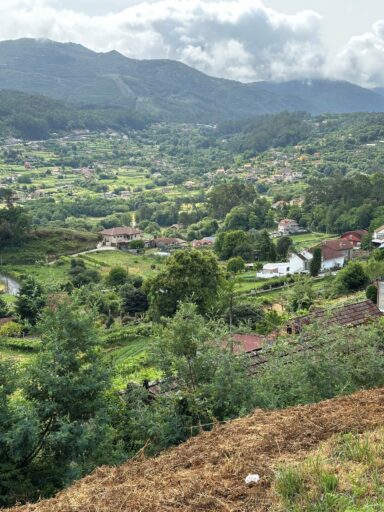
A scenic view from the Camino.
The group endured rainy days, navigated cobblestone and dirt paths, covering degraded pavement and gravel along portions of the journey – and appreciating sections of paved country road when they encountered it. All along the way, the beauty of Spain captivated the group. In addition to the lasting friendship that Kurt and Dabiz developed over the course of their adventure, the beauty of the landscape was Kurt’s favorite aspect of the incredible trip. From the beautiful gardens accompanying the picturesque homes that they passed on the trail to the tiny wildflowers blanketing rolling fields in a dazzling array of color, immersing himself in the stunning beauty of nature was an experience that Kurt will treasure forever.
“Where we spend most of our time in Spain it is hot and dry,” Kurt says. “But the area along the Camino is so amazingly verdant and has so many flowers. I took this one photo of the landscape, looking through the trees with the mist in the late morning air and the fog burning off and still rolling on the ground. I sent the photo to a friend, and she thought it was AI because she couldn’t believe that anything could be that pretty.”
An opportunity for advocacy
While the terrain proved to be the biggest obstacle on their journey, a barrier they faced entering the town of Santiago provided Dabiz with an opportunity to advocate and educate for accessibility.
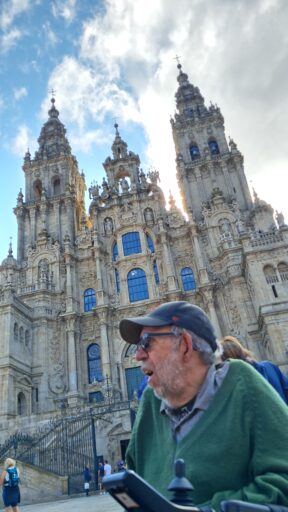
Kurt in front of the cathedral in Santiago at the end of the journey.
When the entourage arrived at their destination after twelve days of traveling and visiting small towns along the way, they encountered a large stairway leading to the grand entrance of the town. The top of the stairway offers travelers an incredible view as they enter the town, a breathtaking celebration at the culmination of their arduous journey. However, wheelchair users could not make the grand entry because navigating the large stairway was not an option. They would be forced to go around the side and enter the town through a much less majestic vantage point.
Dabiz learned that, until about fifty years ago, there had been a ramp instead of a stairway but the municipality had wanted to discourage cars from using the ramp so they replaced it with a massive stairway. Irate at the lack of access, Dabiz entered the town and performed a demonstration in the town square, meeting with the Mayor of Santiago and educating others on the importance of access for people living with disabilities. Dabiz’s efforts exemplified the DisCamino motto: Don’t let anyone tell you that you can’t.
A world of possibilities
Kurt’s motivation to embark on the challenging journey was straightforward, a simple reasoning that many able-bodied travelers and adventurers take for granted – he wanted to complete the Camino simply because he could.
“I had never really thought about it until my friend said that people in wheelchairs could do it,” Kurt says of traversing the Camino. “I had never been able to hike or spend a lot of time in nature. Traveling in Spain is great and I can get to many places by train, but I can’t really get out into the little villages with a wheelchair. Just the idea that I could be out and doing this trek that is such a big deal to so many people made me think that I should do it. I have never thought I could do it – but with the help of the volunteers at DisCamino I realized that I could. It really opened my eyes to possibilities.”
At one point on the journey, Kurt expressed a desire to make a donation to DisCamino. Javier graciously informed Kurt that they receive sponsorships and implored Kurt to find a place within his own community that might benefit from his donation instead. The value of the assistance that the volunteers provided Kurt and the pure altruism that the organization demonstrated reinvigorated his faith in others. And the opportunity to complete a pilgrimage that previously seemed inaccessible to him cemented the realization that anything is possible.
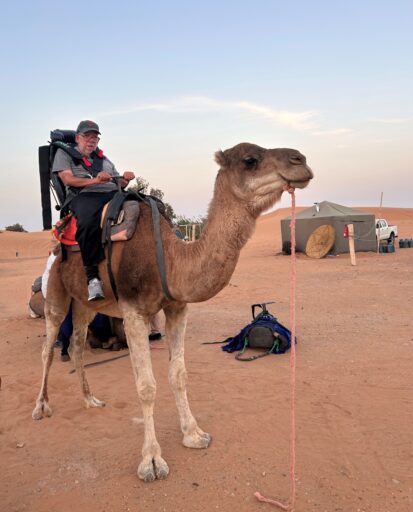
Kurt rides a camel in Morocco.
“This really opened my eyes to what possibilities there are even with great limitations,” Kurt says. “Being able to go on the Camino inspired me to take another leap and go on a trip to Morocco. I was even able to get on a camel and sit on it! I connected with an organization that does wheelchair accessible Moroccan tours. They designed an accessible seat with a four-point seatbelt so that you can ride a camel. A year ago, I would never have even thought of considering riding a camel in Morocco.”
For Kurt, DisCamino made the impossible possible and opened a world of possibilities. He wants others living with disabilities to know that when it comes to seeking new experiences and adventures – nothing is impossible.
Next Steps and Useful Resources
- Stay up-to-date on Quest content! Subscribe to Quest Magazine and Newsletter.


Disclaimer: No content on this site should ever be used as a substitute for direct medical advice from your doctor or other qualified clinician.