
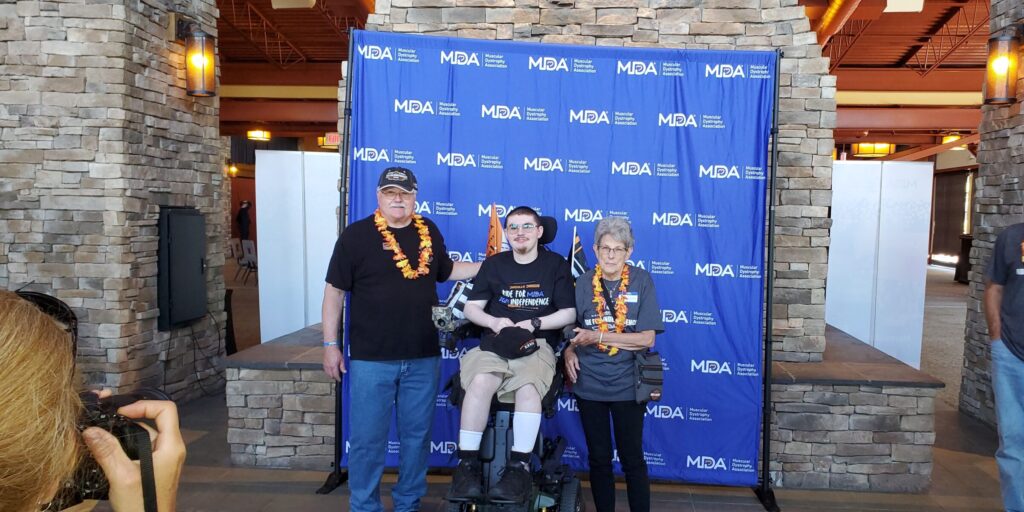
MDA Ambassador Guest Blog: Navigating a Busy Life with a Feeding Tube
By Richard Farrell Jr. | Monday, March 16, 2026
5 Second Summary
MDA Ambassadors play an essential role in furthering MDA’s mission while representing and empowering the neuromuscular disease community. Quest Ambassador Guest Blog series provides a platform to share their personal stories, perspectives, and experience.
Richard Farrell Jr. is 19 years old and lives in Pennsylvania. He was diagnosed with Becker muscular dystrophy (BMD) when he was 5 years old. He loves to repair computers, play musical instruments, play video games, and talk with his friends.
Richard “Richie” Farrell Jr.
Living with a disability has required me and my parents to rise to meet many challenges, experiencing joys and heartbreaks. All in all, it has been an interesting ride – never a dull moment. We rely upon our Catholic faith for the strength to meet the challenges and setbacks and are always thankful for the blessings we have
I was diagnosed with Becker muscular dystrophy (BMD) when I was five years old. Life became a regular parade of doctor visits, trips to specialists, dealing with schools, and navigating daily life. When I was thirteen, I began using a power wheelchair. My family bought a modified van to transport both me and my grandfather, who also lived with muscular dystrophy.
In May of 2020, life took a turn when I required a feeding tube and enteral nutrition.
Adjusting to life with a feeding tube
My parents and I had to take several steps to adapt to this change in my daily life. One challenge is managing all of the materials. We order thirty days’ worth of formula, feeding bags, extensions, and tubing – which all takes up a lot of space. Keeping all of this organized is key. Reviewing the monthly shipments as they arrive is important. You cannot assume that they send the right materials every month, so it all has to be inventoried and stored. We have received wrong formula, wrong bags, bags that leak. Paying attention to the dates on the formula and using the oldest dates first is also important. We often receive various dates in one shipment and it is key to use the oldest stock first.
At about the same time that I started using the feeding tube, my medications increased. I also began to take all medications via the tube. The medications must be scheduled carefully so that they don’t overload my intestinal system yet still meet the medication schedule – which is quite a balancing act. On top of this, syringes (enfit system) need to be cleaned and reused. It is a constant cycle of filling and cleaning syringes. About 70 are in use over the course of one week.
We created a spreadsheet with the daily medication schedule, doses, delivery, etc. We update and track the spreadsheet daily to make sure nothing is missed.
Adding to the complexity of managing all of this, many of my medications need to be compounded at home and put in liquid form so they can be injected into the feeding tube system. Most can be done ahead of time, but some need to be prepared immediately before I take them. Again, keeping to the written schedule avoids missed doses.
Managing complex needs while staying active
The other challenge we face is that we are not always at home when I need my meds or feeding formula. I am involved in a lot of groups and activities – through my church, my role as an MDA Ambassador, and other organizations. Maintaining my social life, passions, and commitments is important to me. . We developed a daily system for measuring and storing what I need. Through a system of trial and error, my parents put together a system of packaging and transporting meds and formula when traveling, whether it is just being out and about for the day or going on an overnight trip. Our method is a combination of coolers, ice packs, and insulated lunchbag-style containers with our own alterations to make the bags work. The formula has to be in a temperature-controlled environment, which is why we need the ice packs and the coolers. Since all the packaging is different, we need to keep a variety of sizes of icepacks on hand. We also have an IV pole for traveling, we hang feeding bags or medication from the pole sometimes and other times I keep the feeding bag in my backpack.
The heart of my feeding tube system is the pump. While there are gravity systems, mine utilizes a Moog Infinity Green pump. We use a model with a pump because using a gravity system would require being in a Skilled Nursing/Nursing Home Facility due to the complexity of measuring drops and how fast it goes, and I would be stuck on an IV pole all day. The Pump allows me freedom to remain independent and to keep exploring the world. (I have never used a gravity system, but I do have one for critical emergency situations if the power were to go out for a long period of time.)
It took a bit of time for us to learn how to use pump system and become familiar with the various settings. We have a specially designed backpack that holds the formula, pump and tubing. Because I use a powerchair quite often when I need to walk long distances and for many of my doctor appointments, we need to be able to hang the backpack on the back of my wheelchair.
The tubing has also necessitated alterations for clothing, mostly for semi-formal and formal events. We cut slits into my dress shirts and then stitch them (to keep from tearing) to allow the tubing to be worn with my suit.
Another key to balancing it all is flexibility. At many times activities – church, MDA events, Knights of Columbus events, travel schedules, and social activities – conflict with my medication times, so flexibility is key. We are very fortunate to have good insurance. Between primary employer insurance provided through my parents’ employers and special needs government provided insurance, my parents have been able to provide everything that I need in order to live a robust and independent life. This is not to say there are no out-of-pocket costs. Spring water for formula, replacement syringes for medications, and devices to hold the tubing in place are all expenses my family needs to absorb. My parents help mitigate this cost by using a Flexible Spending Account through my step-dad’s benefits. This account allows for an amount of money from each pay period to be deducted pretax and then reimbursed as it is spent on medical necessities.
Making it work for us
We do our best to manage all of my needs, stay organized, and stay active while navigating life with a feeding tube. Are our methods perfect? No. Missed meds, complex daily schedules, and lack of facilities when needed can create challenges. It happens. The key is not to panic and to do the best you can.
There are many reasons why this all works for us. When traveling or attending special events, planning is key. Knowing the arrival time, the schedule for the main part of activity, when there are breaks in the activity, etc. all need to be coordinated. My parents and I communicate about what is needed and what issues there are as they come up (supply, insurance, schedules) and we work them out together. We are grounded in our faith and work around church activities and obligations. I want to be able to participate in everything that I am passionate about and a big part of doing that with a feeding tube is staying flexible and understanding that everything is not always going to work out perfectly – and that is okay!
Next Steps and Useful Resources
- Learn more about Becker muscular dystrophy (BMD) here.
- Learn more about Nutrition with a Neuromuscular Disease here.
- Browse MDA’s Mental Health Hub.
- MDA’s Resource Center provides support, guidance, and resources for patients and families. Contact the MDA Resource Center at 1-833-ASK-MDA1 or ResourceCenter@mdausa.org
- Stay up-to-date on Quest content! Subscribe to Quest Magazine and Newsletter.


Disclaimer: No content on this site should ever be used as a substitute for direct medical advice from your doctor or other qualified clinician.