
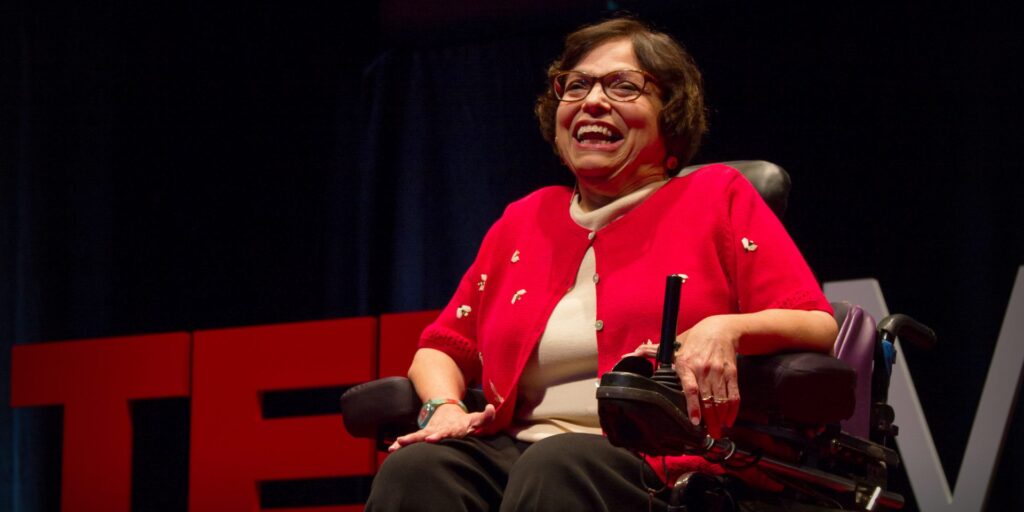
Being Heumann: My Unpublished Interview with the Disability Rights Pioneer
By Gus Alexiou | Monday, November 2, 2026

Author Gus Alexiou
Being Heumann opens in selected US cinemas on November 6 and on Apple TV on November 13.
The film, from Siân Heder, the Oscar-winning director of CODA (2021), recounts the 1977 Section 504 sit-in, when disability activists occupied the San Francisco offices of the Department of Health, Education and Welfare for 26 days – one of the longest occupations of a federal building in US history.
They were protesting delays in implementing Section 504 of the Rehabilitation Act of 1973, which prohibited disability discrimination in federally funded programs.
Among the occupation’s principal leaders was one Judith Heumann, portrayed in Apple’s new film by disabled British actor Ruth Madeley, who previously starred in the BBC disability-rights drama Then Barbara Met Alan. Heumann, then 29 and deputy director of the Center for Independent Living in Berkeley, California, was a full-time wheelchair user after contracting polio in infancy. She became known as the “mother of the disability rights movement” after what the media at the time called an “occupation army of cripples” forced the government to sign regulations requiring federally funded institutions to tackle barriers to education, employment and public services. Crucially, Section 504 paved the way for the sweeping Americans with Disabilities Act of 1990.
In the decades that followed the 504 sit-in, Heumann went on to hold senior roles in the Clinton and Obama administrations, championing disability rights on the international stage until her death in 2023 at the age of 75.
In December 2022, just three months before she died, I had the privilege of speaking with her at length on a video call from my home near London. That conversation was never published, but with the story of the 504 protests now being brought to the screen, her reflections offer a revealing perspective on the struggle for disability equality nearly half a century later.
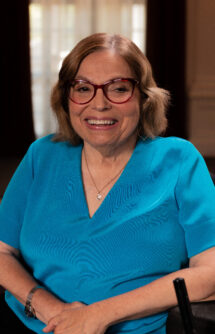
Disability Rights Activist Judy Heumann
I was immediately struck by Heumann’s warmth, her generosity with her time, and her sharp sense of humour.
Early in our conversation, conscious that my knowledge of American disability rights history was less extensive than my knowledge of the British movement, I volunteered that she could probably tell I was from the UK. “I was sure you were from Brooklyn,” Heumann grinned back.
Her manner was somehow piercingly authoritative while simultaneously relaxed and amiable. My recollection chimes with Heder’s remarks in Being Heumann‘s production notes that Heumann “had a great sense of humour, was totally intimidating to everyone around her, and could be both harsh and warm at the same time. She was a force of nature.”
Recounting her early life, Heumann’s first recollection of schooling was jarring. She had grown up among disabled peers, including at Camp Jened, later featured in the 2020 documentary Crip Camp. Heumann recounted:
“Speaking about myself and my friends, many of us would not have been going to school if we had physical disabilities.
“My experience was that my mom took me to school and the principal says I can’t go to that school because I’m a fire hazard. Instead, a teacher would come to my house twice a week for two and a half hours for three and a half years.”
Later in life, in a remarkable reversal, Heumann sued New York City’s Board of Education after being refused a teaching license because she used a wheelchair. She succeeded in becoming a teacher and, decades later, served as a senior education official in President Bill Clinton’s administration.
“If we would have been prepared as societies before I got whatever I have, many of the issues that I’m having to deal with wouldn’t be there because they would have already been addressed,” Heumann explained to me.

Judy Heumann at the 504 Sit In. (Photo Credit: HolLynn D.)
Listening back to my 2022 interview with Heumann after watching the film, I was struck by how closely her reflections echoed what might be considered the film’s defining refrain.
Addressing the assembled activists during the sit-in, Madeley’s Heumann proclaims: “They see you in front of the stairs and they think you’re the problem. The stairs are the problem.”
Here we see the epitome of the social model of disability – the notion that disability is not simply a matter of “fixing” broken bodies through medical intervention, but of reforming social attitudes and the built environment to include as many people as possible.
During our interview, Heumann posed the question: “Do we look at disability and think about it as only belonging to a narrow population or do we look at disability as something that can happen at any time?”
I developed my journalistic specialism in disability inclusion following a diagnosis of multiple sclerosis in my mid-twenties. Later in our conversation, Heumann pulled me up on my repeated use of “the disease” to describe my condition.
“Do you still use the word disease?” she asked, seemingly without judgement. “You don’t use ‘disabled’?”
It was a reminder that the disability community has never been monolithic — something the film captures through the differing priorities and identities of the activists gathered for the 504 sit-in.
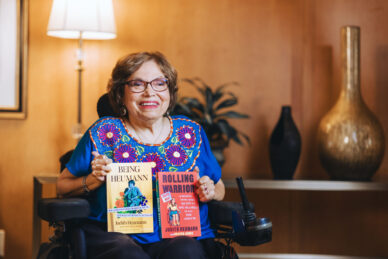
Judy with two of the books that she published.
In one scene, wheelchair users argue for widespread curb cuts, while blind activists point out that a continuous curb is useful for navigation. Deaf activists, meanwhile, express a preference for preserving their distinct cultural identity.
There are disagreements over strategy too. Fellow organizer Kitty Cone accuses Heumann of acting like “Queen Judy” when she expects protesters already struggling with their health to join her in a hunger strike.
In the film, Joseph Califano, the US Secretary of Health, Education and Welfare played by Mark Ruffalo, observes: “These people aren’t asking for a place on a bus. They’re asking for a whole new bus.”
My conversation with Heumann ranged far beyond the 504 protests. We discussed how the disability rights movement of the 1970s drew inspiration from other civil rights struggles and, in the case of the Black Panthers, worked alongside them.
She likened the continued reliance on unpaid family carers for disabled people to “indentured servitude”.
Heumann was able to answer perhaps the most important question of all: how far had disability rights really progressed since the 1970s?
“Have there been significant improvements? I would say absolutely ‘Yes’,” she told me. “There is a much more organized group of disabled people across our country, and across Great Britain, as a result of the Convention on the Rights of Persons with Disabilities.”

Judy Heumann, December 18, 1947 – March 4, 2023. (Photo Credit: Rick Guidotti)
Crucially, she added: “We still have not yet created societies where disability is seen as a normal part of life. If we look at disability as a normal part of life, we’re looking at people with or without disabilities having the same goals and aspirations: education, community inclusion, being able to go to the stores, to go to the movies, to get a job and access transportation. While we’ve made great progress in some countries, it’s still not where we need to be.”
In that sense, the Section 504 protests can be viewed as a starting point rather than anything approaching the finish line. For the woman who went to war with the stairs, there were always going to be more barriers to dismantle.
Gus Alexiou is a British journalist who began specialising in disability-related stories following a diagnosis of multiple sclerosis in his mid-twenties. He spent over five years as a disability contributor for Forbes and has also written for The Times, The Guardian, The Telegraph, The Independent and BBC News.
Next Steps and Useful Resources
- Check out the Quest Media Disability Legislation series to learn about the key US laws that protect and empower people living with disabilities in their everyday public and private lives.
- Stay up-to-date on Quest content! Subscribe to Quest Magazine and Newsletter.


Disclaimer: No content on this site should ever be used as a substitute for direct medical advice from your doctor or other qualified clinician.