Muscle Regeneration Remains a Hot Topic at MDA Clinical & Scientific Conference
By Rebecca Hume | Wednesday, October 21, 2026
Every March, the leading clinicians and researchers in the field of neuromuscular disease join industry partners, advocacy organizations, and community members at the MDA Clinical & Scientific Conference to share their expertise on the exploration of new treatments, groundbreaking research, and clinical accomplishments.
The conversations and presentations that occur at conference on topics related to current and cutting-edge research and clinical discoveries are more than just talk. In fact, the meeting of the minds plays an intrinsic role in the research to reality journey, often serving as a catalyst in the ever changing and ever advancing treatment landscape.
“We are at an exciting time in neuromuscular disease care, with advances in genetic testing, gene therapy, emerging treatments, and multidisciplinary care creating new possibilities for the community. But progress is about more than scientific breakthroughs alone. It’s about ensuring people can access timely, coordinated care, helping families navigate complex decisions, supporting wellbeing and independence, and adapting care as people live longer with neuromuscular diseases,” says Nora Capocci, EVP of Healthcare Services at MDA. “The care sessions at the 2027 MDA Conference bring these priorities together, connecting the latest evidence and clinical practices with the real-world experiences of individuals and families. By bringing clinicians, researchers, allied health professionals, and the broader community together to share knowledge and tackle challenges, we can turn progress into better care today and greater hope for the future.”
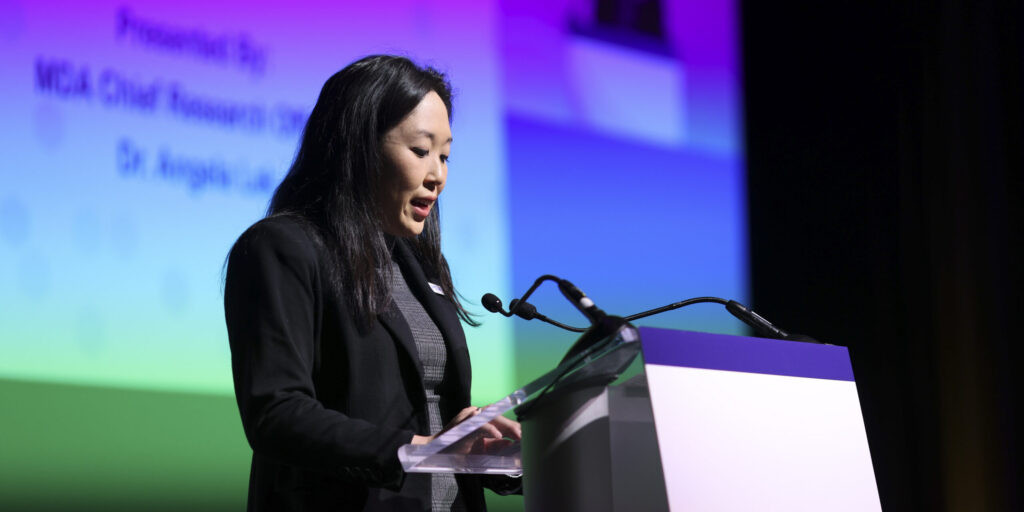
Angela Lek, PhD, MDA Chief Research Officer, at the 2026 MDA Clinical and Scientific Conference
With so much hope on the horizon, many previous conference topics have had relevant progress that tangibly impacts the neuromuscular disease community and their access to clinical trials and new therapies. One topic that continues to garner attention at the conference is muscle regeneration. With advances in muscle regeneration and repair yet again claiming a spot on this year’s 2027 MDA Clinical & Scientific Conference Agenda, we checked in with Angela Lek, PhD, MDA Chief Research Officer, for expert insight into the progress surrounding muscle regeneration research.
Muscle regeneration is a recurring topic at the MDA Clinical & Scientific Conference. Why does it continue to be such an important area of research?
Muscle regeneration represents one of the biggest goals in neuromuscular research: helping people rebuild muscle that has been damaged or lost to disease. Treatments that slow disease progression are enormously valuable, but many people begin treatment after significant muscle loss has already occurred. We want to understand whether we can help them recover some of that lost function.
The hope is that therapies addressing the underlying disease could eventually work alongside therapies that rebuild muscle. That combination could open new possibilities for preserving independence and making everyday activities easier. It is a challenging goal, but one with tremendous potential for patients.
What normally triggers muscle stem cells, or satellite cells, to wake up and repair tissue? How and why does that signal fail in neuromuscular diseases, and how do potential treatments aim to fix it?
Our muscles have a resident repair team: muscle stem cells called satellite cells. They usually remain in a resting state beside muscle fibers. When an injury occurs, signals from damaged tissue and nearby cells – including immune cells – activate them. They multiply, and some develop into cells that fuse with damaged muscle fibers or help form new ones. Others remain behind to maintain the stem cell supply for future repairs.
In muscular dystrophies, the problem often is not that the repair signal is absent. The muscle may be repeatedly sending out calls for help. But ongoing damage, persistent inflammation, and the buildup of scar tissue make successful repair increasingly difficult. In some diseases, the genetic defect also affects how the stem cells themselves function. Research in Duchenne muscular dystrophy (DMD), for example, shows that the absence of dystrophin can disrupt the way muscle stem cells divide and produce cells needed for repair.
Potential treatments approach this from several directions: improving the function of the body’s own stem cells, introducing healthy muscle-forming cells, making the surrounding tissue more supportive of regeneration, or protecting muscle fibers from repeated damage. We also need to address the underlying disease, because newly formed muscle may otherwise remain vulnerable to the same damage.
What were some of the key research updates and discussions surrounding muscle regeneration at previous MDA Clinical & Scientific Conferences?
In the past, a major theme has been how to turn promising cell-based research into practical treatments. Researchers discussed different sources of muscle-forming cells, including cells taken from human muscle and cells generated from induced pluripotent stem cells. These are mature cells that have been reprogrammed in the laboratory and can then be guided to become muscle-forming cells.
The presentations covered approaches such as correcting cells outside the body before transplantation and developing donor-derived cells that could be manufactured in advance. Another important topic was senescent cells – cells that have entered a state in which they no longer divide normally and can release signals that interfere with tissue repair.
Taken together, those topics highlight a central challenge: we need both the right cells and an environment in which those cells can survive, rebuild muscle, and function. Safety, manufacturing, affordability, and delivery are all part of making that happen.
What progress was shared at last year’s conference?
The field is advancing on several fronts. The 2026 conference reflected a broader approach to both regeneration and repair. Alongside stem cell strategies, researchers discussed synthetic polymers and therapeutic proteins designed to protect or repair the outer membrane of muscle fibers. Other presentations explored autophagy (the cell’s system for recycling damaged components) and three-dimensional muscle tissues grown in the laboratory to improve disease modeling and treatment testing.
These approaches serve different purposes. Protecting a muscle fiber from damage is different from generating new muscle, but both could be important parts of a future treatment strategy.
Do researchers expect that the same muscle regeneration technology will apply to all neuromuscular diseases, or will it need to vary from one disease to the next?
Some technologies may have broad applications, while others will need to be tailored to a particular disease.
For example, an approach that helps muscle stem cells function better or reduces harmful scarring could potentially benefit several muscular dystrophies. A platform for producing healthy muscle-forming cells might also be adaptable across diseases. But if researchers use a patient’s own cells and correct their genetic defect before transplantation, the correction would need to match that person’s disease.
The cause of muscle weakness also matters. In DMD and many limb-girdle muscular dystrophies (LGMDs), the muscle itself is directly affected. In spinal muscular atrophy (SMA), loss of the nerve cells that control muscle is a central problem. Rebuilding muscle alone would not solve that loss of nerve input. Ultimately, the treatment must account for what is damaging the muscle, which muscles are affected, and how much viable tissue remains.
Which diseases are the focus of current research?
DMD is a major focus, including research on stem cell transplantation and ways to improve the muscle’s own repair capacity. Researchers are also studying regeneration in LGMD and facioscapulohumeral muscular dystrophy (FSHD). Those diseases provide opportunities to understand both shared problems and differences in how muscle repairs itself.
SMA is also important in the broader effort to improve muscle health and function alongside treatments that address the underlying disease. However, it is useful to distinguish treatments that help existing muscle grow or perform better from treatments intended to regenerate lost muscle. Both can matter to patients, but they are not the same biological process.
What are some of the cross-disease research collaborations?
One example is a collaboration that grew out of MDA’s Muscle Regeneration Summit. MDA joined with Parent Project Muscular Dystrophy, the FSHD Society, and the LGMD2L Foundation to fund Dr. Abigail Mackey’s research at Copenhagen University Hospital, Bispebjerg Hospital.
Her team is creating a detailed molecular map of how healthy human muscle regenerates and comparing it with muscle samples from people with DMD, FSHD, and LGMD2L. The aim is to identify where repair succeeds, where it breaks down, and which findings might be relevant across diseases.
That is the value of collaboration: organizations can pool resources around a shared biological question, and the resulting knowledge can support several patient communities.
How are newly identified biomarkers helping researchers track whether muscle regeneration therapy is working even before physical symptoms change?
Biomarkers are measurable clues to what is happening inside the body. For regeneration, researchers can examine muscle samples for signs of activated stem cells or proteins associated with newly forming muscle fibers. These may reveal a biological response before a noticeable change in strength or daily function.
However, we still need better, well-validated ways to measure successful regeneration in people. A sign of active regeneration can also mean that muscle is being repeatedly damaged and trying to repair itself. Seeing more repair activity does not automatically tell us that a treatment is producing healthier, lasting muscle.
That is one reason we are supporting Dr. Mackey’s work with our partner organizations. Defining what healthy human regeneration looks like – and how it differs in disease – could help researchers identify better markers for future trials. Her study is building that foundation; it is not yet a validated test of whether a regeneration therapy works.
What is a realistic timeline for advancing muscle regeneration therapies from preclinical mouse models into human clinical trials?
The timeline depends on the approach and how far along it is. For some technologies, the move into human trials is already happening. Dr. Peter Kang at the University of Minnesota is leading a phase 1 trial of MyoPAXon, which uses muscle-forming cells derived from induced pluripotent stem cells. The university currently lists the study as recruiting adults with DMD who are nonambulatory. Its initial focus is safety and determining an appropriate dose.
Other approaches remain earlier in development. Before entering human trials, researchers need to establish safety, manufacture a consistent treatment, and work out how to deliver it to the muscles that need it. Rebuilding muscle throughout the body presents a much greater challenge than treating a small, localized area.
Entering a trial and becoming an available treatment are different milestones. We will need careful studies to determine whether these therapies produce lasting muscle repair and meaningful improvements in people’s lives. But I am encouraged that some approaches have reached clinical testing.
2027 MDA Clinical & Scientific Conference registration is open
This year’s conference will be held March 21-24 in Orlando, Florida. Detailed information about the conference and registration can be found here.
Members of the neuromuscular disease community registered with MDA are welcome to participate in the virtual conference at no cost or attend in person at a discounted rate offered for patients, caregivers, and MDA volunteers until allotted spaces are filled. People living with neuromuscular conditions and their families interested in attending virtually or in-person, please complete this form prior to registration. Once verified by MDA, individuals will receive a separate email containing a registration link for the 2027 MDA Clinical & Scientific Conference.
Next Steps and Useful Resources
- Detailed information about the 2027 MDA Clinical and Scientific Conference and registration can be found here.
- Check out the 2027 MDA Clinical & Scientific Conference Agenda.
- Stay up-to-date on Quest content! Subscribe to Quest Magazine and Newsletter.


Disclaimer: No content on this site should ever be used as a substitute for direct medical advice from your doctor or other qualified clinician.