
Understanding SELENON-Related Myopathy
By Michelle Jackson | Wednesday, November 18, 2026
5 Second Summary
SELENON-related myopathy can cause muscle weakness, scoliosis, and breathing problems. A rare disease researcher shares what families should know about diagnosis and supportive care, along with early research exploring drug discovery and gene therapy.

Alan Beggs, PhD
SELENON-related myopathy is a rare genetic muscle disease. Only an estimated 150 people in the United States have been diagnosed.
SELENON-related myopathy is considered a congenital myopathy, as weakness can be present from birth, yet it does not progress rapidly. It causes muscle weakness throughout the body, along with progressive stiffness of the spine that can lead to severe scoliosis and breathing problems. Because the condition is so rare, researchers believe many people remain undiagnosed due to factors such as delayed recognition of milder cases and disparities in access to genetic testing.
Alan Beggs, PhD, director of the Manton Center for Orphan Disease Research at Boston Children’s Hospital, has spent decades studying SELENON-related myopathy. In this interview, he explains what families should know about the condition, how it’s diagnosed and managed, and why new research is creating hope for future treatments.
What is SELENON-related myopathy, and what are its most common symptoms?
SELENON-related myopathy usually appears around birth or during the first few years of life.
One of the hallmarks of the condition is weakness in the muscles that help keep the spine straight. As those muscles weaken, the spine becomes stiff, eventually leading to severe scoliosis. Many children also begin needing breathing support at night during mid-childhood.
Despite generalized muscle weakness, many people can walk for most of their lives. As with many congenital myopathies, severity varies widely. Some children need help getting around, while others aren’t diagnosed until adulthood because their symptoms are much milder.
How is the condition diagnosed and managed?
Years ago, physicians used different names for this condition, including rigid spine muscular dystrophy and minicore or multicore myopathy. Today, we know these are all one condition caused by changes in the SELENON (formerly called SEPN1) gene.
Genetic testing has made diagnosis much more accurate. If there’s a family history, or a baby is born very weak or needs breathing support, genetic testing can often identify the condition within weeks or months. Sometimes children aren’t diagnosed until symptoms become more apparent later in infancy or childhood.
Management focuses on supportive care, including physical and occupational therapy, orthopedic care, and breathing support. Regular monitoring by an orthopedic specialist is important because scoliosis can worsen over time.
When spinal fusion is performed before the curve becomes too severe, it’s usually very effective and typically lasts for life. Sleep studies and careful monitoring of respiratory functions are also important parts of general management.
What have researchers learned about what causes SELENON-related myopathy?
The SELENON gene provides the instructions for making a protein called selenoprotein N. One of its most important jobs is helping regulate the movement of calcium inside muscle cells. Calcium is what triggers muscles to contract.
I like to compare the process to a rechargeable battery. When a nerve tells a muscle to move, calcium is released to make the muscle contract. It then has to be pumped back into storage so the muscle is ready for the next movement.
Without selenoprotein N, the channels that pump calcium back into storage become damaged by oxidation and don’t function the way they should. As a result, muscles can’t contract and recover as efficiently, which we believe contributes to the muscle weakness we see in this condition.
What research gives you the most hope right now?
Today, we’re focusing on three promising treatment strategies: reducing damage inside muscle cells, helping unhealthy muscle cells function more normally, and improving how cells produce energy. A drug that improves any of those processes could potentially improve the disease.
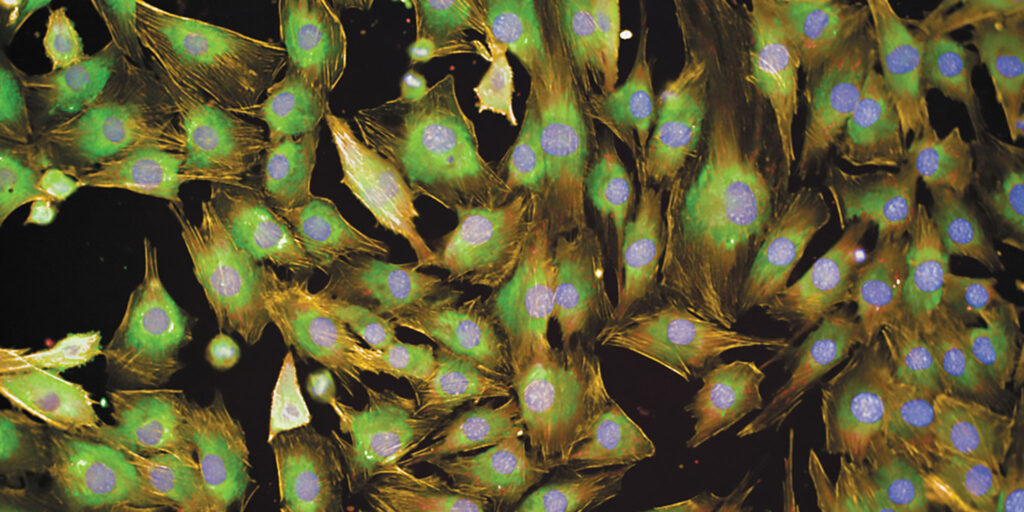
One exciting area is drug discovery using a technique called cell painting. We compare healthy cells with cells missing selenoprotein N using high-resolution imaging and artificial intelligence. Using highly detailed images of cells stained for different components and machine learning, cell painting studies can detect subtle differences between healthy and selenoprotein N-deficient cells that the human eye can’t see, allowing us to quickly identify drugs that might reverse those changes. This is still in a relatively early stage.
We’re also pursuing gene therapy. Because SELENON-related myopathy is caused by the absence of selenoprotein N, our goal is to deliver a healthy copy of the SELENON gene into muscle cells. It’s the same general approach already being used in Duchenne muscular dystrophy (DMD) and spinal muscular atrophy (SMA). We’re currently in the pre-clinical stage, testing this approach in mice to see whether replacing the missing protein can improve the condition.
What would you most like families to know?
We know of only about 100 to 150 people living with SELENON-related myopathy in the United States, but based on population estimates, we believe the true number may be closer to 800 or 900.
That’s why raising awareness is so important. Greater awareness can help people get diagnosed and connected to the care they need. It can also attract the funding needed to advance research and bring new treatments closer to families.
Michelle Jackson is a writer for Quest Media.
Next Steps and Useful Resources
- Browse our library of disease-specific content.
- Stay up to date on Quest content! Subscribe to Quest Magazine and Newsletter.


Disclaimer: No content on this site should ever be used as a substitute for direct medical advice from your doctor or other qualified clinician.