Building a Community of Support on My Journey to Advocacy
By Wanzie Li | Wednesday, November 18, 2026
I was diagnosed with Charcot-Marie-Tooth disease (CMT) at 9 years old. Having been able to walk as a child, I am now a power wheelchair user, with scoliosis, restrictive lung disease, and minimal movement in my fingers and wrists.
Living with CMT has taught me resilience and problem-solving, as I come to terms with the limitations and possibilities of my changing body. But more than anything, it’s led me to find an incredible community.
For the first 16 years of my life, growing up in the city of Guangzhou, China, and then immigrating to the US, I never knew a fellow wheelchair user, let alone realized that disability can be an identity and a way of belonging. Instead, I saw my CMT as no more than a burden and shame that isolated me from others, both physically and emotionally.
It was while volunteering with an organization called the Disability Pride Project that I first encountered the world of disability advocacy — one that told me not to fit myself into any concept of “normality,” but to ask why I was never there in the first place. Sharing my story was a powerful way of telling others like myself: You are not alone. And I started seeking what more I could do.
Finding my people
Attending an online high school, I realized how many disabled experiences went unseen and the importance of raising awareness. Co-leading the Disabled Students Alliance with a small group of wonderful peers, I hosted school-wide events to share lived experiences, advocated for a more comprehensive accommodations system, and created resources for digital accessibility practices and navigating disability while applying to college. Behind each milestone, I treasured most what we had built: a community of warmth and mutual support in which we openly and unapologetically pushed for access for one another.
During my senior year, I attended MDA’s Mentorship Program, where I met mentors with neuromuscular diseases doing incredible work in fields of law, policy, and social service. There, my community expanded to encompass people nationwide, at vastly different points in life, yet united by shared joys and struggles. Learning about the injustices they encounter in society, as well as those from my own life, strengthened my conviction to pursue advocacy in higher education. Where I once saw CMT as what was holding me back, it is now constantly driving me forward.
Of course, there will always be moments of isolation and frustration. Every rampless curb, too-narrow aisle, support-cutting policy, and ableist remark still tells me I’m living in a world that wasn’t made for me, but that we hope, in small and big ways, to remake. What my communities have taught me stretches from the large to the mundane: that asking for help is not a show of weakness but an opportunity to build care; that sometimes just getting out of bed in the mornings is a feat to be celebrated; that being with and listening to one another is how we validate our individual existences and redefine disabled joy.
Looking ahead
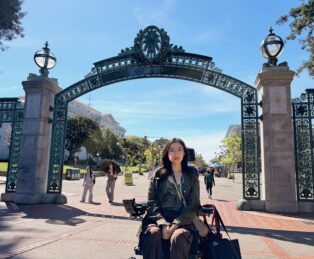
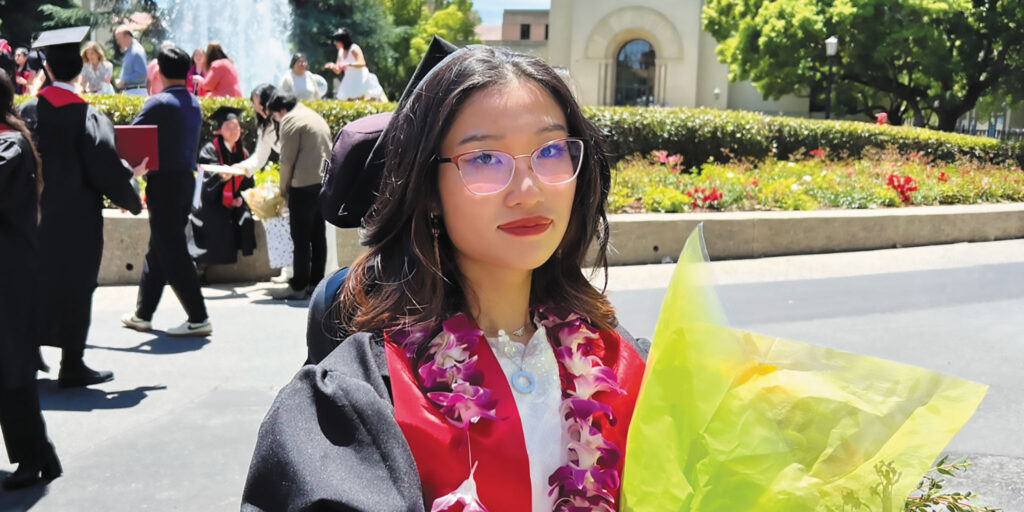
Wanzie at UC Berkeley
In the fall, I started college at the University of California, Berkeley. I’m hoping to study sociology, literature, and public policy to work toward a career in disability rights. Seeing wheelchair users on the streets, riding buses across campus, and attending disability pride events in the city of Berkeley, I once again realize our community is so much bigger than I ever thought, and that there is so much for me to yet explore. Researching the history of the Americans with Disabilities Act and meeting people from blind, deaf, and autistic communities, I’ve learned about the power of cross-disability solidarity in innovating methods of universal access and collectively advocating for rights. Most of all, I’ve learned the importance of disability movements led by those most impacted — “nothing about us without us” — and the importance of telling our stories rather than letting others tell them for us.
Whether it’s my circle of close family and friends who have given me their unyielding support, my fellow advocates at organizations like MDA, or the new people I meet and converse with on a daily basis, my definition of community is ever-expanding. What I can say for certain is that it’s taught me all I know about loving myself and my unwieldy body.
It’s only been two years since I started calling myself an advocate. I feel like I’ve only scratched the surface, and there’s a much longer way to go. But to all of the people I’ve been able to take this journey with, thank you from the bottom of my heart. Let’s continue giving each other the strength to keep on going.
Wanzie Li, 18, is an undergraduate student at the University of California, Berkeley. You can find her on Instagram at @wanzalien_07.
Next Steps and Useful Resources
- Listen to a conversation with Cerys Davage, a Welsh podcaster and social media content creator living with limb-girdle muscular dystrophy (LGMD), who talks about what life is really like as a young person with a disability.
- Stay up to date on Quest content! Subscribe to Quest Magazine and Newsletter.


Disclaimer: No content on this site should ever be used as a substitute for direct medical advice from your doctor or other qualified clinician.