MDA Ambassador Guest Blog: Finding My Rhythm Again: The Power of the Chair Workout
By Rebecca Gregg | Tuesday, January 6, 2026
5 Second Summary
MDA Ambassadors play an essential role in furthering MDA’s mission while representing and empowering the neuromuscular disease community. Quest Ambassador Guest Blog series provides a platform to share their personal stories, perspectives, and experience.
Rebecca Gregg has limb-girdle muscular dystrophy (LGMD2B), is a board member of the LGMD Awareness Foundation, and is an MDA Ambassador. She lives in Edmond, OK, with her husband, David, and two daughters, Addison and Lauren. In her free time, she makes jewelry for her Etsy shop.
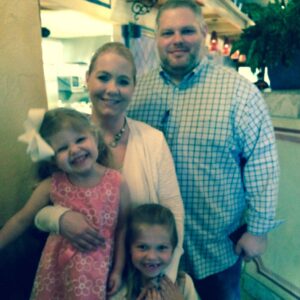
My family including, my husband, David and my two daughters, Addison and Lauren.
I can still vividly recall the cadence of my feet striking the track, the familiar rhythm accompanying every mile I ran. Throughout my teenage years and well into my twenties, running served as my sanctuary—a reliable space where I could alleviate stress and maintain my physical health. It was a cornerstone of my identity.
But once I crossed the threshold into my thirties, an unwelcome change began. A persistent weakness started setting in, and my body was no longer able to do the simple movements it once did so effortlessly. I began falling, often for no explainable reason, and everyday tasks like climbing stairs started to feel like scaling my own personal Mount Everest.
Fast-forward to age 43, when I finally received a diagnosis that brought clarity to a decade of confusion: adult-onset limb girdle muscular dystrophy (LGMD). It was a heavy diagnosis, but it all finally made sense—the reason why my body consistently felt as though it was betraying me.
Now I am 50 years old and in more recent years, the progression of LGMD has necessitated a significant life transition, moving from using a walker to relying primarily on a wheelchair. This shift brought new struggles, notably weight gain and reduced physical movement. Trying to pinpoint a fitness routine specifically tailored for my unique needs felt out of reach, a goal that seemed impossible to achieve.
My breakthrough moment arrived when I discovered chair workouts a few years ago
A new way to workout
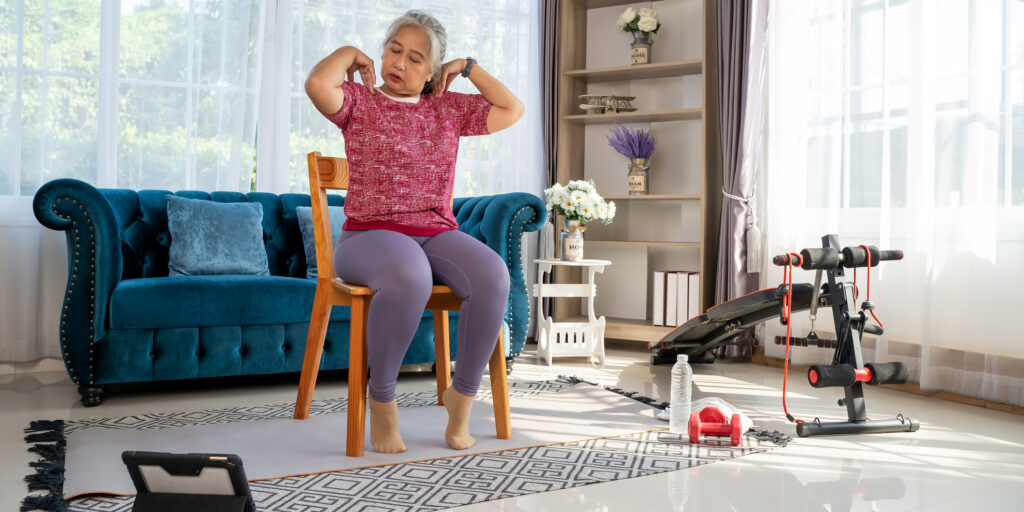
Chair workouts are precisely as they sound: fitness routines designed to be executed while seated. This simple adaptation makes them inherently accessible for people with diverse disabilities, older adults, and individuals managing chronic conditions.
These routines have given me a vital, safe pathway to movement without the fear of falling or the risk of overexerting muscles that are already fragile. The beauty of these routines lies in their comprehensive focus; they prioritize gentle strength building and enhance flexibility and cardiovascular exercise—all while respecting individual physical limitations.
YouTube boasts an extensive library of chair workouts readily available at your disposal. I have explored several different routines, but my personal favorite and steady companion has been Caroline Jordan Fitness.

A screenshot of Caroline Jordan’s YouTube page, where you can find all her chair workouts.
Caroline is a vibrant, empathetic, and fun certified health coach who truly comprehends diverse physical challenges and who champions adaptive movement as a powerful form of medicine. Her extensive content library is free to access and includes everything from seated yoga to intense, no-impact cardio and strength sessions. You can find her YouTube channel at Caroline Jordan Fitness channel.
The benefits I’ve personally experienced have been genuinely life-changing, extending far beyond muscle tone.
A healthier (and happier) me
These workouts are genuinely challenging. I have lost weight, built strength, and improved my cardiovascular fitness. While the routines are designed to be modified to suit various physical levels (Caroline always explains how to adjust each exercise), they are far from “easy.” They effectively engage muscles, improve range of motion, and absolutely make you sweat!
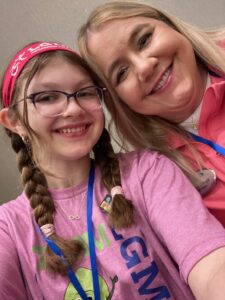
Rebecca and her daughter, Lauren, at the recent MDA Engage Conference in November.
The satisfaction from completing a 30-minute seated aerobics class is immense and has given me a huge confidence boost. It has helped restore a part of the old “me” that I truly thought was gone forever; the part that loves a healthy challenge and the feeling of self-competition to improve myself. That has felt incredibly rewarding and similar to the satisfaction I used to feel when I was a runner.
The mental health impact has been substantial. Living with LGMD and the daily challenges that come with having a progressive condition led to anxiety and depression. The mindful breathing techniques and the focus on what my body can still accomplish, rather than dwelling on what it cannot, has been incredibly empowering.
Chair workouts didn’t just give me a new way to exercise; they restored my fitness autonomy. They are not merely a consolation prize for losing the ability to walk; they are a legitimate, effective pathway to a healthier, stronger and more positive life. For anyone navigating life with a disability and/or mobility issues, these routines are an absolute game-changer.
Finding a workout for you
There are some challenges to pay attention to. Muscular dystrophy makes overexertion a risk that may cause muscle fatigue; if you are not careful, pushing too hard can leave your body in a worse condition than when you started. I have learned to listen to my body and pause when needed. Before you start a new workout, talk to your doctor or care team to ensure that it is safe for you.

Rebecca Gregg
It is also crucially important to choose instructors who truly understand accessibility—some workouts merely labeled “chair” still inadvertently assume a level of mobility that not everyone possesses. I recommend previewing videos before starting. The best keywords for finding these routines on YouTube include “chair exercises,” “seated workout,” “wheelchair fitness,” “gentle seated yoga,” etc.
With so many options, you can find the right workout for you and discover your rhythm again – it’s waiting for you.
Next Steps and Useful Resources
- Learn more about Limb-girdle muscular dystrophy (LGMD) here.
- Browse MDA’s Mental Health Hub.
- MDA’s Resource Center provides support, guidance, and resources for patients and families. Contact the MDA Resource Center at 1-833-ASK-MDA1 or ResourceCenter@mdausa.org
- Stay up-to-date on Quest content! Subscribe to Quest Magazine and Newsletter.


Disclaimer: No content on this site should ever be used as a substitute for direct medical advice from your doctor or other qualified clinician.