

MDA’s DME Grant Program Helps Get Essential Equipment to Live Well
By Amy Bernstein | Tuesday, May 26, 2026
Access to durable medical equipment (DME) is vital for safety, mobility, and greater independence.
For Chuck Vrasich, of Illinois, a light, portable lift lets him move around his home without worrying about falls.
For Jo Ann S. Rincon, of Texas, a toilet lift provides the support she needs to use the bathroom independently.
Both of these community members obtained their equipment through MDA’s DME Grant Program, which assists people in accessing tools to help them live with strength and confidence.
Access to vital equipment
Many people in the neuromuscular community face challenges getting wheelchairs, lifts, canes, and other tools that support daily living. Insurers, including Medicare, often have coverage limits for DME, and the approval and ordering process can be cumbersome. Sometimes requests are denied.
“MDA recognizes that many families and individuals face financial burdens when obtaining necessary medical equipment,” says Brooke Smith, LMSW, MEd, Senior Director of the MDA Resource Center. “MDA’s DME Grant helps reduce barriers to accessing DME and strives to alleviate financial burden for families.”
The program provides grant awards of up to $1,000. Many commonly used products, including lift chairs and toilet lifts, are within this price range. For higher-cost items, MDA Specialists can work with individuals and families to identify potential community resources to secure funding beyond the grant amount.
The MDA DME Grant Program covers several types of equipment, including:
- Mobility support: Manual and power wheelchairs, lift chairs, batteries
- Home modifications (nonpermanent): Portable ramps, grab bars, showerheads
- Medical equipment: Hospital beds, respiratory support devices
- Orthotics and devices: AFOs, TLSOs, orthotic shoes, communication devices
The program is open to people applying for grants for themselves or a loved one who has been diagnosed with a neuromuscular disease covered under MDA’s program.
Success stories
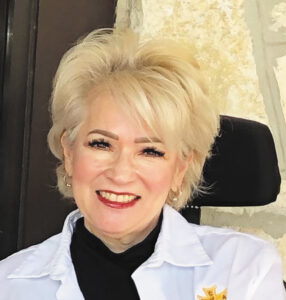
Jo Ann S. Rincon
Jo Ann lives with inclusion body myositis (IBM), which causes progressive muscle weakness in the hands and legs. As her disease progresses, she finds everyday activities more difficult, including sitting down and standing back up.
Jo Ann learned about the MDA DME Grant Program through her MDA Care Center in Texas and used the online form to apply for the grant for a toilet lift.
“The process was straightforward and easy to follow. The instructions were clear, and I felt supported throughout,” Jo Ann says.
Having more independence at home has given Jo Ann a boost in confidence. “I use the toilet lift daily to help me get on and off the toilet more easily,” she says. “It reduces physical strain and the need for assistance.”

Chuck Vrasich
Chuck, who lives with Becker muscular dystrophy (BMD), also learned about the MDA DME Grant program through his MDA Care Center. Chuck enjoys cooking with the vegetables and herbs he grows in raised beds in his backyard. But, “I tend to fall,” he says.
He used the MDA DME grant to purchase a lightweight floor-to-stand lift for his home. “If I fall, someone can slide it to me, and I can sit on it and then stand up,” he says.
Overall, he describes the process of applying for the MDA DME Grant as “pretty painless.”
“It didn’t take more than 20 minutes once I gathered the information,” he says. He received the lift within a month.
“The application asks some basic questions so that we can get a sense of your need,” Brooke says.
There are minimal documentation requirements, including a quote for the requested item. “This helps us process your request quickly. Once we have all the needed documents, we are typically able to approve a grant within a day or two. Payment can take between two and four weeks.”
A painless process
Celest Scherb, LCSW, a social worker at AdventHealth Neuroscience Institute in Orlando, Florida, an MDA Care Center, helped one of her clients obtain an MDA DME Grant. Celest saw that her client, who lives with amyotrophic lateral sclerosis (ALS), would benefit from adding a headrest on her power wheelchair, but her hospice program rejected the request.
“She’s still very active, very engaged,” Celest says. “She was starting to have more drop with her neck, and it was impacting her vocal cords and her speech. We wanted to keep her confidence up and keep her speech preserved as long as possible.”
Celest helped her client get a quote from a wheelchair vendor and spoke with an MDA Specialist about why the headrest was needed quickly. She was pleased that MDA followed through immediately, and her client had the headrest within two weeks.
“It doesn’t seem like there’s as much red tape with this grant request as there can be with so many other things,” Celest says. “That’s a breath of fresh air, especially in healthcare.”
Amy Bernstein is a writer and editor for Quest Media.
Next Steps and Useful Resources
- Watch these MDA Virtual Learning webinars: Practical Solutions for Accessing Equipment and Assistive Devices and Home Solutions for Greater Independence
- Learn more about MDA’s DME Grant Program and available support resources through the MDA Resource Center.
- For one-on-one support, contact the MDA Resource Center at 833-ASK-MDA1 (833-275-6321) or ResourceCenter@mdausa.org.
- Stay up to date on Quest content! Subscribe to Quest Magazine and Newsletter.


Disclaimer: No content on this site should ever be used as a substitute for direct medical advice from your doctor or other qualified clinician.