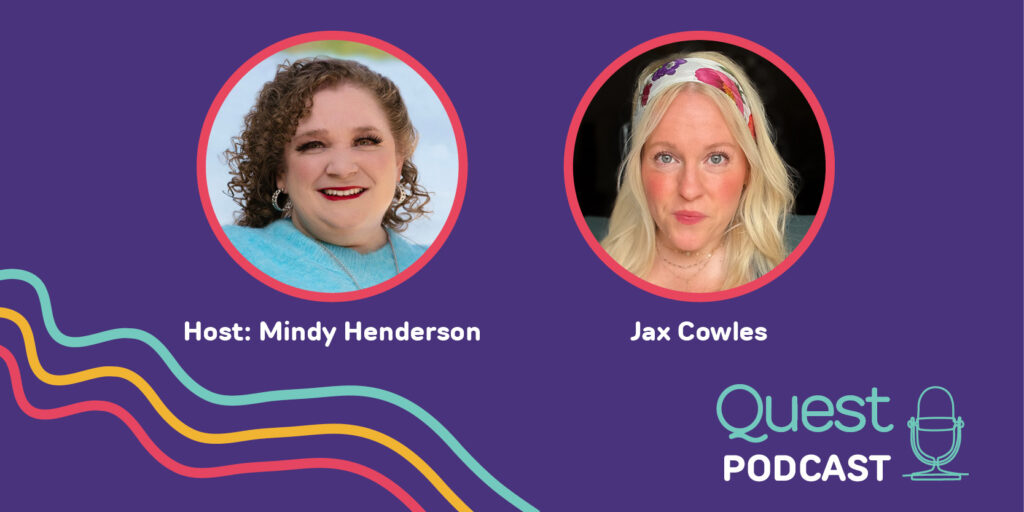
Quest Podcast: Redesigning the Day: Accessibility and Mindset Life Hacks with Jax Cowles
By MDA Staff | Wednesday, January 21, 2026
5 Second Summary
Living independently with a neuromuscular disease often requires ingenuity. Quest Media’s Life Hacks series features a variety of resources to make daily living easier and more accessible. From tips for improving accessibility at home to navigating the world around you, these hacks for an adaptive, independent lifestyle provide solutions to common barriers.
In this Quest Podcast episode, we chat with public speaker, consultant, and disability advocate, Jax Cowles. Jax shares an honest, thoughtful, and deeply creative conversation about daily life, independence, and problem-solving. She opens up about how creativity and “life hacking” became essential tools rather than optional skills, and how small, low-cost adaptations can completely transform everyday tasks. Jax shares her experiences, expertise, and advice when it comes to practical insight, encouragement, and a refreshing perspective on living creatively and fully—exactly as you are.
Read the interview below or check out the podcast here.
Mindy Henderson: Welcome to the Quest Podcast, proudly presented by the Muscular Dystrophy Association as part of the Quest family of content. I’m your host, Mindy Henderson.
Together, we are here to bring thoughtful conversation to the neuromuscular disease community and beyond about issues affecting those with neuromuscular disease and other disabilities and those who love them. We are here for you to educate and inform, to demystify, to inspire and to entertain. We are here shining a light on all that makes you, you. Whether you are one of us, love someone who is, or are on another journey altogether, thanks for joining. Now let’s get started.
Today’s guest is someone who doesn’t just talk about inclusion. She designs it, lives it, and invites all of us to imagine it differently. Jax Cowles is a speaker, consultant, and disability advocate who uses creative storytelling, organizational strategy and her expertise in architectural and fashion design to challenge the way we think about the challenges that come along with living with a disability.
Diagnosed with spinal muscular atrophy at just 20 months old, Jax began sharing her story early in life, speaking at schools and community events to show that being different isn’t something to hide. It’s something to celebrate. From her early school days to serving as a 2024 keynote gala speaker, Jax has long been a proud and powerful voice within the MDA community. Through her travels from London to Paris to Amsterdam, Jax explores and highlights accessibility around the world, reminding us that nothing is impossible when you’re the writer of your own story.
She believes that accessibility should never be a question and that with the right tools, information and mindset, we can build a more inclusive world, not just by thinking outside the box, but by breaking the box altogether. I’m so excited for you to hear her perspective, her creativity, and her unapologetic approach to redefining what’s possible. Please join me in welcoming Jax Cowles.
Jax, I’m so excited you’re here.
Jax Cowles: I am so excited. Thank you so much for having me. Hello to everyone out there listening. I can’t wait for us to dive in together.
Mindy Henderson: Yes. I have so many questions for you. And you and I have actually known each other for a while. We’ve been acquainted, and then we met finally in person at a conference last year, and I was absolutely blown away. I started asking you about different things on your chair and how you do this and that, and we were fast friends. And I’ve continued to poke you and bug you about how could I make this work or what should I do about this? And you are just one of the most brilliant and creative problem solvers I have ever come across.
So let’s just start off with a little bit about you and what your daily life looks like. If I’m not mistaken, you live in New Jersey and work in New York, which is the epitome of hustle and bustle. And in a lot of ways, it may make things, I would guess, both easier and harder at the same time for someone living life from a wheelchair. What does a day in the life look like for you?
Jax Cowles: Well, first of all, thank you for all the wonderful compliments. I accept all of them. Thank you. Thank you. It’s so funny to go back and think about it because I feel like it’s something I may not think about on a daily basis, which everyone has their moments. We have those things where we think about today’s a really difficult day or frustrations, but I was honestly brought up where you figure it out and that there was no choice but to figure it out. So if you wanted to do something, you were doing it. And if something wasn’t accessible, we were making it accessible.
So I think that that mindset was given to me at such a young age, and it’s actually something that was given to my parents from my doctor that said, “Do not allow any excuses, if I can give you one set of advice, and to really push her to do everything that she wants to do and to figure it out.” My parents and my family took it to heart, and it’s the best thing they ever did for me because I now, without really thinking about it, I just figure it out. If something isn’t accessible, we make it accessible.
And at the same time, I understand that we’re not yet at a place where everything in the world is accessible. It would be great if it was, but the fact is, is that it’s not. So I’m very lucky that I have worked across a few different industries, entertainment, sports, fashion, also have done a lot of consulting and brand engagement. And I think across it all, every industry comes with its own positives and negatives when it comes to accessibility for what is available.
But at the same time, it really gives me that great 360 to bring everything that I’ve learned into what I do. And as you said, commuting and living in different cities and living in different states and working in different states and things like that, each one is very unique. So when I lived in Florida, it was a very different commute than working, let’s say, in New Jersey where I currently live now, or even working here and traveling and commuting into the city, there are things. And of course, weather is always a wonderful add-on to how you make things accessible or not.
Mindy Henderson: So very out of our control too.
Jax Cowles: Yes, weather is definitely always something. I try to simplify everything I do the most that I can so that accessibility is not overwhelming. It doesn’t have to be. We just need to simplify the way that we look at things.
Mindy Henderson: Well, and I want to reiterate something that you said because it feels to me like problem solving and creative thinking are part of your DNA with the way that you grew up. And it sounds like we had some similar experiences and came from similar families in that my parents also, I think one of the biggest favors that they did for me was to not let me make excuses not to do something because it was hard or it was inaccessible or whatever. Like you said, we just figured it out and that was the only option, really.
Jax Cowles: Yeah, and it’s something as small as my cousins were roller-skating outside and because of the way we were all brought up and that Jax will figure it out and she is supposed to be a part of everything, I remember putting skates on my feet, putting my feet to the ground and wheeling around in my chair. And in my mind, I was skating exactly the same as everybody else. It wasn’t like, that silly. It’s like, no, it’s not silly.
Mindy Henderson: No.
Jax Cowles: I’m a big believer in doing small things. So if you go to a yoga class and you want to meditate, give yourself that same environment. If that means putting a mat down for you and wheeling your chair over it or putting a chair on top of the mat, you do it because there is no reason not to.
Mindy Henderson: I love it. I absolutely love that. So gosh, so many questions. Just starting with daily living itself, and then we can go almost top down and get more and more narrow and specific about some of the hacks that you’ve come up with for yourself. But let’s start with transportation because that’s a biggie for so many people in the neuromuscular community, just getting from point A to point B. And of course, it varies according to where you live, like you also alluded to. How do you handle transportation or can you give us some different looks at different ways that you’ve approached transportation depending on where you lived?
Jax Cowles: Yeah, so transportation, of course, is something that is huge, right? It’s how we get around on a daily basis, and it’s so important to be able to have accessible transportation. But not just accessible transportation, but transportation that actually works, right?
Mindy Henderson: Right.
Jax Cowles: Every state, at least in the US, has to have some type of accessible transportation. A lot of times when you do transportation through the state, you get a giant four-hour window that is like, by the way, we might come at 1:00, but we also might come at 5:00, so make sure you give yourself four hours before you have to be somewhere, and it’s not great.
Mindy Henderson: Yeah, and if you have a job interview, that doesn’t work.
Jax Cowles: Exactly. It’s just not realistic. Not everyone, and I want to preface this, is that not everyone can always afford all the different ways that there are to make life accessible. Unfortunately, accessibility does sometimes come at a cost, just like everything else in life. And I think that some of the ways that I do it is I have a wonderful set of transportation options to make sure that my life is accessible for me. So I think, first and foremost, hiring great care is really important. And I always preference when I hire someone that they are a PA, a personal assistant that also does care.
Mindy Henderson: I do the same.
Jax Cowles: I think that a lot of times when people hire a caregiver, it is just that. It is a caregiver, someone that is caring for you. And that’s not necessarily what you always need as someone with a disability. I don’t need someone to care for me. I need someone to help me with things that I can’t do. So I think it’s really important to preface that and to make sure that the people that you hire have flexibility and are able to give you that independence.
I also have an amazing driving service that I use, and they will actually drive my vehicle. It is something that they offer to all of their clients. But if you do not have someone in a company that automatically gives that to all their clients, I do suggest calling a travel service, a transportation service and asking if they are willing to drive your vehicle because that’s the vehicle that is accessible for you to use. And sometimes you have to be prepared. They might say no because of insurance purposes, but other times you might be able to work something out great and be able to do it.
Mindy Henderson: That never would have occurred to me, ever. How-
Jax Cowles: It works really well. It’s really helpful. I’m able to call someone. Of course, you pay hourly or by the day or whatever the trip is. They come, they pick up me and my car, and we go wherever I need to go. They’re there. I feel very important that day when I have a driving service. You feel so important being driven around, but it really does make things really accessible for you and helpful. So that’s something I do. Also, before-
Mindy Henderson: Let me stop you for one second because I’ve got questions about that. How does it work if, let’s say you’re going to go to a movie and you need start to finish, maybe the movie is two and a half hours and they come pick you up in your car and then drop you at the movie, they’ve got your car. How does that work?
Jax Cowles: They hang out with your car. They wait.
Mindy Henderson: They do, okay.
Jax Cowles: Yeah, they wait, which is very nice. They wait. They find parking. They hang out in the area, all of that, which is wonderful. It’s a really wonderful service to have.
Mindy Henderson: Amazing.
Jax Cowles: I suggest people looking in their areas for driving services that are willing to use your car instead of their own.
Mindy Henderson: Wow.
Jax Cowles: Every time I travel, I also make sure that I check taxis, Uber, Lyft. Unfortunately, in New Jersey, there are no Uber and Lyfts that are accessible and no taxis, so I have to use driving services. When I fly to Orlando, there are handicapped cabs, Ubers and Lyft’s everywhere I go. So it’s not that difficult. It makes accessibility really easy. So it just depends on where you are. Same thing with London. Every single cab in London is wheelchair accessible, every single one.
Mindy Henderson: I heard that.
Jax Cowles: Yep.
Mindy Henderson: That’s amazing.
Jax Cowles: Every single one has a ramp that they can put up.
Mindy Henderson: That is how it should be.
Jax Cowles: Yeah, it’s amazing. So I think that no matter where you travel to, where you live, just look up transportation and find out something that works best for you so that you can go. If not, hire a PA that is willing to drive. Hire multiple PAs so that you have backups and people that can be on call so that if a friend calls you, you want to go out to dinner, you can do it, and you don’t have to ask family or friends to pick you up if you want that independence.
Mindy Henderson: Right. So you’ve mentioned caregivers and personal assistants a few times, and you’re the only person I’ve ever spoken to who also calls their caregivers personal assistants. And it’s because they help me with so much more than just caregiving or personal care. I love that.
Talk a little bit about, if you don’t mind, because caregivers or assistants, whatever you want to call them, is another hot topic right now. They can be hard to find. People have different situations going through state agencies or employing them privately, and there are a lot of different ways to do it and a lot of options. Can you talk about what you’ve done over the years?
Jax Cowles: Yeah, where do I get started?
Mindy Henderson: I know.
Jax Cowles: I’ve tried every single thing you can imagine. I am very lucky right now that I have the most amazing PA, and I have had some wonderful PAs that I’ve worked with in the past as well that I had for so many years and so thankful for each one of them. I think that as much as they are here to help, I also learn so much from them. Everyone does something a little bit different. So I like to say that I’ve taken a little piece of the way that each one of them has done something with me to the next.
Mindy Henderson: Nice.
Jax Cowles: And a few of them I definitely still keep in contact with to this day, which is wonderful. I think that a few things. So you have to look at financially-wise what works for you.
Mindy Henderson: Right.
Jax Cowles: That’s first and foremost.
Second, I think you need to look at what is available where you live, different states, different rules, different options available to you. So I think those two things are number one.
Then I really suggest writing a list. What are the things that would make you feel the absolute most independent? And that’s what I go by. What are my basic needs that I need for living that I know I can’t do myself? And then what are the things that make me feel mentally and emotionally independent because that’s so important to feel independent.
Mindy Henderson: I don’t want to get too nosy, but can you give me a few for examples of what those mental and emotional things are that you keep front of mind that help you to feel independent when you’re hiring someone?
Jax Cowles: Yeah, so I like to be a part of every single thing that I do. I always say that I’m hiring people to be my hands. That is exactly how I do it. So if I am asking for help with my laundry, that helps me be more independent, I don’t want to have to ask. If I’m living with a roommate, I don’t want them to have to do it. If I’m with family, I don’t want them to have to. I do not want anyone to have to have an obligation to do things that I can do independently with a caregiver or a PA.
So I’m a part of it. I have them go in with me. I go through my laundry together. We decide darks, lights, however, oh my God, they’re washing my clothes, and we do that because that’s how you feel independent. At least that’s how I feel independent. Not by other people just doing things, but being a part of everything. I think that really stems, as I was saying before, back from my parents.
As soon as I could be, I was a part of every single IEP meeting at a very young age. Even in elementary school, even if I didn’t know what was going on, I was a part of the decision of how my accessibility was. No one ever did it for me, and I think that’s important. Be a part of everything you do.
I absolutely love to cook. It is my favorite thing. And when I invite people over and I am cooking, or whatever it is, yes, I am not physically stirring the pot and flipping the steak or whatever, but the people that are there are helping me physically. And they will say, “Oh my God, Jax made the most incredible dinner,” or whatever it is. Physically, they did it, but that meal wouldn’t have came out the way it came out if I wasn’t hand in hand. So I think that’s where I talk about what makes me feel independent and I’m doing something with a PA, or whatever you may be, compared to I need help getting dressed in the morning. That’s more tactical.
Mindy Henderson: Right, okay. That makes a lot of sense. And it’s funny because I’ve got just a running joke with my assistants because I also love to cook, and I’m there telling them how much oregano I want and all of that. And so I had one that started calling me the head chef and they were the sous chef that was doing all the chopping and the mixing and stuff. So yeah, I love that you do the same thing.
Jax Cowles: Yeah, and it’s fun.
Mindy Henderson: It is fun. It’s so much fun.
Jax Cowles: I love it. I can drink my glass of wine and cook all at the same time. It’s wonderful.
Mindy Henderson: Exactly, I love it. How do you decide when something is worth hacking and finding a way to do it yourself and putting in the time and the energy and the time spent looking for products and things that you can make shift to be what you need it to be? And then when you decide it’s better just to ask for help or let someone else just handle it, even though you may be right there by their side, how do you decide which is which and what gets your energy?
Jax Cowles: So timing, to me, is everything, and the end result is let’s take, for example, and over the past few years my arms have gotten weaker.
Mindy Henderson: Same.
Jax Cowles: And because of that, it makes eating more difficult to do on your own. It is probably one of the most difficult things that I’ve dealt with having SMA because I felt it the most in regards of a loss of muscle. So that was definitely something that was hard.
I have tried every single hack you can possibly imagine to try to be independent for eating on my own. After doing that, I have bought super long forks. I have bought super lightweight plastic forks, and I used to carry them around. I bought this little thing on Amazon that held your arm so there wasn’t any weight on it so that you can move your arm around. I’ve tried quite a few things.
I even tried where I would prop my arm up in a certain way, and I realized that I wasn’t gaining anything by doing this. I was having a really hard time. I was eating super slow. It was super frustrating, and it wasn’t bringing the muscles in my arm back. So it was almost less work for me, less stress, and less stress on the person I’m with for them to just help me than it was for them to help me pull out a special fork, set up my arm in a certain way, make sure I have it. Ah, now my arm moved, now I can’t do it any more than just giving me the french fry, you know?
Mindy Henderson: Yeah.
Jax Cowles: So at that point, it was like, what is worth it? And it’s something that I’ve gotten more comfortable with as time has gone by, and it’s just a part of my daily life now. I don’t think anything about asking someone to help me take a jacket on and off. And now I really don’t think that much about asking someone to help me eat.
And I think that you will realize the more people that you talk to and are completely your unapologetic self around, the more people are willing to help than you know that really it doesn’t bother them. And I think the only uncomfortability that you will ever see in people is that they just don’t know and they don’t want to do something to offend you or hurt you or anything like that. It’s not that they’re not willing. They’re just afraid or in a state of unknown. And I don’t blame people for not knowing. It’s not their fault.
The more people that have helped me, I feel very fortunate with my coworkers now that I can ask anybody to help me with anything. And I feel so independent when I’m at work and I’m able to do what I need to do, and I can eat and I don’t have to think about it and be like, well, today I starved because I was by myself. No, I can ask someone to hand me my coffee or help me eat a slice of pizza or whatever it may be.
Mindy Henderson: Right. I’m having so many thoughts right now, and I adore you so much because I’ve got a few years on you. I’m a little bit older than you are. Well, you know this, but I really want to be you when I grow up because of the way that you live your life in this unapologetic demeanor that you’ve developed. And I think I’ve always, I think so many of us in this community worry about looking vulnerable, looking like a burden, feeling like a burden and all of those things. And that stopped me in my tracks more than a few dozen times when I needed something and I didn’t ask for it and therefore I didn’t get it and all of those things.
And you and I were having a conversation a few months ago, I think, and I can’t remember what it specifically was, but you were telling me about asking a stranger for help. I don’t know if it was getting something out of your bag or do you remember that conversation?
Jax Cowles: Yeah, so I’m a big believer, and I probably talk to strangers more than I should. Let’s just preface that. I really have no filter when it comes to talking to the people around me. And I want to preface too that, yes, I try to be as unapologetically myself as possible, right? It doesn’t mean that I don’t have hard days, and it doesn’t mean that I don’t sometimes feel that burden-y feeling because sometimes it’s hard, right?
Mindy Henderson: Yeah.
Jax Cowles: Especially in a big crowd or something like that where there’s a lot of people and everyone’s really busy and there’s a lot going on. When everyone has their own-
Mindy Henderson: Or people are going to notice.
Jax Cowles: There’s a lot of stuff going on. Everyone’s trying to do their own thing and you can’t do what you need to do because you need someone but everyone’s busy, and you have to bother someone for outside of what they need to do for you to do what you need to do. So I’m a big believer in therapy. I think that therapy is so important. Whether you feel like you are on top of the world or underneath it, I think that everyone should go to therapy and talk these things through. I think it’s really helpful to do so.
But to go back to your question about strangers, I mean, I ask strangers to push elevator buttons all the time. If I’m in a big hotel, when we were at that conference, that hotel was humongous and there were elevators everywhere, and I will literally go down the hallway to the first stranger I see to ask them to come back with me to the elevator.
Mindy Henderson: Yeah, it’s true.
Jax Cowles: Because I’m not not getting where I need to go, so I will ask people to open a door, do whatever.
When it comes to my bag, and I know you and I spoke about this, about the way that I handle my bags, I always preface my bags, and the things I’m with, that other people are going to go in them, and it’s because I can’t do it myself. So I organize my bags so that I can say, “In the back zipper, there is a black bag. Inside that black bag you will see X, Y, Z.” I think that that really helps people to be able to not feel like they’re snooping through your bag and to go straight to it.
I also have, I will call doom scrolls, of hacking through different products and items as to what can fit on the controller of my chair. And I’ve added straps to bags before that snap on. I want my wallet the same way a pocket would be and something like that to be right here so that if I am alone in the city, if I’m alone in another country, I can ask someone to take something out of my wallet right here in front of my face. I also feel that using something like a credit card is always safer because if something wild happens, you can dispute it on the credit card compared to someone taking cash out of your bag or grabbing your debit card or something like that.
So there’s little safety measures that I put in to make sure that I feel safe and comfortable asking strangers at a store to like, “Oh, can you grab my credit card to pay for something?” And I mean, now with Apple Pay and all these digital things, it’s amazing because I don’t really have to pull anything out anymore. It’s right on my phone.
Mindy Henderson: Yeah, it’s true. And I remember thinking when you and I were… It really opened my eyes because I used to be better at it than I am now. When I was in my 20s and 30s, I don’t know if it was a naivete that I had about me or a different kind of bravery, but I would go places by myself all the time, and I was better at asking strangers to do things when I needed them. And that’s, over time, the less I’ve done that, I’ve lost the skill a little bit. And when you told me that you, this one day, asked this stranger to do this particular thing, I was like, oh my gosh, you’re a rockstar. I’m going to do that.
And I do believe that the more I started to think about it, I was like, I really genuinely believe that more people in this world are kind and good than there are people who are going to be jerks if you ask them to open a door for you. And I think that that’s, honestly, it can be one of the gifts that we get by living with one of these conditions is that we do get to see the humanity in people and the kindness in our daily lives in the interactions that we have with people. So I just wanted to share that with you.
The other thing that’s coming up for me, because we’re talking about feeding ourselves, and this is something that I’ve also really started to struggle with lately. And I think that why this one is so hard, and I bring it up because I know there are going to be people listening that have this same issue, but it’s so much of it that gets intertwined with when do you problem solve, when do you put the energy into something?
There’s also the loss factor. And when you’re trying to retain a piece of function that you can see going away. And I am fighting like hell to keep my ability to feed myself because of what that loss represents. And so I don’t know if you can relate to that or if those are things that you’ve also seen in these things that you’ve had to work through for yourself.
Jax Cowles: Yeah, I think there’s so many. I mean, when you, at least for SMA, is that at a young age, you have more muscles, you’re tinier, so there’s less for them to move. I always say that my muscles are four years old trying to pick up a woman in her 30s. Imagine that. That is difficult.
So I think that I try to keep a positive mind about it, but it’s hard. It’s hard to think about not being able to do certain things that I used to be able to do. I mean, I used to be able to go through my entire school day and carry my binder around, open it, close it, put a key in an elevator, turn the key, go up and down in the elevator and be fine and be by myself and not worry. Yes, it was a little difficult, but I could do it.
Now there is no way that I could get a key in an elevator and turn the key, and it’s a grieving process to lose that sense of independence that you once have. That’s where I go back to finding what makes you feel independent. What is it? It’s not turning the key that makes you feel independent. It’s not having maybe to have someone attached to your side to bring you up and down.
And when I leave my office, I have so many people that are like, “Oh, do you want me to come push the elevator button for you?” Great, I do. That’s wonderful. And I think that not everyone realizes what a weight that is off someone’s shoulder that can’t do something. And it’s the small things I think that are harder to deal with than the big ones, at least for me.
But you’re right, it’s a grieving process I think for everybody. Having a good support system is everything.
Mindy Henderson: Everything.
Jax Cowles: When I’m having a bad day, my family and friends and the people I talk to on a regular basis, they remind me of who I am, and they remind me of all the things that I can do that a lot of other people can’t. So it’s like, are you mad about pushing the elevator button because you can do this, this and this, and I could never do that even if I wanted to. So I would give up pushing an elevator button.
Mindy Henderson: Yeah, that’s a really important point. And not to belabor, I am going to move on after I say this, but not to belabor the whole feeding yourself thing, but one thing that’s actually been surprisingly liberating for me is I spent so many years when I would go to a restaurant or go on a date, or whatever, I would look at the menu with an eye to what was going to be easiest for me to eat. Not what I wanted, but what was going to be the least messy, the easiest to get in my mouth and all of that.
And since I’ve had to start asking people to help me, I can order whatever I want on the menu. And I hadn’t eaten a hamburger in a restaurant for 20 years because I didn’t want to pick it up and risk dropping the whole thing down my front and feeling silly. And now I can order a burger if I want to.
Jax Cowles: Yeah, I’m right there with you. I mean, it’s so wonderful to be able to go out to dinner and drinks with friends and be able to do just that, go out to dinner for dinner and drinks with friends and enjoy yourself and eat the chicken wing and whatnot.
Something that I will say, because I know we’re talking about all these hacks and things, is that when you go to a restaurant, if you want to feel more independent, most restaurants and places will cut your food before they bring it out. It is something that I ask. So if I’m getting steak or whatnot, and I’ll tell you that sometimes your food comes out better because now the chef is normally the one cutting it and your steak will come out perfect every time because they’re looking at it before they bring it out.
Mindy Henderson: It’s true.
Jax Cowles: But it is something that a lot of times I will request. It’s a step that now I don’t have to worry about at the table trying to ask someone to help me cut my dinner where then where does their dinner plate go? Where does my dinner plate go? So don’t be afraid to ask the people that work at the spot that you’re at to help with those types of things because it’s wonderful.
Same thing for clothing stores. Ask for what you need. Ask them to put your bag on the back of your chair. Ask them if there’s other sizes. Ask them if they have tailoring. Ask them.
Mindy Henderson: Yes. Yes. I love this so much. I could talk to you forever, Jax. You’re amazing. And it always makes me get my own ideas and think of things I wouldn’t have thought of before.
So let’s switch gears a little bit. Is there anything that comes to mind as your favorite or your most rewarding moment or story from a time when a simple workaround completely changed a task or an experience for you, and what was it?
Jax Cowles: Okay. So I’m going to have to say with my phone, I know we’re all addicted to our cell phones, but I think that what’s really great is I found an adaptation for my cell phone that made it more accessible for me.
So I saw something for a PopSocket that hooks to your car. It was flat and I said, you can stick it anywhere. Just because they say things are for cars, it doesn’t mean it’s for cars. You can put on your wheelchair. You can put it on your computer. You put it wherever you want.
So I put a PopSocket on my chair. Before doing that, I used to use hair ties and rubber bands to rubber band my phone to the control box so that it was always visible, and I didn’t have to worry about carrying it after dropping my phone I don’t even want to say how many times.
But once I found this, my phone sits right on top of my controller. It’s always there. I use voice access and control now, which is my best friend. It’s amazing. I pushed myself for a long time to do this, do that. And now, I mean, I probably shouldn’t say it, but I can text and drive my chair at the same time. Probably very dangerous, but I can do it. So it allows me to fully use my phone, bring that independence back to me, and my phone is right here at all times.
And for safety, a long time ago, I was doing stuff and I lost my arm on my chair, and I was home alone, and I was stuck leaned over for a few hours home by myself.
Mindy Henderson: Been there.
Jax Cowles: I couldn’t reach my phone. I couldn’t call anybody. It was before we had Alexa and Google and all these wonderful things. So I couldn’t call anybody, and I just had to hang there waiting for someone to get home. And thank goodness someone was like, “Wow, she really has an answered. This isn’t normal. I’m worried.” And my neighbor came over and was like, “Hello?” And I was like, “I’m in here. I’m in here.” And technology can be so great for accessibility in so many ways if you utilize it in the right way. That’s probably my favorite of all times.
Mindy Henderson: I love that one. And I think that that might be the one that got us really talking because I saw your phone right there on your chair, and I was like, “How do you have that attached?” And that was the start of this amazing conversation.
That is a pretty inexpensive solution, that little PopSocket. And so many people think, I think, that an accommodation or a solution of some sort is going to be complicated or expensive. Do any others come to mind that are inexpensive little items that you found that are your favorites?
Jax Cowles: Yeah, so I’m the queen of returning. So sometimes you have an idea of something that’s going to help you in traveling, you’re making it more comfortable, accessible and everything. And then you find out, well, actually this is terrible and actually makes it a lot more difficult. And it’s like, okay, great. Let’s just back up and re-buy.
In all of my buying and returning, I have found a few things that I have shared out with so many people. Obviously, the PopSocket is one of them. The second is a clip-on cup holder. And yes, they make these things for the wheelchairs. A lot of the wheelchair brands make phone holders and cup holders and things like that, but a lot of times they’re permanent or they’re big.
I want people to see me first, not my chair. I don’t like equipment. I don’t even have my footrest on my chair. I don’t like anything on it that I don’t need. And so I got a clip-on little cup holder that can come on and off as I need it. And I even found this little lipstick… It’s for your car, and it’s like a little lipstick holder and it’s supposed to stick on in your car so you can put your ChapStick in. And I was like, great, I’ll take one of those. I put it to the cup holder and now I can have my cup and my ChapStick.
And I put the credit card holders that go on the back of your cell phone. That’s not useful for me. I can’t keep flipping my phone over. So I attached it to the cup holder or I’ve attached it to the side of my chair so that we can use it for anything.
One thing that I want to make sure everyone really think outside, not just outside the box, but we want to break the box altogether, is that glue is glue and the sticker is a sticker. So stick it where it is the most accessible for you. Just because it’s made for a cell phone, it doesn’t mean that’s where you got to put it. Just because it’s made for a car, it doesn’t mean that’s where it needs to go. That is where I have found the most useful tools is by reading articles on best travel hacks, best car items, ways to simplify your life.
Mindy Henderson: Interesting.
Jax Cowles: You start looking and you find products and then you stick it where it is most accessible for you.
Mindy Henderson: Yeah. And I have become best friends with little reams of Velcro that you can just cut off the piece of the Velcro that’s the size that you need it. I have bought Gorilla Glue. And I don’t want anyone out there to break their $100,000 wheelchair, but I have Gorilla Glued things to my wheelchair before. Be careful. Just think about what you’re doing and make sure that you’re not going to hurt anything. But I agree with you. I think that things can be repurposed so many different ways, and I love the way that you’ve embraced that.
If anybody is listening who maybe is either newly navigating a life with SMA or another neuromuscular condition or maybe wanting to move out on their own for the first time and want to be as independent as possible, what would your advice be to them, people who are just stepping into this and wanting to get comfortable with trying things out?
Jax Cowles: I like to play the worst-case scenario game. I think that that’s always the best, right? Think about the things of the what if. What if I don’t feel good this day? What if I have a caregiver call out? What are your safety measures? As we were talking before, I think that Google Homes or Amazon, Alexa, whatever you want to use, are incredible tools for safety.
So first and foremost, find your safety things. Talk to those strangers, make them not strangers anymore. If you’re living in an apartment, if you’re living in a house, talk to your neighbors. Have that safety guard around you wherever you are.
After college, I moved down to Florida. There were six of us. We all just met that day, moved in together, and it was very much like, “Hi, this is me. This is what I need. This is what I do,” and we all did the same thing to know. I mean, you have people with allergies. You have people that have anxiety, stress. It is overwhelming for everybody, so I think that remind yourself of that.
It’s also very overwhelming to constantly have to be adapting and learning how to let go of things and bringing everything back to basics. Bring it back to basics of reminding yourself what do you actually need to feel yourself? And not just like, oh, I need to shower, and I need to get dressed, and I need to go to the bathroom. It’s like, okay, but I also need to be able to cook, and I need to be able to put my makeup on the way that I want, and how do you do that with anyone?
So I like to make my routine foolproof, as much as it can be, so that anyone can help me, no matter who it is, so that I can feel like myself and not feel like, oh, I only feel like myself when this person helps me. Is it that you’re feeling like yourself or you’re feeling like them, right?
Mindy Henderson: Right.
Jax Cowles: And so to add in another little hack here is that I bought an electric makeup brush. It’s the best thing I’ve ever bought, and I can put my makeup on it. I can have someone hold it and bring my face to the brush, and it blends for me and now I don’t have to be like, “Do circular motions, back and forth, up and down.” The brush is moving, so I can move to the brush.
Mindy Henderson: So smart.
Jax Cowles: Little things like that. So I think anyone that is newly navigating SMA or any type of neuromuscular is that go to your basics, what makes you feel like yourself, what is important? I want to be comfortable doing the things that I want to do. I used to be able to do my makeup completely independently. Now I need a little bit of help, but I’m not going to have someone else do my makeup. I just need someone to hold my arm up so I can do my mascara.
Mindy Henderson: Right, same.
Jax Cowles: I’m not going to not wear mascara because I can’t lift up my arm. I’m going to pivot and adapt and not apologizing for needing to do it because mascara is great, and we all deserve to wear mascara if we want to. So I think that that’s important and remind yourself.
I was watching a show, and it really got me thinking that so many people hire help and personal assistants and makeup artists and hair people just because they want to or because they’re not good at makeup. So it’s really okay to ask people to do things because you want to feel like yourself because you can’t do it alone when you have other people in this world. And they’re not apologizing for hiring a makeup artist. You don’t need to apologize for asking someone to help you put makeup on or to help you shave your beard, for men, or whatever you want to do. Everybody deserves to look and feel the way they want to feel and adapt for what you need.
Same thing with clothes. I think you and I were talking about this, that I love blazers, and they were always the world’s biggest pain to put on and off.
Mindy Henderson: Yeah, they’re horrible.
Jax Cowles: They’re horrible, to be able to fit where they’re comfortable on your body. I did styling for a very long time for different modeling agencies. And in doing so, I learned so many hacks of ways to adapt clothes and the way that things fit, and we need to make our clothes fit our bodies. I actually had a seamstress split the jacket completely in half and add a hidden zipper. I put on the left side. I put on the right side.
Mindy Henderson: Genius.
Jax Cowles: And I zip it down so that I can wear the size that I need to wear without buying a bigger size just because my arms don’t lift up high enough and twist where I’m not like, well, I’m wearing a cute jacket, but my shoulder is now sprained.
Don’t be afraid. It’s fabric. Everything is fabric. Take the bottom off a pair of shoes, cut the blazer in half, do what you need to do to make your life accessible for you.
Mindy Henderson: I love it. I love it. And I don’t want that to be the last word, but I feel like it’s a perfect word to leave everyone on. You are an absolute goldmine of information, and I’m so glad that I have your phone number so that I can text you and be like, “So I’m trying to, I don’t know, do a half double twist with a vault and sprint and all of it. How can I do that with SMA,” and you always have the answer, so.
Jax Cowles: Well, I appreciate that so much, and I’ve learned so much from you too. And I would suggest everyone just have the conversations and talk to people, talk. You have to talk and find things out. You never know who’s sitting next to you. And they might know something in a way of doing something that you don’t, so have that conversation.
I think that finding a way to make your life accessible so you can be a part of everything you do and can be more independent is so important. I mean, I have a picture of every single thing in my closet so that I can pull it up and be like, “I want this shirt and this pair of pants.” And I can style an outfit myself without having someone standing there next to the closet being like, “Can you grab that jacket? Can you grab this? Can you grab that?”
Mindy Henderson: That was a hack I was going to ask you about. You were telling me that you have pictures of every closet, every storage space in your house.
Jax Cowles: I do.
Mindy Henderson: Which I love.
Jax Cowles: Yeah, I do. I am a big believer in taking photos of everything. They come in handy so often, especially when you’re out shopping. You’re like, “Do I own that?” And you’re like, “Hold on, I got a picture.”
But I do take pictures. And the reason being is that I cannot open a closet by myself and point exactly where a pair of shoes are that I want or something that I need. So my basement is not wheelchair accessible. Elevators are very expensive, and there’s no need for me to go down there, but I have stuff down there. So I ask my PA to take pictures of downstairs when we put stuff away and what is in the box so that when I am home alone, when I am at night I do a lot of before I go to sleep things. I’m shopping before I go to bed, organizing things. I’m like before bed my brain is like, this is when we want to work.
But I will go on and I will look, okay, it’s in this box. So then when my PA comes, I don’t have to hire them for as many hours because I can say, “Downstairs there is a box with this label on it. Inside is this,” and show them the picture, “This is what it looks like.” Or, “I need these shoes for the morning. Can you grab them?”
Mindy Henderson: Love it.
Jax Cowles: Pictures are so important. I highly recommend it. Take pictures.
Mindy Henderson: Well, you’re making me think because every time I hire a new PA, I have to train them on how to use the Hoyer lift and everything. It’s never occurred to me to have them take a video while my current PA is showing them how to do it and then they can watch it 87 times.
Jax Cowles: Yes.
Mindy Henderson: And, yeah, that-
Jax Cowles: I take videos of everything. If I like my clothes folded a certain way or if I learn something new from someone, I’m like, “Hold on, I’m going to take a video of that.” And then no matter who I’m with or where I am, a lot of people are visual learners. And I say this, and everyone takes this with a grain of salt, I always say I only have my voice. So I’m not physically doing things, and it’s such a blessing and a curse at the same time. I think that I have a lot of heightened senses because I can only do things verbally when it comes to big things.
Of course, I’m very lucky. I can still move my body. I can write. I can still do a lot, but I’m not picking up a heavy box, and I’m not getting myself dressed. My voice is my strongest asset. So because of that, I want to make sure that I can show the physical with it because sometimes verbal descriptions don’t work for people.
Mindy Henderson: So true.
Jax Cowles: So take the videos, have the conversations to go along with what you’re telling them.
Mindy Henderson: Yeah. I cannot thank you enough for your time. I’ve been looking forward to this conversation for a really long time, and you have shared so many good ideas. And I know that just by hearing you and how you think about things and look at things, I’m sure everybody else is now going to have their own brilliant ideas and new ways of figuring things out. So again, thank you. Come back sometime. We’ll have to do a round two.
Jax Cowles: I would love to. Thank you so much for having me. I just want to encourage everyone to try. It’s okay to make mistakes. It’s okay if something doesn’t work out, but take that trip, get on that plane, take that car ride, try that product, return it if it doesn’t work. You will learn the more that you do, so I just encourage everyone to do, to do.
Mindy Henderson: Yes. And it gets easier to ask for help to do the things.
Jax Cowles: Yes, it does.
Mindy Henderson: So wonderful.
Jax Cowles: Thank you.
Mindy Henderson: Well, thanks, Jax. We’ll talk soon.
Jax Cowles: Sounds good.
Mindy Henderson: Thank you for listening. For more information about the guests you heard from today, go check them out at mda.org/podcast. And to learn more about the Muscular Dystrophy Association, the services we provide, how you can get involved and to subscribe to Quest Magazine or to Quest newsletter, please go to mda.org/quest.
If you enjoyed this episode, we’d be grateful if you’d leave a review. Go ahead and hit that subscribe button so we can keep bringing you great content and maybe share it with a friend or two.
Thanks, everyone. Until next time, go be the light we all need in this world.


Disclaimer: No content on this site should ever be used as a substitute for direct medical advice from your doctor or other qualified clinician.