
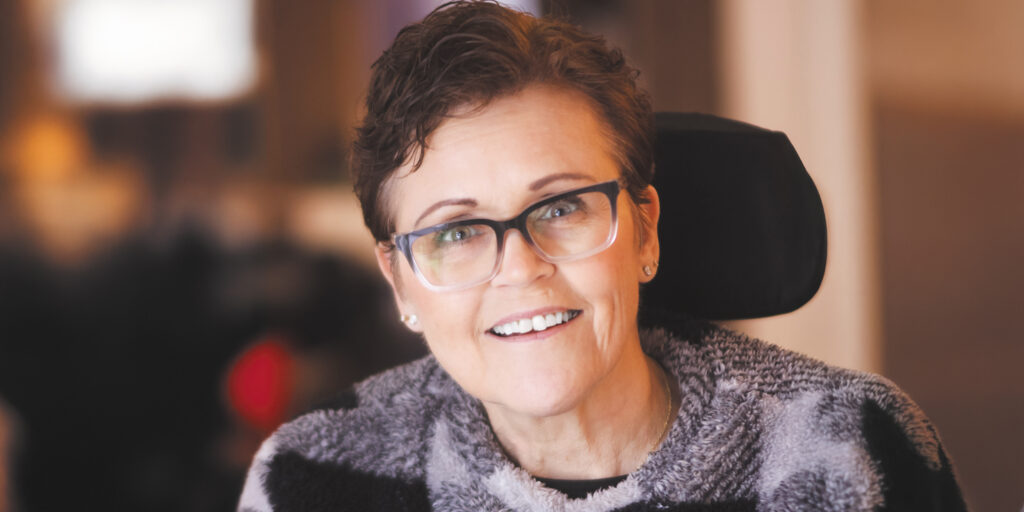
Second-Act Career: Sharon Townsend Finds Purpose in a New Role
By Rebecca Hume | Tuesday, May 26, 2026
5 Second Summary
Quest for Success explores the different paths that individuals with neuromuscular disease have taken to reach their potential and pursue dreams. This series spotlights individuals from our community and shares their journey to independence and accomplishment.
Sharon Townsend spent the first chapter of her adult life focused on creating a loving, comfortable, and happy home for her three children. Now, the 63-year-old has found a new purpose in providing the same warmth and hospitality as a Front Desk Agent at the Hampton Inn.
Getting a diagnosis
Sharon Townsend
Sharon spent the busy years of motherhood nurturing and loving her family — volunteering at classroom parties, shuttling her children to and from activities, maintaining a home, and sometimes working part-time to supplement the family income.
Shortly after her third child was born, Sharon began to have difficulty walking up stairs. At that time, her sister was also experiencing muscle weakness. Both women underwent testing and were eventually diagnosed with limb-girdle muscular dystrophy type 2B (LGMD2B).
During her kids’ school years, Sharon transitioned from using a cane and walker to using a power wheelchair. As her symptoms progressed, she struggled with depression and guilt about her disability.
“I felt like I could do everything as a parent before I lost mobility,” Sharon says. “I was always a doer. But once I needed my family’s help with things around the house, I felt more guilty the weaker I got.”
With her family’s support, she’s working on letting go of that guilt. “I always apologize for needing help, and my kids correct me,” she says. “They’ve helped me to understand that this is just part of my life, and everyone lives differently and does things differently.” Learning to accept help without apology is a lesson that she has carried into her new career.
A new chapter
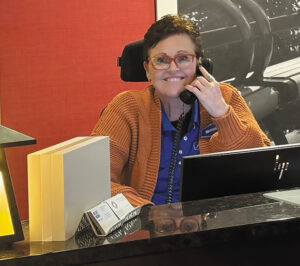
With her children grown up and out of the home, Sharon found her second calling working at a hotel front desk. “This job allows me to have one-on-one conversations, share humor, brighten someone’s day, and make connections. My personality was made for this,” she says. “This is what God wanted me to do to use my talents.”
The Office of Vocational Rehabilitation (OVR) in Indiana supported her during her job search and helped her obtain accommodations when she began working at the hotel. The front desk was modified with a cutout to fit her wheelchair and a raised keyboard. Tasks that were physically challenging, like lifting the hot coffee urns, were redelegated.
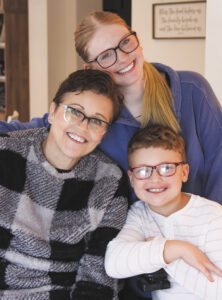
Sharon enjoys time with her grandkids.
Sharon drives a modified van to and from work and uses an elevator seat on her power wheelchair, both of which the OVR helped her obtain. As muscle weakness in her arms increased, an occupational therapist (OT) visited her job site and created a long-handled basket that Sharon uses to slide keys and credit cards across the desk when checking guests in.
“When I lift the basket, I say, ‘I am going to put your stuff in this, not bonk you on the head,’” Sharon laughs. “I try to joke with the guests. I love this job and try to stay as positive as I can. It takes me longer to do things, like getting supplies and toothbrushes from a lower drawer. I have to lower my wheelchair, and it takes a while, so I do the Jeopardy music while we wait, and they always laugh.”
Now in her ninth year at the Hampton Inn, her needs have changed over time, but her abilities and her joy in fulfilling her role have only increased.
“I love the people, the guests, and talking. I do whatever I can to make people smile because that is my goal,” Sharon says. “And I have learned to take help when I need it.”
The right resources
Using available resources has significantly increased Sharon’s independence and her ability to bring her talents to the table — or, in this case, the front desk. In addition to providing on-the-job support, OVR initially covered Sharon’s at-home care. As her needs progressed, OVR connected her with a local nonprofit that helped her enroll in the Medicaid Waiver program for long-term home and community-based care.
Sharon keeps an eye on the number of hours she works and her earned income to maintain financial eligibility, typically working 24 hours each week.
“I would work more if I could,” she says. “At work, I feel valued and appreciated. It has really helped me to gain confidence and stop being ashamed of my disability. I’m learning to accept help and not to feel guilty about it. Life is too short to be negative. I want to focus on what I can do, not what I can’t do.”
Her advice to others is to use the supports and programs available to them. “Connect with OVR, find out what programs you qualify for, and pursue any and all assistance available to you because these organizations are there to help. Take the help. Don’t feel guilty. Don’t say no. Just say thank you,” she says. “And then bring your talents out into the world.”
Rebecca Hume is a Senior Specialist and Writer for Quest Media.
Next Steps and Useful Resources
- Learn more about OVR and other Community Resources You Need to Know.
- Read Ready to Work: How People with Disabilities Balance Benefits and Employment.
- Stay up to date on Quest content! Subscribe to Quest Magazine and Newsletter.


Disclaimer: No content on this site should ever be used as a substitute for direct medical advice from your doctor or other qualified clinician.