Understanding ADSS1 or ADSSL1 Myopathy
By Michelle Jackson | Tuesday, May 26, 2026
ADSS1 myopathy (formerly known as ADSSL1 myopathy) is a very rare, genetic neuromuscular disease that causes progressive muscle weakness beginning in childhood. It’s a slowly progressive condition that affects skeletal muscles, breathing muscles, swallowing, and, sometimes, the heart.
The number of reported cases worldwide ranges from 100 to 200, but many more are believed to be undiagnosed.
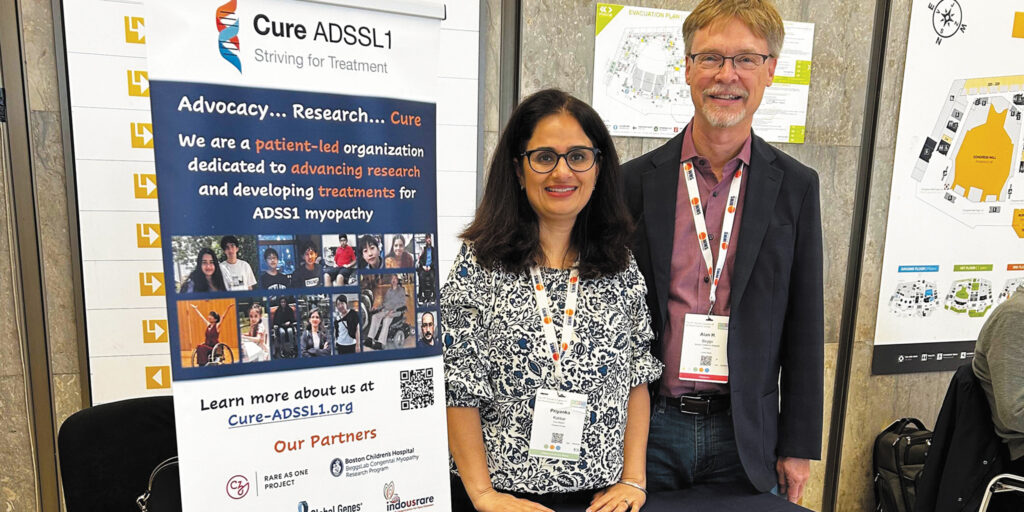
Priyanka Kakkar, whose two children live with ADSS1, shares her family’s diagnostic journey and why she believes it is important to help drive research, clinical care guidance, and global patient connection. Her experience advocating for her children led her to co-found Cure ADSSL1, a nonprofit focused on advancing research to develop treatments.
How did you become involved in ADSS1 research and advocacy?
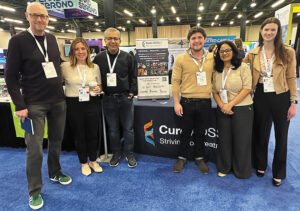
The Cure ADSSL1 team at the MDA Clinical & Scientific Conference
I got involved in 2021, when both of my children were diagnosed with this rare neuromuscular disease.
It took us 17 years to get this diagnosis through genetic testing. When our neurologist told us, he had never heard of the disease. We were handed two research papers, and that was the only information available. I came home and started searching online — trying to find other patients, hospitals that see these patients, or research that was happening. Everything led back to the same two papers.
We went to many specialized hospitals, and everywhere we heard the same thing: “Your children are the first ones we are seeing, and they might be the last ones we will see in our career.” That reality — nobody knowing this disease — was very difficult.
At the same time, I learned that rare diseases that have treatments today often got there because patient groups supported research and helped advance it. That’s when my husband and I decided we wanted to be the driving force for this disease, and we started Cure ADSSL1 in 2022.
What symptoms did you see in your children, and how does ADSS1 progress?
The first symptom we saw was in our daughter when she was 4 years old. She couldn’t run or jump like other children, and she had hypermobility (movement beyond the normal range) in her joints. When we saw a neurologist at that time, we were told she had hypotonia (low muscle tone). Genetic testing wasn’t common then, so they couldn’t find a diagnosis.
This is a slowly progressive disease. My children were able to do things, but at a slower pace than other children. It started progressing more when they were around 13 or 14 years old, which is typical.
The symptoms can get worse when patients hit puberty, and the progression rate accelerates. By around age 30, patients often need a wheelchair for mobility. Eventually, patients may need breathing assistance and a feeding tube.
How is ADSS1 managed currently?
It requires multidisciplinary care: a cardiologist, pulmonologist, neurologist, physical therapist, and speech therapist.
My children visit an MDA Care Center once a year. Getting a respiratory and cardiac evaluation every year is critical because respiratory failure is the leading cause of death in ADSS1. Patients don’t always know they need a respiratory evaluation, and we lose patients as early as their 30s or 40s because they never saw a pulmonologist.
That’s one reason Cure ADSSL1 is creating clinical care guidelines to share with patients and clinicians. Our community is spread across different countries, and not everyone has the same standard of care. We want something families can take to their doctor that explains what organs are impacted and what assessments are needed — especially for respiratory and cardiac care, because those symptoms can be life-threatening.
What research are you most hopeful about so far?
Cure ADSSL1 recently received US Food and Drug Administration (FDA) clearance to start a clinical trial for a potential therapy. For a disease with no approved treatments, this milestone means so much to our community. This drug — adenylosuccinic acid (ASA) — had already been tested in phase 1 and phase 2 trials for Duchenne muscular dystrophy (DMD) back in the 1980s, and it could potentially bypass the metabolic block caused by the ADSS1 gene mutation.
We are starting small with a two-patient phase 1 trial. But once safety is proven, we want to expand it to more patients, and we’re applying for grants to do that.
For our small patient-led organization, navigating drug development, regulatory approval, and trial sponsorship has been both daunting and rewarding.
What would you tell someone who has been diagnosed with a rare disease?
Getting diagnosed with a disease your doctors might not understand — and where there’s very little information — can be overwhelming. Join patient groups and connect. It doesn’t change the diagnosis, but it changes the way you live with it. You can share what helps and stay updated on research.
Second, participate in research as much as possible. For ultra-rare diseases, every data point and every patient matters. Many times, studies don’t go well because there aren’t enough patients. Participation is one of the only ways to advance research.
Michelle Jackson is a writer for Quest Media.
Next Steps and Useful Resources
- Read more of the Quest Spotlight series on rare diseases.
- Stay up to date on Quest content! Subscribe to Quest Magazine and Newsletter.


Disclaimer: No content on this site should ever be used as a substitute for direct medical advice from your doctor or other qualified clinician.