Life with Lily: My Favorite Accessible Fashion & Beauty Tips
By Lily Sander | Tuesday, June 23, 2026
5 Second Summary
MDA Ambassadors play an essential role in furthering MDA’s mission while representing and empowering the neuromuscular disease community. Quest Ambassador Guest Blog series provides a platform to share their personal stories, perspectives, and experience
Hello!
In this blog, I’m sharing accessible beauty and fashion tips I’ve collected through plenty of trial and error. Beauty and fashion are major forms of self-expression for me, and I know I’m not alone in that. People with disabilities deserve to present themselves to the world in whatever way feels authentic and comfortable to them. Unfortunately, accessibility can often be a barrier to that self-expression.
The good news is that beauty and fashion are becoming increasingly accessible as brands adapt and innovate to create products that more people can enjoy. Many of the products I’ll mention were created by disabled founders, meaning their designs reflect real lived experiences and genuine community needs. After all, the disability community’s motto, “Nothing about us, without us,” belongs in beauty and fashion, too.
Rare Beauty
Lily Sander, MDA National Ambassador
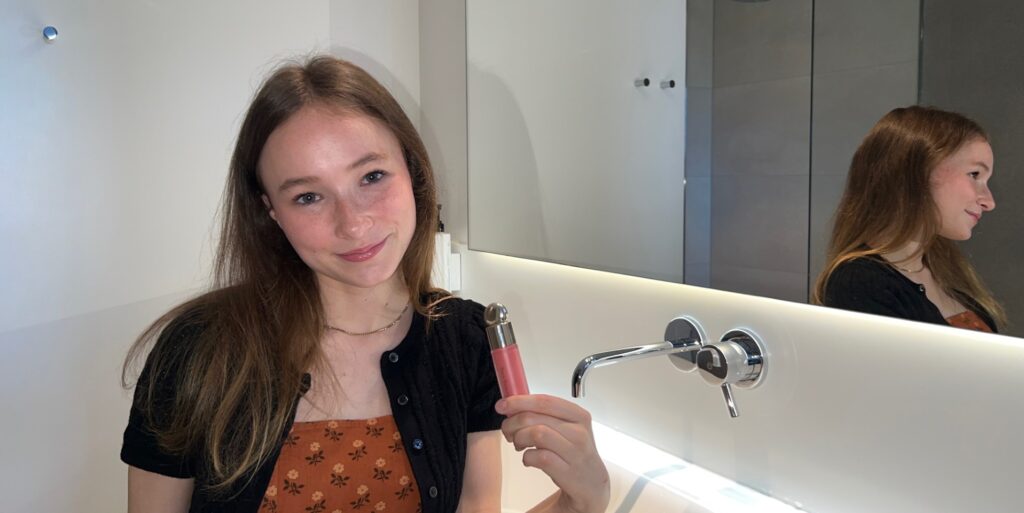
First on my list is Rare Beauty. Founder Selena Gomez lives with lupus, and her own experiences with dexterity challenges inspired her to design products with accessibility in mind. My favorites, not only because of their formulas but also because of their thoughtful packaging, are the Soft Pinch Liquid Blush, Soft Pinch Tinted Lip Oil, Stay Vulnerable Glossy Lip Balm, and Rare Eau de Parfum.
The blush features a spherical cap that provides extra grip, making it easy to open. The lid requires little force to twist off, and the rounded top makes it much easier to hold securely.
Like the blush, the lip oil has a spherical cap and an easy-twist design. It is slightly smaller in circumference, making it a bit harder to hold, but it is still significantly easier to grip than many comparable products.
Stay Vulnerable Glossy Lip Balm
The Stay Vulnerable Glossy Lip Balm has a unique semi-circular shape that makes twisting it open easier. Plus, the flat bottom keeps it from rolling off a countertop or vanity—a small but appreciated accessibility feature.
Rare Beauty’s fragrance, appropriately named “Rare,” gets bonus points from me as someone living with a rare disease. The bottle features a large circular top that can be pressed using a palm, finger, wrist, elbow, or whatever works best for you. I haven’t actually smelled the fragrance yet, so I can’t comment on the scent itself, but it’s already in my cart because I won’t have to wrestle with the tiny spray nozzles on most perfume bottles.
Tilt Beauty
Staying on the beauty train, let’s talk about Tilt Beauty. Founder Aerin Glazer, who lives with psoriatic arthritis, created the brand after experiencing the frustration of traditional beauty packaging that was painful and difficult to use.
My favorite products are the mascara, lip stick, lip liner, and lip gloss. Their packaging is made with soft-touch silicone and designed with larger, ergonomic shapes that are easier to grip and control. An added bonus? Their larger size makes them much easier to find in a purse or makeup bag.
Guide Beauty
Rounding out the makeup section is Guide Beauty. Their makeup brushes and eyeliner tools feature spherical bases that fit comfortably in the hand and provide a more secure grip. The design allows for easier handling and more precise makeup application.
Hair
When it comes to hair, I’ve struggled with holding and clamping traditional flat irons. Enter the Revlon One-Step Volumizer.
The ergonomic handle is much easier to hold, and because it combines a blow dryer and styling brush into one tool, it replaces both a hair dryer and a flat iron for me. The multifunctionality means less time styling and fewer tools to manage. Plus, it gives incredible blowouts.
Jewelry
Moving into fashion, magnetic jewelry clasps have been life-changing.
For years, I struggled to put on necklaces and bracelets. The process was frustrating, time-consuming, and often discouraging. I didn’t want to rely on someone else because I enjoy experimenting with different pieces and changing my mind based on my outfit.
Independence looks different for everyone, but for me, being able to accessorize on my own is important.
At first, I searched for jewelry with built-in magnetic clasps, but that limited my options and didn’t solve the problem of the jewelry I already owned. Eventually, I discovered magnetic clasp converters that can be added to almost any necklace or bracelet.
I’ll admit I was skeptical. I worried they would come undone too easily. Instead, I’ve been impressed by how securely they stay fastened while still being incredibly easy to remove when I want to take them off.
Side note: after helping me add magnetic clasps to my jewelry, my able-bodied mom loved the convenience so much that she magnetized her entire collection, too—which, of course, makes it much easier for me to borrow (universal accessibility for the win)!
Earrings
Similarly, earrings used to be my worst enemy. Trying to line up a tiny earring post with an even tinier backing was incredibly frustrating, and eventually I stopped wearing earrings altogether.
That changed when I tried hoop earrings and other styles with built-in closures. They eliminate the need to fumble with tiny backs, making them much easier to put on independently. Another accessibility win. Bonus? Chunky hoop earrings are having a moment right now.
Liberare
My final recommendation is the Liberare Accessible Front Closure Bra.
Designed and extensively tested by disabled people, the bra features a magnetic front closure with finger loops for easier gripping. The magnets are incredibly secure while you’re wearing the bra but release easily when you’re ready to take it off. It honestly feels a little like magic.
Liberare recently expanded their designs, offering more styles and colors while maintaining the same accessible features. They also make magnetic adaptive underwear designed to make dressing easier, including for people who dress while seated.
One thing I especially love about Liberare is that they use disabled models in their campaigns. Representation matters, and it’s refreshing to see a brand designing products for disabled people while also showcasing disabled people. Their products prove that adaptive clothing can be both functional and stylish, challenging the outdated idea that accessibility and fashion can’t coexist.
Accessible fashion is often designed primarily for older adults, which is an important market, but younger disabled people deserve options that reflect their personalities and style as well. Liberare helps fill that gap.
I hope these beauty and fashion tips were helpful! I’d love to hear if you try any of these products and how they work for you. These recommendations meet my own accessibility needs, particularly around hand weakness and dexterity challenges, but everyone’s needs are different.
It has been incredible to witness the fashion and beauty industry’s commitment to innovating accessible products, making these forms of expression easier for our community to engage with. It is my sincere hope that companies recognize the value in the beauty and creativity disabled people have always expressed and continue to innovate to make fashion and beauty even more accessible.
If you have any favorite accessible products or hacks, please share them! The best recommendations often come from the disability community itself.
Here’s to getting ready with confidence and independence!
Next Steps and Useful Resources
- For more information about Charcot-Marie-Tooth disease (CMT), a full list of symptoms and causes can be found here.
- MDA’s Resource Center provides support, guidance, and resources for patients and families, including information about exon skipping therapies, open clinical trials, and other services. Contact the MDA Resource Center at 1-833-ASK-MDA1 or ResourceCenter@mdausa.org.
- To learn more about MDA’s Young Adult Programs, visit here.
- Stay up-to-date on Quest content! Subscribe to Quest Magazine and Newsletter.


Disclaimer: No content on this site should ever be used as a substitute for direct medical advice from your doctor or other qualified clinician.