
MDA Ambassador Guest Blog: What the Disability Movement Means to Me
By Callie Hall | Tuesday, July 21, 2026
5 Second Summary
MDA Ambassadors play an essential role in furthering MDA’s mission while representing and empowering the neuromuscular disease community. Quest Ambassador Guest Blog series provides a platform to share their personal stories, perspectives, and experience.
Callie Hall lives in Orlando Florida and lives with a unique neuromuscular disability. She is passionate about disability rights, bluegrass mandolin, and being outdoors.
RIIIIIIIING the school bell signals the end of the class period. My teacher says, “Alright everyone, we have finished our week of learning about all the Civil Rights Movements.” Chairs shift and backpacks are zipped up but I stay where I am, the question is still bothering me. As the crowd of students file out, I go up to my teacher and ask, “When are we learning about the Disability Rights Movement?” My teacher responds that he is not sure if it happened in the timeline we are learning. I go to Spanish, Physics, and Guitar class and the question still bothers me. I know that there is disability parking. I know that some of my classmates get extra time on tests. I know that there is an elevator in my school for me to get around. But I guess they haven’t always been there. Something about ADA? When I get home, I indulge my curiosity and start researching.

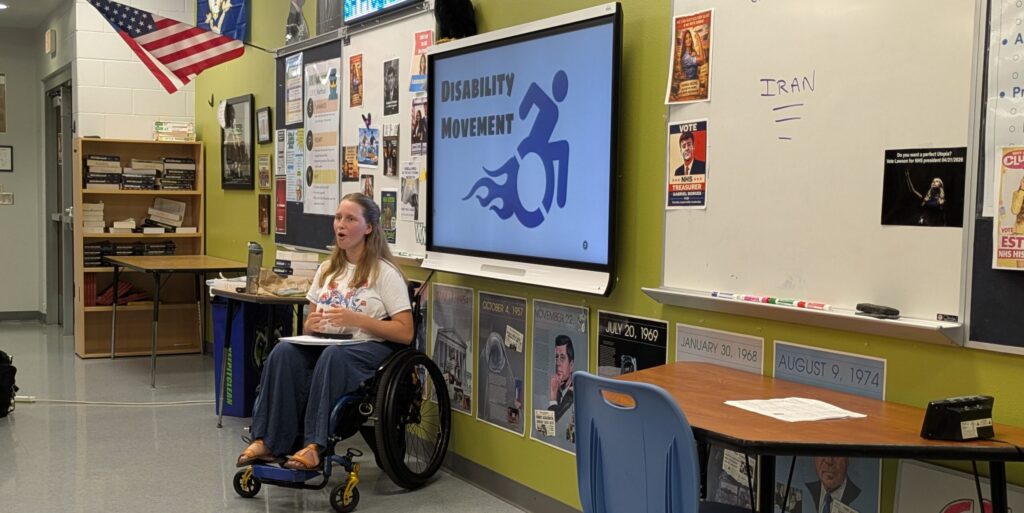
Callie Hall leads a classroom discussion on the history of the Disability Rights Movement.
Twenty percent of Americans have a disability, accounting for the largest minority in the United States. In early Native American culture, people with disabilities were seen as having a closer connection with the spirits and were honored in many ways. The American Industrial era of the late 1800s brought with it a highly destructive view of disability. It was the era of the Eugenics movement and laws known as the “Ugly Laws” that allowed for arresting someone in public for being visibly disabled. However, disabled people in America have been advocating for themselves for more than a hundred years.
The first documented sit-in of a government building in America happened in 1935 by the League of the Physically Handicapped. Organizations such as the Center for Independent Living, built by disabled people for disabled people, came together to support each other and make change.
This was incredible to learn, a history that I had known nothing about. My history. I eagerly went back to my teacher. “Could I teach the Disability Movement to our class?” I asked him. He agreed and I went to work polishing up my facts, making a slideshow, and practicing how I would present it to the class.
“Camp Jened was a camp run by hippies during the 1960s and 70s in the Catskill Mountains of New York. It was a summer camp for people with disabilities. Kids like Judy Huemann, Bobbi Lin, and Jim LeBrecht enjoyed camp and realized that life could be better for them. At the time Judy, a wheelchair user, had initially not been able to go to school because she was considered a fire hazard. Between lack of curb cuts to steep stairs, the barriers were everywhere. In 1972, the Rehabilitation Act was introduced. Hidden towards the end of the bill was section 504. It was a short paragraph requiring accessibility in federally funded buildings like public schools. It would allow disabled people a freedom they had never had before. And Nixon vetoed it. In protest, a group of disabled people, including Judy Huemann and many other former campers from Camp Jened stopped traffic. They stood in the road of Madison Avenue during rush hour in New York City to make their voices heard. Finally, in 1973, the Rehabilitation Act was signed. It wasn’t until 1977 that it was actually enforced, after many sit-ins at government buildings, including the longest peaceful sit-in in US history that took place in San Francisco, California and lasted 26 days.”
The day arrived for me to teach. I took a deep breath and began my presentation.
“The Americans with Disabilities Act, better known as the ADA, would be life changing for people with disabilities. The ADA would apply the regulations outlined in Section 504 of the Rehabilitation Act of 1973 for schools and federally funded buildings to grocery stores, movie theaters, and anywhere open to the public. On March 12th, 1990, disabled people came together to advocate for the ADA in what is now known as the Capitol Crawl. More than 1000 people with various disabilities proceeded from the White House to the Capitol building. People with mobility aids put aside their walkers and wheelchairs and began to make their way up the stairs as the law was being debated. It was beautiful and symbolic to show not only how next to impossible it was for disabled people to get around their existing world, but also how difficult it was to have their voice heard in government. 8-year-old Jennifer Keelan climbed up those 83 steps saying, ‘I’ll take all night if I have to.’ The ADA was signed into law. Without courageous heroes like Judy Heumann, Bobbi Lin, and Jennifer Keelan, without the ADA, without Section 504… I wouldn’t be here, on the second floor of our school, teaching about the Disability Movement.”
I taught every class period that day. It was amazing to see how my message touched so many disabled and non-disabled people as they came to talk to me at the end of each class. The next year, my senior year, I taught it again. Now, having just graduated from high school, I am teaching and giving the lesson to upcoming juniors to teach next year when I’m gone. To bring to life the story of disabled people. To help students never see a ramp the same way. The story of The Disability Movement is bold, powerful, and we must teach it. It is my dream for The Disability Movement to be taught in every school across America and eventually the world. To continue to advocate for our rights. And I’ll take all night if I have to.
Next Steps and Useful Resources
- Visit the MDA Advocacy Action Center to learn about current issues and how you can help advocate for public policies that support people with disabilities.
- Read more about the Rehabilitation Act of 1973.
- To learn more about the Americans with Disabilities Act (ADA), visit here.
- Browse recent updates to Section 504.
- MDA’s Resource Center provides support, guidance, and resources for patients and families. Contact the MDA Resource Center at 1-833-ASK-MDA1 or ResourceCenter@mdausa.org
- Stay up-to-date on Quest content! Subscribe to Quest Magazine and Newsletter.


Disclaimer: No content on this site should ever be used as a substitute for direct medical advice from your doctor or other qualified clinician.