New Myotubular Myopathy Clinical Trial May Lead to Safer Gene Therapy
By Amy Bernstein | Thursday, August 13, 2026
5 Second Summary
Gene therapies are increasingly available for muscular dystrophies and other neuromuscular diseases. My Gene Therapy Journey is a Quest Media series that gives members of the neuromuscular community a platform to share their experiences with gene therapies — both approved therapies and those in clinical trials — and provides essential information to help individuals and families make decisions about gene therapies.
At 10 months old, Stevie touched his feet for the first time. Before this moment, he did not exhibit any of the typical motor skills for his age. He could not sit up on his own, crawl, or pick up toys.
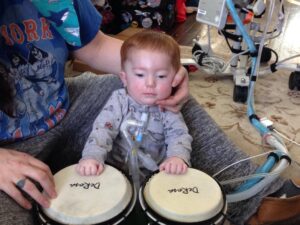
Stevie in 2018
Stevie was born with myotubular myopathy (MTM, also called X-linked myotubular myopathy, or XLMTM), a rare hereditary muscle disorder that can cause severe muscle weakness and life-threatening difficulties with breathing and feeding.
“This is a devastating disease. Traditionally, it’s been said that as many as half of children born with MTM don’t survive past the age of 2,” says Alan Beggs, PhD, Director of the Manton Center for Orphan Disease Research at Boston Children’s Hospital.
After his birth in 2017, Stevie needed a ventilator and feeding tube. When Stevie was diagnosed with MTM at 2 months old, his parents were told he had a life expectancy of 29 months.
“It was like we weren’t really supposed to hope, but I did,” says Stevie’s mother, Ann Skaats. She researched everything she could about the disease and found a clinical trial testing an experimental gene therapy for MTM. She immediately emailed the company sponsoring it and talked with Stevie’s doctor.

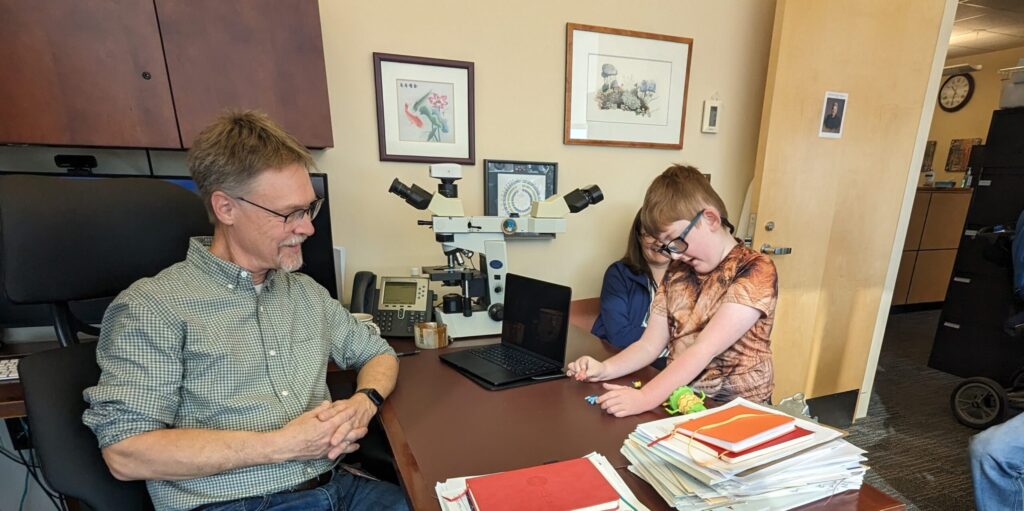
Alan Beggs, PhD
Stevie had a genetic test to confirm his MTM diagnosis (the initial diagnosis was made from a muscle biopsy) and was enrolled in the clinical trial, called ASPIRO.
“We were accepted into the trial with the potential of going to the treatment phase,” Ann explains. “It wasn’t a guarantee that he would get treated.”
However, in April 2018, Stevie became the sixth baby treated in the ASPIRO trial.
Preclinical studies of the gene therapy had been promising, but ASPIRO was the first time the experimental therapy was given to humans. Stevie’s parents didn’t know if the therapy would help him breathe or move. Even researchers didn’t know what to expect.
“Despite everything looking wonderful in our animal models, they are not people, and you never really know how things are going to translate until you can try them in a real patient,” Dr. Beggs says.
Fortunately, the therapy was effective for Stevie.
“Before Stevie was treated, his intentional movement was very minimal,” Ann says. “And he couldn’t be in a sitting position, even with the ventilator, for more than 15 minutes at a time.”
After he received the one-time gene therapy infusion, Ann watched him touch his feet for the first time, and she noticed that she didn’t need to suction Stevie’s tracheostomy as often — a sign that his breathing muscles were working better.
Stevie gradually gained more function and strength, beginning to breathe without the ventilator during the day about a month after the therapy, then going fully off the ventilator and having his tracheostomy tube removed six months later. As he grew into a toddler and then a school-age child, he learned to walk and climb stairs.
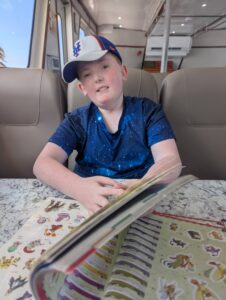
Stevie in 2026
Today, at 8 years old, Stevie can walk, although he tires quickly and uses a wheelchair due to challenges with balance and spatial reasoning. He continues to breathe on his own and eat solid foods.
While the experimental gene therapy made a big difference for Stevie, it was not as effective for every child in the clinical trial. Some had milder benefits, although all participants had improvements in breathing. And, tragically, four children died due to liver complications. The ASPIRO trial was stopped in 2021.
This led researchers to learn about previously unrecognized liver issues associated with MTM. Armed with this knowledge and knowing that the therapy has the potential to deliver dramatic improvements for babies with MTM, like Stevie, researchers persevered. Drug developer Astellas Gene Therapies is sponsoring a new phase 1/2 MTM gene therapy clinical trial called VALOR, which builds on the experience in the former trial. It is testing a more potent gene therapy candidate that researchers hope will deliver disease-modifying benefits at lower doses without endangering the liver.
Learning about MTM and the liver
MTM is caused by mutations in the MTM1 gene, which is responsible for producing myotubularin, a protein that is essential for muscle development. The disease is known to cause muscle weakness, but after the gene therapy trial was halted, the research community focused on trying to understand how MTM affects the liver.
In MDA-supported studies by the Jim Dowling Laboratory at Toronto SickKids Hospital (now at the University of Pennsylvania and Children’s Hospital of Philadelphia), scientists examined zebrafish that were missing a working MTM1 gene. In these fish, bile (a liquid made in the liver) became backed up instead of flowing normally. This is called choleostasis. Replacing the myotubularin protein in the fish fixed the problem.
In 2023, they published their finding that myotubularin is not just essential for muscles but also for proper liver function.
“Sometimes patients can have susceptibilities that we’re not aware of ahead of time, and in this particular disease, we now understand that the liver is sick in a different way than the muscle,” Dr. Beggs says.
The ASPIRO clinical trial used a naturally occurring adeno-associated virus (AAV) as a vector to deliver a healthy MTM1 gene into muscle cells. These viruses don’t make people sick, but they do enter the body’s cells and bloodstream. Because the liver plays a critical role in filtering toxins, including viruses, from the blood, a lot of the AAV enters the liver.
“When we do a gene therapy infusion, we’re pumping as much as a million times more virus into the bloodstream than you or I ever encounter in the course of normal living,” Dr. Beggs explains. “Because of the way the blood flows, a lot of the virus ends up in the liver and then eventually gets broken down and excreted.”
Three of the deaths in the ASPIRO clinical trial occurred in participants who received higher doses. Researchers now believe that the heavy virus load in an already weakened liver may have overloaded the organ.
Developing a better AAV
In a separate scientific advancement at the Broad Institute in Cambridge, Massachusetts, researcher Sharif Tabebordbar, PhD, had been developing a novel AAV vector, named MyoAAV, that targets muscles more specifically and is safer for the liver. Dr. Tabebordbar approached Dr. Beggs about using MyoAAV as a delivery method for a new MTM gene therapy.
They started by testing the new therapy in mouse models and showed that it successfully treated MTM1 mice at doses 50-100 times lower than with the standard AAV used in the ASPIRO trial.
In 2020, Dr. Tabebordbar and Dr. Beggs helped form a new company, Kate Therapeutics, to develop MyoAAV to treat neuromuscular diseases, including MTM. The MyoAAV-MTM program was subsequently licensed to Astellas Gene Therapies, which had inherited responsibility for the first ASPIRO trial, and became the basis for the VALOR clinical trial that started this year with a small number of participants.
“The virus that we did the preclinical work with, which MDA supported, led directly to what’s being used in the VALOR trial,” Dr. Beggs says.
Hope for the new MTM clinical trial
In addition to developing a gene therapy using MyoAAV, which researchers hope will be safer, the VALOR trial has a couple of other important differences.
Researchers revamped their candidate screening process to find participants who are at lower risk from AAV gene therapy and may get the most benefit. The new trial enrolls only patients up to 3 years old who are screened to ensure they have no preexisting liver issues.
Also, the VALOR trial will use much lower doses than the previous trial. This should protect the liver by giving it less virus to process. MyoAAV’s ability to target muscle cells means low doses are likely to be effective.
“The innovation is that, because it’s so much more effective at targeting the muscle, we can give 50 to 100 times less of the virus, so there should be much less that’s going to the liver,” Dr. Beggs says.
Astellas plans to report data from the VALOR trial in October 2027. The results could have implications for gene therapies for other muscle diseases. For example, liver toxicity has also led to adverse reactions in some Duchenne muscular dystrophy (DMD) gene therapy clinical trials. A safer, more effective way of delivering gene therapy to muscle cells without overloading the liver would be a breakthrough for this and other diseases.
The importance of clinical trials
Ann approached Stevie’s clinical trial knowing that he might not receive the experimental therapy and, if he did, the effects could be unpredictable. She also understands that, because AAV gene therapy is a one-time treatment that cannot be repeated, Stevie cannot enter another gene therapy clinical trial or receive a gene therapy if one is eventually approved. Still, she’s grateful her family chose to enroll in the trial.
The value went beyond the experimental therapy’s impact on Stevie — it also benefited the neuromuscular disease community. The ASPIRO trial led researchers to discover how a muscle disease can also affect the liver, and it showed that a gene therapy for MTM could improve critical outcome measures, including breathing. These lessons may translate to other diseases, eventually leading to more therapies.
“Each family’s contributions are critical,” Dr. Beggs says. “This is a very personal decision for them — and only them — to make. They shouldn’t ever feel any pressure to enroll or join in something like this. If they do, our hope is that they will benefit. And we are certain that the community will benefit, because the only way to make progress is to do these studies.”
Next Steps and Useful Resources
- MDA’s Gene Therapy Support Network provides education, resources, and access to Gene Therapy Support Specialists.
- Watch an MDA Virtual Learning webinar on Next-Generation Genetic Medicines
- Stay up to date on Quest content! Subscribe to Quest Magazine and Newsletter.


Disclaimer: No content on this site should ever be used as a substitute for direct medical advice from your doctor or other qualified clinician.