MDA Ambassador Guest Blog: Adapting and Prioritizing a Healthy Lifestyle as I Age
By Leslie Krongold, Ed.D. | Thursday, January 15, 2026
5 Second Summary
MDA Ambassadors play an essential role in furthering MDA’s mission while representing and empowering the neuromuscular disease community. Quest Ambassador Guest Blog series provides a platform to share their personal stories, perspectives, and experience.
Leslie Krongold is 63 years old and lives in Mendocino, California where she keeps busy with several volunteer and DIY activities including peer counseling, facilitating online support groups, and organizing accessible walk and roll activities. She was diagnosed at 36 years old with myotonic dystrophy type 1 and has been using a walker at home and a power wheelchair outside for the last few years.
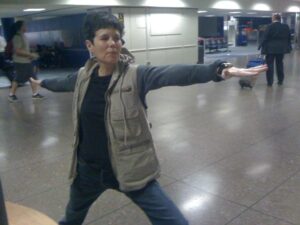
Leslie practicing yoga
It’s hard to imagine there’s a photo from only 15 years ago of myself doing the yoga warrior pose in an airport waiting to board an international flight. When I first received my diagnosis of myotonic dystrophy type 1 (DM1) at 36 years old, I would tell people yoga was my primary treatment modality, along with a vegetarian-based diet and positive attitude. Now, as a senior of 63, I can no longer do a standing warrior pose, nor do I have the arm range of motion to do a seated version.
This is just one of the losses that I deal with living with DM1, a progressive multi-systemic disorder. I often question if a new normal is part of DM or just the aging process.
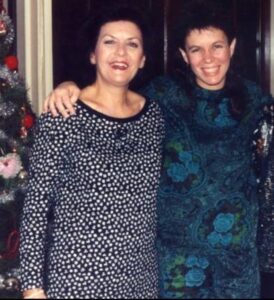
Leslie and her mother mid-1980’s
I’m grateful to experience aging as I can recall the first brochure I read about this condition listed expected lifespan of 48 – 55 years. I didn’t question it at the time since my mother had passed at 55 years old and due to anticipation (the expansion of the CTG nucleotide sequence for successive generations resulting in more severe symptoms for progeny ), I didn’t expect to live beyond 55. So, how did I get so lucky to age beyond that expectation?
One thing I know for sure is that I try to focus on what I still can do. And there is plenty. It’s not as if I ignore the changes, but I try my best to adjust to them and mitigate their impact. I’m still tweaking that exercise-diet-attitude algorithm that’s worked for me so far.
Adopting and adapting a healthy lifestyle
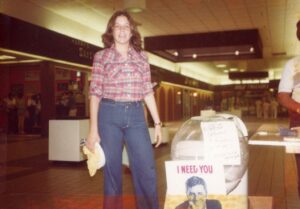
Leslie organized a MDA Dance Marathon in 1978
During my youth I did not participate in sports or any formal exercise, but I did love to dance. Growing up in the 70s, I appreciated the disco craze. That music still gets me moving now – whether I’m seated or at my barre stand. Sometime after college, I had my first introduction to yoga and I gradually became more disciplined. I practiced all types of yoga and eventually tai chi, Pilates, and most recently gyrokinesis. There are lots of online opportunities to practice adaptive, or seated, versions of these movement modes.
Also, while in high school, I began to question my diet. Over several years, I decided that a vegetarian diet was best suited for me. My body just felt better. As I’ve aged and a garden variety of endocrine issues have presented themselves, I’ve made modifications with supplements and even omega 3s, or fish oil.
As I age, I prioritize maintaining an adapted exercise routine and health-conscious diet even more.
Connecting with and helping others
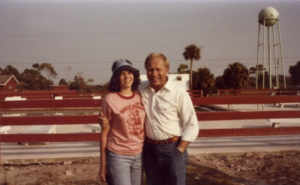
Leslie as a MDA camp counselor in Florida with Chuck Zink
When I was first diagnosed, I wasted no time in contacting the local MDA office in San Francisco. I had the unusual privilege of being an MDA Summer Camp volunteer counselor in high school without any knowledge that DM1 was in my genetic makeup. Volunteering for MDA was a pivotal experience for me, and I was more than aware of the irony.
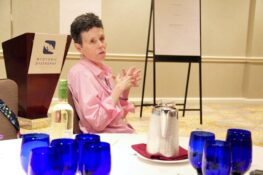
Leslie as an Outreach Coordinator
Nearly 30 years ago, after a few MDA support group meetings, I was asked to become a facilitator though nothing in my previous education or experience prepared me for it.
I took this role seriously. I learned so much by interacting with many families impacted by neuromuscular disease. Had it not been for MDA, I would not have crossed paths with many of these people due to so many differences, yet we bonded over our shared challenges and grew to respect and even love one another.
Practicing and promoting healthy behaviors
Eventually I returned to school to pursue a different direction than my undergraduate school of the arts. I spent five years researching health education and wrote a doctoral dissertation titled Professional and lay facilitators’ perceptions of roles, goals, and strategies to promote social support and self-management in face-to-face support groups for adults with multiple sclerosis and myotonic muscular dystrophy.
Quite a mouthful, but the research process led me to the concept of Self-Management Health Behaviors, which I’d been unknowingly practicing prior to diagnosis and subsequently promoting in the MDA in-person groups I facilitated and the current online groups I lead.
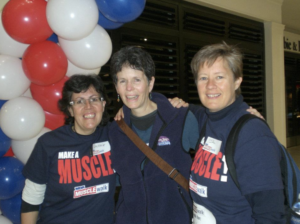
Leslie with two friends at an MDA “Walk and Roll”
Self-management is a set of behaviors to help a person manage their own illness in addition to what medical care provides. Numerous research studies of people with different chronic conditions – asthma, diabetes, cardiovascular disease, cancer, and HIV/AIDS – have identified specific areas of health behavior that can be managed by the patient. These self-managed health behaviors include exercise, nutrition and diet, medications, breathing techniques, and symptom management for fatigue, pain, stress, and emotions. Prior research suggests that promotion and practice of self-management behaviors for people with chronic health conditions have resulted in better functional outcomes such as increased physical activity, weight loss, and fewer hospital stays and physician visits.
Staying active and building community
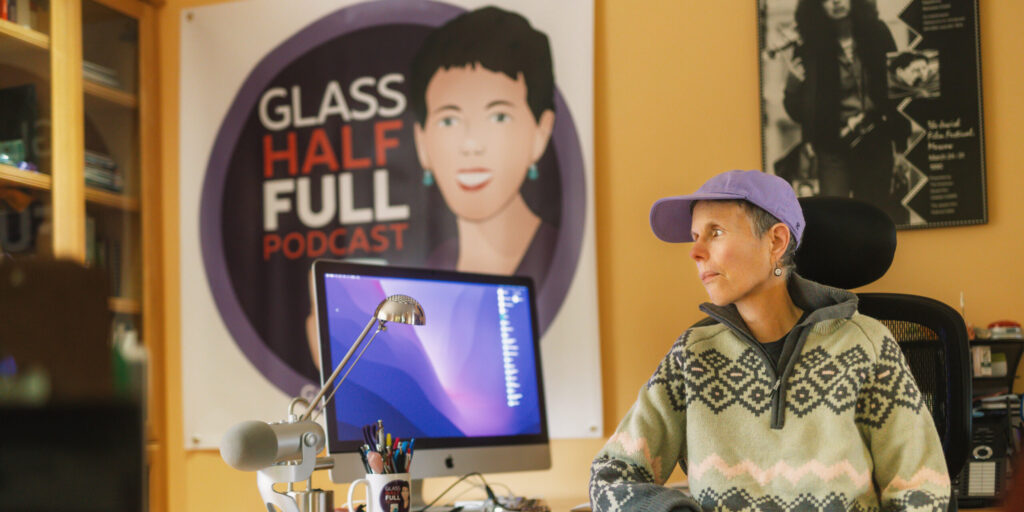
While these support groups laid the groundwork for my newfound life purpose, focusing on self-managed health behaviors and teaching others gave me the confidence to create other DIY opportunities that give my life continued quality and purpose. When my career transitioned and my wage-earning capability lessened, I produced a podcast series called Glass Half Full, started an online May Movement Challenge during COVID, and launched a program called Leslie’s Accessible Walks (LAW) with a variety of partners from CalParks biologists to local historians, muralists, and gardeners.
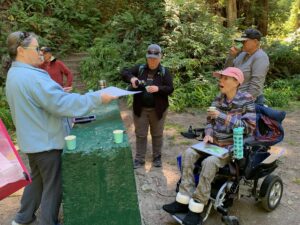
A meeting of Leslie’s L.A.W. Program (Leslie’s Accessible Walks)
Shortly after I moved to Mendocino in 2021 – a northern rural California town – I began falling more frequently and needed mobility assistance with a walker but soon upgraded to a power wheelchair. The natural beauty of the mountains and coast was my magnet to this location, but I soon realized how limited the access is in parks and historical sites. I started a free walk and roll program and named it LAW. The program offers accessible walking adventures along accessible coastal routes, creating community through relaxed strolls and an opportunity to appreciate the areas beautiful scenery.
Although my warrior pose has lost some of its zing, my internal warrior keeps me going to face the new challenges with grace and veracity.
Next Steps and Useful Resources
- For more information about Myotonic dystrophy (DM), a full list of symptoms and causes can be found here.
- MDA’s Resource Center provides support, guidance, and resources for patients and families, including information about exon skipping therapies, open clinical trials, and other services. Contact the MDA Resource Center at 1-833-ASK-MDA1 or ResourceCenter@mdausa.org.
- Browse MDA’s Mental Health Hub.
- MDA’s Resource Center provides support, guidance, and resources for patients and families. Contact the MDA Resource Center at 1-833-ASK-MDA1 or ResourceCenter@mdausa.org
- Stay up-to-date on Quest content! Subscribe to Quest Magazine and Newsletter.


Disclaimer: No content on this site should ever be used as a substitute for direct medical advice from your doctor or other qualified clinician.