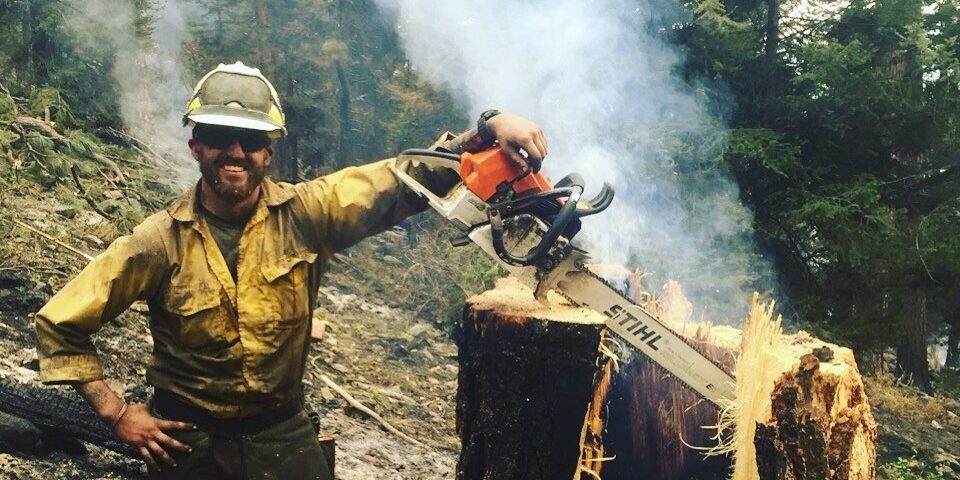
Wildland Fire Fighter Refuses to Allow Diagnosis to Define His Life
By Rebecca Hume | Tuesday, March 24, 2026
When Tyler Long was diagnosed with facioscapulohumeral muscular dystrophy (FSHD) during his senior year of high school, doctors advised him that this diagnosis meant that he should plan his future around a “non-strenuous” lifestyle. For the active and athletic outdoorsman, this suggestion wasn’t in alignment with how he saw himself and how he wanted to live his life. Time spent in Montana’s majestic and rugged wilderness was an intrinsic part of Tyler’s identity and he couldn’t imagine adopting a lifestyle that would limit his time and activities in the great outdoors. As he processed his diagnosis, and the impact that it might have on his future, he made the decision that he would not allow anyone else to define his limitations – or his lifepath.
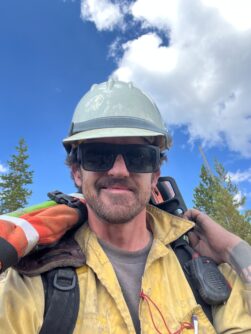
Wildland fire fighter Tyler Long.
“The doctor told me I should live an easy-going, non-strenuous lifestyle, and to me that meant giving up the outdoor activities of hunting, fishing, snow mobiles, skiing, ice fishing, and other adventures. Changing my lifestyle would change my whole life and change me from the person I am – and that didn’t align with me,” Tyler says. “In my mind, I rejected that. That is not me, not who I am, and I am going to do what I can while I can for as long as I can.”
That determination paved the way for Tyler to pursue the career of his dreams. Now, the 34-year-old is in his tenth year serving as a US Forest Service Wildland Fire Fighter on the Missoula Helitack team for Region 1 of the Lolo National Forest in Montana. As a Squad Leader, he trains and guides his team on initial attack responses, large fire support, search and rescue missions, and project work throughout the region and utilizing the squad’s two helicopters for large fire support and resource prepositioning across the western United States.
Decisions and determination after diagnosis
Tyler’s first symptoms during his junior year of high school consisted of painful “stingers” in his shoulders on the football field. Around that same time, he was working at a saw shop that also specialized in outdoor power equipment, deck set ups, and delivery and removal of hot tubs. After a shoulder injury while moving a hot tub, he noticed that he failed to regain full range of motion. His mother, who worked as a medical assistant and paramedic, brought him to his doctor – who noticed muscle atrophy, scapular winging, and limited range of motion. After a referral to a neurologist and painful nerve conduction tests, doctors initially suspected that Tyler had amyotrophic lateral sclerosis (ALS). His mother pushed back on the suggestion, noting the scapular winging, and they continued to pursue testing which eventually revealed the accurate diagnosis of FSHD.
“The process was unnerving – no pun intended,” Tyler says. And although the diagnosing doctor advised him that life with FSHD would mean limiting his activity, Tyler felt both relief that the ALS diagnosis had been erroneous and determination that he would not allow FSHD to define him. “I wasn’t sure exactly what I wanted to do with my future, but that experience solidified my decision that I wasn’t going to just “take it easy” with my life and that I wanted to work outside.”
Having moved to Montana when he was six years old, Tyler’s childhood was shaped by the outdoors and his interest in wildland fire fighting began early. He recalls seeing helicopters flying overhead in the summer as a teenager and realizing that wildland firefighting was a career that he was interested in. His dad, who passed away when he was eight years old, was a career structure fire fighter. Tyler followed those footsteps and began working as an emergency fire fighter when he was sixteen. As he contemplated where his future would lead after graduation, those passions pointed him in a direction that he was determined to follow.
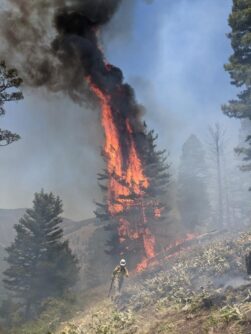
Tyler navigating an initial attack at a forest fire in Rock Creek, MT.
Tyler enrolled in the University of Montana (UM), where he joined the Forestry Club and Woodsmen Team as he pursued his Bachelor of Science in forestry with a minor in wildland fire management.
Chasing the dream and finding his team
While he was in college at UM, Tyler joined the fire crew for the Tally Lake Ranger District through a seasonal field/fire position for students. He spent five summers on the crew – and did not disclose his diagnosis until his last season.
“I was hesitant to share my diagnosis,” Tyler says. “There were people who would ask me about my shoulders occasionally. At that time, my right shoulder was affected more and you could see that they weren’t symmetrical. I started divulging a little, but I was more open with my peers than my supervisors. When I finally told my supervisor, he was like okay well that explains your push-ups and pull-ups, but you are still able to do the job.”
Tyler says that his biggest limitations, both then and now, are his physical testing capabilities when it comes to push ups and pull ups. Fire crews have a fitness challenge baseline that includes pull ups, which Tyler is not capable of doing. Now that his supervisors are aware of his diagnosis, he does a flex arm hang instead. He also executes modified push-ups with his knees on the ground. Limited range of motion and shoulder muscle weakness also make it difficult to lift heavy objects over his head.
“This job isn’t a job where you have to do a lot of these things by yourself though,” he says. “We often move heavy things from A to B, but you have a team and you work together. We all work together and we find those weak links and accessorize them with each other’s strengths.”
His tasks at Tally Lake included a lot of project work like fuel reduction thinning (utilizing a chainsaw to take down trees and “thin” areas of the forest), trail clearing, and initial attack response in the event of a forest fire. During his tenure at Tally Lake he also began working on position qualifications. “Helicopter crew member (HECM) was actually my first achieved qualification outside of basic fire fighter (FFT2),” he says. “I became a qualified HECM at the end of my second season at Tally Lake Ranger District – and I was hooked on the fire and aviation side of the job then.”
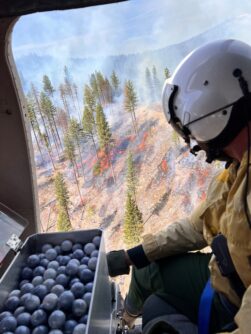
Tyler operating a machine while his helicopter is in flight.
Tyler joined the USFS Missoula Helitack team as a seasonal crew member after graduation, earning the designation of “Crew Member of the Year” following the 2017 fire season. He became a Senior Fire Fighter in 2019 and was promoted to an Open Squad Leader Position in 2024, a role in which he manages the helicopter fire aircraft. This role includes navigating the aircraft, communicating with ground resources and dispatch centers on missions, facilitating morning safety briefings, and overseeing daily operations. When he is not in the aircraft, he serves as the lead firefighter and chief of party for ground groups. His crew oversees initial attack responses, large fire support, search and rescue efforts, district training for crew member qualified personnel across the forest, and the provision of aircraft and manpower to large fires throughout the country.
While flying helicopters and spending the day thinning with a chainsaw are two of Tyler’s favorite aspects of his job, what he enjoys the most is the opportunity to connect and build camaraderie with a widely diverse team of people while traveling the country. “You encounter all sorts of different mindsets, personalities, backgrounds, and new places,” he says. “I spent a week in Jackson, Wyoming fighting small lightning fires and that is part of the country I probably wouldn’t have seen otherwise. I’ve gone to Alaska twice in my career, I’ve seen the peaks of the northern cascades, the Missouri River breaks in eastern Montana. I love the uniqueness of the world and meeting different people.”
Prioritizing mental health, embracing challenges, and practicing fulfillment
For all of the incredible opportunities and joy that Tyler experiences as a wildland fire fighter, there are also unique challenges to the position. Many fire fighters battle with depression and other mental health issues during the sometimes isolating transition from “fire season” to “off season” after having spent months with their teams.
“Mental health alone across the board in wildlife fire is huge, because you spend May through October with the same 20 people and all of a sudden it is cut off in October. It’s challenging to go from that team to nothing at all,” Tyler says. “And for me, having the muscular dystrophy side of it too, its worrying about the future when I need to just be present. I’ve learned to find that balance and listen to my body but also stay present in the moment because I can’t control the future.”
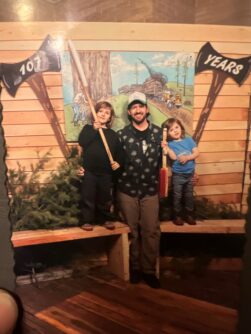
Tyler with his daughters, Wrenley and Mesa.
Around the time that he became a Senior Fire Fighter in 2019, Tyler experienced an especially challenging chapter of personal loss. Struggling with grief and work/life balance after the passing of his son Noxon, he sought support through therapy. Tyler advises anyone struggling with mental health to talk about it. Talking to the people that he trusts, his family and support system, and connecting with a therapist has proven undoubtedly valuable through the years.
“Whether it’s a physical diagnosis or mental health struggle, you can wear it with a badge of honor. Don’t be ashamed,” he says. “Don’t necessarily hide behind it worrying. Embrace it. Sit with the pain and rise from it. Talk to others about it. Everybody has something, just not everyone’s something is visible.”
On and off the workforce, Tyler finds balance in doing the things that he loves – and refuses to let challenges or limitations prevent him from practicing fulfillment. Whether it is fighting fires, mountain biking, embarking on river adventures, or spending time with his two daughters, Wrenley and Mesa, he focuses on staying in the present and striving to enjoy every aspect of life.
“Life is short. You don’t know what tomorrow may bring,” he says. “You have to do what you want and follow what you feel in your heart and soul that drives you. You can’t let outside opinions or voices define who you are. You are in control of how you define yourself. You know who you are and what you enjoy and what brings you fulfillment. Fulfilment is a practice – it’s a practice that I do every day.”
Next Steps and Useful Resources
- Stay up-to-date on Quest content! Subscribe to Quest Magazine and Newsletter.


Disclaimer: No content on this site should ever be used as a substitute for direct medical advice from your doctor or other qualified clinician.