Quest Podcast: The People Behind the People: Family Caregiving, Policy, and the Power of Showing Up
By MDA Staff | Thursday, May 21, 2026
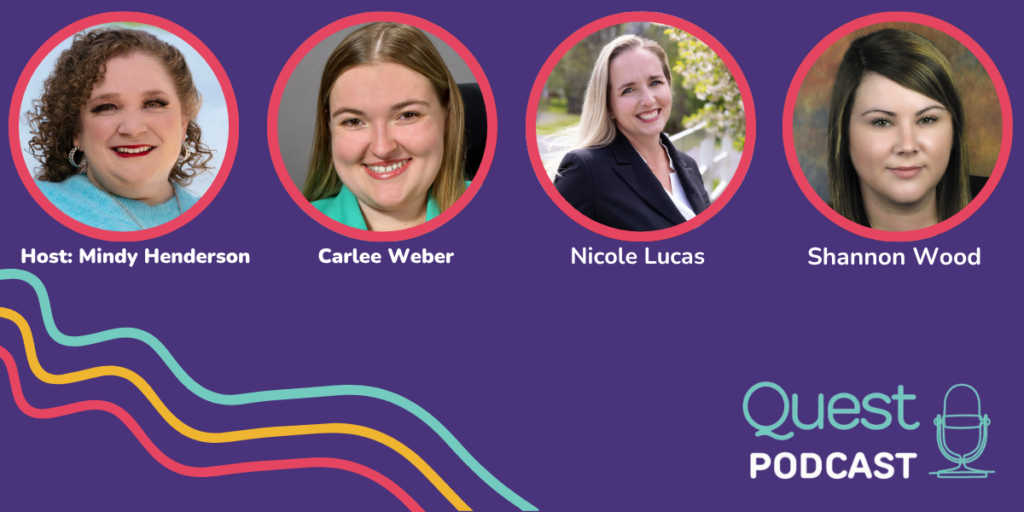
In this episode of the Quest Podcast, we chat with Nicole Lucas, a devoted family caregiver and dental hygienist who stepped away from her career so that her daughter could pursue her dreams; Carlee Weber, a 24-year-old law student at the University of Pittsburgh living with spinal muscular atrophy (SMA) who has never let expectations define the size of her ambitions; and Shannon Wood, MDA’s Director of Disability Policy, who brings both professional expertise and personal experience as a family caregiver to the conversation. Nicole opens up about the sacrifices, logistical challenges, and profound love that have shaped decades of caregiving — including making the difficult decision to leave her job when the system failed to provide adequate support during Carlee’s first year of law school. Carlee shares what it means to build an independent life with the right support behind you, from navigating caregiver shortages and agency failures to setting her sights on a career in disability law. And Shannon pulls back the curtain on the current policy landscape, including MDA’s caregiving campaign and the legislation that could finally bring meaningful relief to the millions of Americans quietly holding everything together. Together, they share their experiences, expertise, and heartfelt perspectives on partnership, advocacy, sacrifice, and why supporting family caregivers isn’t just a family issue — it’s a societal one.
Visit mda.org/supportcaregivers to share your story and take action.
Read the interview below or check out the podcast here.
Mindy Henderson: Welcome to the Quest Podcast, proudly presented by the Muscular Dystrophy Association as part of the Quest family of content. I’m your host, Mindy Henderson. Together, we are here to bring thoughtful conversation to the neuromuscular disease community and beyond about issues affecting those with neuromuscular disease and other disabilities and those who love them. We are here for you, to educate and inform, to demystify, to inspire and to entertain. We are here shining a light on all that makes you, you. Whether you are one of us, love someone who is, or are on another journey altogether, thanks for joining. Now, let’s get started.
Today on the MDA Quest Podcast, we’re talking about something that sits at the heart of so many lives in the neuromuscular disease community: family caregiving. But this conversation is about far more than tasks, routines, or logistics. It’s about partnership, advocacy, independence, sacrifice, and the powerful relationships that make it possible for people with disabilities to live bold, full lives.
Joining me are three incredible guests bringing deeply personal and professional perspectives to this conversation. First, you’ll hear from Nicole Lucas, a wife, mother, dental professional, and devoted family caregiver whose journey began when her daughter Carlee was diagnosed with spinal muscular atrophy at just 20 months old. Nicole has spent decades helping ensure her daughter could pursue every opportunity life had to offer, from college experiences to now supporting her through law school.
We’re also joined by Carlee Weber, a 24-year-old law student at the University of Pittsburgh who has never allowed expectations to define the size of her dreams. From advocating for accessibility on campus to pursuing a future in law, Carlee’s story is one of determination, confidence, and possibility.
And finally, we’ll hear from Shannon Wood, my colleague and director of disability policy at the Muscular Dystrophy Association, whose work focuses on advancing policies that help people with disabilities fully participate in all aspects of life. Shannon also brings her own perspective as a family caregiver, giving her unique insight into both the emotional realities and policy challenges caregivers face every day.
Together, we’ll explore the realities of caregiving, the importance of support systems, the evolving policy landscape, and why recognizing and supporting family caregivers matters not just for families, but for society as a whole.
You guys, I am so happy you’re here. I’ve really been looking forward to this conversation. So I am going to dive in and let’s just start, Nicole and Carlee, with your story. You’ve had a long journey to get to where you are today. You have a fascinating story. Can you take us into what daily life looks like for you as a mother and daughter and as caregiver and recipient?
Carlee Weber: Yeah. I mean, I’ll start by saying that our lives look a lot different than they did even a year ago. My mom has always been my primary caregiver, but I’ve also had a lot of other family support, but my mom took a lot of that on her shoulders growing up. It used to be that my mom would come out to Pittsburgh and help me throughout the week for my first year of law school, and then I would have a team of caregivers that would help me on the weekends so that she could go home. And she was driving four hours home and then back to me every week, and it was a lot, but she would come, she would make sure that I was getting fed properly, because when you’re in law school, it’s a lot just doing the work, let alone taking care of yourself, too.
So it was really great to have my mom there during the first year to make sure that I was staying on top of my health, staying on top of everything that comes with the transition of moving four hours away. That was the biggest thing. I mean, for most of my life, my mom worked part-time. She was able to work three days a week, and she would have Mondays and Fridays off so that she could take me to any appointments or anything that I needed medically over the years. But once I moved out here to Pittsburgh, there was a lapse in coverage because I changed counties, and that made it so that I had no caregivers for two weeks. And as you probably know, that’s not really possible. I can’t just lay –
Mindy Henderson: It’d be a long two weeks.
Carlee Weber: Yeah. So my mom decided that she was going to step away from dental hygiene so that I could go to law school, and I can’t thank her enough for doing that because it truly would not have been possible, especially in that two-week period of not having anyone in Pittsburgh, not knowing anyone out here, trying to have hired people and not being able to pay them. So that was a very pivotal moment, I think, for our caregiving journey. And being in my own space has been a new thing, too, because having my own apartment. My mom helped me set up my apartment and made sure everything was good to go. But the biggest thing for me, I think, is that my mom always wanted me to be independent. She never raised me in a way that I would feel like I needed to be dependent on her, but she showed that she would always be there if I needed her.
Mindy Henderson: So there’s nothing like a mom, is there? Moms are, I think, some of the most resilient creatures on the planet. I often say… They say all the time, if you need something done, give it to a busy person. I say give it to a mom because moms will get it done.
So Carlee, a quick follow-up question for you. You and your mom both, also very graciously, participated in the interview for a blog article that’s up on the Quest Media blog now that I hope people will go and read. But when I read this, it gutted me. As someone who also lives with SMA, I can’t fathom. You had an agency. Was it a home healthcare agency? And they told you something, I think ,was it, around the time that you’re describing when you were trying to figure out the caregiver dance?
Carlee Weber: It was actually when I was in my undergrad career.
Mindy Henderson: Was it?
Carlee Weber: So I was only an hour away from home at the time, and I was in a bigger city area, and I knew that it was a big college town, so I was like, “It shouldn’t be too difficult to find caregivers out here.” But that was at a time when Pennsylvania would not allow me to hire my own caregivers yet because I was under 21, which is strange to me. I feel like it should be 18 and up.
Mindy Henderson: Yeah.
Carlee Weber: But being in college, I still had to work with a nursing agency, home health agency, and they had so much trouble finding caregivers for me that, my last couple years of college, I ended up being a commuter, and my mom and my grandma were driving me back and forth to my classes. And it was difficult to make the decision to not work with the agency anymore, but we got to a point where I was only getting a couple hours of coverage every week and my family was substituting the rest anyway.
And that was a time when I couldn’t pay my family caregivers, and it made me feel awful that they had to do all of this for free. They wanted to do it. They wanted to see me succeed.
Mindy Henderson: Of course.
Carlee Weber: But it would be much better if I had been able to pay them at that moment in time, but I couldn’t because PA, it’s 21. And so my mom had been talking with the agency and trying to get them to figure out more reliable care, because the caregivers that they had found often just wouldn’t show up anyway, or they would call out. So my mom was like –
Nicole Lucas: I still have a voicemail that I saved. “Mom, my day nurse called off.” So I was like, “Oh, well, I guess I’m going to state college.”
Mindy Henderson: Mm. Yeah.
Carlee Weber: Yeah. And so my mom had a meeting with the agency, because I was just trying to figure out college at that point. And she sat down with them and she was like, “Look, this is not something you can mess around with. This is her life. If somebody doesn’t show up, she’s not getting out of bed. That is not acceptable that these people are not here and it’s not acceptable that you’re not trying to find more people to work for her because it’s too hard of a case or something.”
Mindy Henderson: Yeah.
Carlee Weber: So my mom ended up talking to him, and it wasn’t even to me that he said this, he said it to her… But I don’t know, mom, maybe you’d be better to explain what he said.
Nicole Lucas: Well, I mean, that was a little while ago, but just basically he said he would never take another case that required the level of care that she needed because they pretty much are incapable of providing that so they wouldn’t even take it on. So had they not taken it on, we probably… I don’t know what we would’ve done.
Mindy Henderson: Yeah. It’s such a broken system right now. I mean, I know that your story is around family caregiving, but I think we can’t help but zoom out just for a second on caregiving in general and the shortages and the positions that the home healthcare agencies are in. I think everybody knows what the struggles are and I just kind of wanted to acknowledge it.
And I would guess that there are a lot of other people listening who have had similar situations. And I’m really sorry that it came to that, but you’re so fortunate, Carlee, because you have an amazing mom. Nicole, can you share with us maybe some of the specific… Carlee went into it a little bit, but some of the specific types of support that Carlee needs on a daily basis? And what people might not fully understand about what it takes to provide that care.
Nicole Lucas: Well, it’s pretty much everything.
Mindy Henderson: Yeah.
Nicole Lucas: Carlee is the boss. I can tell you that. Carlee dictates exactly what will be done and when it will be done. However, it starts out we get her up out of bed in the morning, make her breakfast, get her her meds, start the daily routine, to toileting, showering, dressing, and we do the whole nine. And she does law school, which is, in my opinion, harder, so…
Mindy Henderson: Not an easy feat, for sure.
Nicole Lucas: No.
Mindy Henderson: And you guys have such a great relationship. The caregiving aside, the pictures that you sent us for the blog article at Taylor Swift’s concert and just out and about everywhere. I just wanted to go hang out with you guys for a bit because it looks like you have a lot of fun.
Nicole, we mentioned the caregiver shortage in the world right now and finding the care you need being such a challenge. And so, as a result, as you guys have experienced, caregiving responsibilities often do default to the family. If the support wasn’t there, which in some cases it’s not there, if you were unable to provide the level of support that Carlee needs to move several hours away from home to go to law school, for example, what would that mean? And how might Carlee’s life look different than it does today?
Nicole Lucas: Well, quite honestly, she wouldn’t have been able to stay in Pittsburgh. She would’ve had to quit law school, which she had earned some major scholarships to attend. She had set up all of her housing and her care. I mean, she had done everything to get herself to where she was, which was huge. And we were at the last minute faced with this challenge of, “Okay, but I have to go back to work, but I can’t leave you here without somebody to care for you. And who else to do it but your mom?” Believe me, it was scary. It was a scary decision for me to make that choice, but was also like there’s nothing that I can do in my life that’s going to be more important than taking care of Carlee and getting her a better start.
Mindy Henderson: Well, and the ripple effect that I’m thinking about. Because you are there for Carlee and because of the care that you’ve given her over the years, clearly as so many of our community members are, Carlee is intelligent and talented. And what you just described, if that other scenario had played out, the rest of the community and the world that we all live in would have been shortchanged by what Carlee brings to the table and what she’s going to do as an attorney when she graduates law school. And so it’s so much bigger than just taking care of your daughter. It’s making sure that the world has access to the talents and the skills that the disability community brings to it.
So Carlee, let’s talk about that. What are your goals and aspirations for the future? What do you see ahead in terms of what you’ll be able to accomplish and what you want to accomplish because this support system exists?
Carlee Weber: Well, a lot of the support that I get from my family caregivers comes with traveling I think, and I would love to travel more. I’ve still never left the country, but I would love to leave the country at some point. I would also probably like to own a home someday. I’m not sure that that necessarily comes from family caregiving, but at the same time, it does, because my family caregivers have shown me that I can be independent.
Mindy Henderson: Yeah.
Carlee Weber: So owning a home would be a big one, living independently in that way. And in the future, it would be really cool if I could help with legislation and regulation of disability rights. That would be the main goal, probably, in the long run, but we’ll see how things pan out. I mean, I’m really excited to get a full-time job, hopefully, after graduation. That’s a big thing. I’ve always enjoyed working, doing school, whatever I can to be productive. I tend to not be a person who does well when I’m sitting at home, not really with much to do.
Mindy Henderson: Yes.
Carlee Weber: So it’s better for me and my mental health, too, when I’m productive and can be working. But I know that if I didn’t have someone there to get me out of bed in the morning, it would just be awful.
Mindy Henderson: Yeah.
Carlee Weber: So yeah, goals, travel more, and do my attorney work someday, and own a home and do the normal life things that able-bodied people would be expected to do.
Mindy Henderson: Yeah, those are good goals. Incidentally, how far into law school are you?
Carlee Weber: I just finished my second year, so I have one year left.
Mindy Henderson: Oh, wow. Do you know yet what kind of law you want to practice?
Carlee Weber: I’m not exactly sure. I’m kind of just seeing where the wind takes me. That’s been my entire law school journey. I just end up where I feel like I’m needed, and I apply for a swath of positions, and then whichever one says, “Yep, this is the job for you.” I’m like, “Okay, that’s where I’m being called right now.”
Mindy Henderson: Yeah.
Carlee Weber: So my first summer, I worked with Disability Rights Pennsylvania, and this summer I’ll be working with the Pennsylvania Health Law Project.
Mindy Henderson: Amazing.
Carlee Weber: Yes, some ties to disability law and health law, but I also love music law, but that’s not really a big thing in Pennsylvania. But my undergrad degree was in public relations and I liked that because of concerts, and music, and things like that.
Mindy Henderson: Yeah.
Carlee Weber: So that’s the dream, but the passion is with disability rights for sure.
Mindy Henderson: Love it. Love it. Well, none of those would be bad options. I feel like you’ve got a bright, bright, bright future. Nicole and Shannon, we’re going to get to you in just a second because there’s a lot to unpack in the policy landscape. But Nicole, caregiving can, of course, be kind of all-consuming. For other moms or family caregivers who might be listening, how have you navigated maintaining your own identity alongside being such a critical part of Carlee’s life?
Nicole Lucas: Well, that’s been a huge struggle, I can tell you, especially now that we’ve transitioned to this not being needed as much anymore. So it has been a huge struggle, but I try to be intentional. Every year I take a week of vacation, just my husband and I. No kids, no other family. It’s always been a thing. We always take at least a week to ourselves. My work really was what was for me for the longest time, was that profession, I had developed a lot of relationships with my patients over 23 years in the same office, and that was my passion, really. So those few days a week that I would be working as a hygienist, that was what I did for me.
Mindy Henderson: Yeah. Well, I’m glad that you managed to find ways to just be you because the world certainly needs that, too. I know that so much of caregiving, it’s kind of a learning as you go in a lot of moments and figuring things out in real time. Are there any sort of life hacks or kind of… I’m doing sort of air quotes, “We cracked the code on this,” moments, like systems, or routines, or things that have really made your day-to-day life or work easier or better?
Nicole Lucas: Well, it’s been a huge relief to not have to work, take care of my house and take care of Carlee at the same time. I just can say I was super hesitant to ever accept a position as a paid caregiver for Carlee. That was not something that I ever saw myself doing. But when I was able to do that, I was able to dedicate a little bit more time and attention to what Carlee really needed, so that’s definitely something I would encourage if you have the opportunity as a parent to get paid. Which I didn’t for 21 years, but then it definitely changed. She felt a little bit less guilty asking for things than she did before.
Mindy Henderson: Yeah. Yeah. Well, and you bring up a really good point, because families are families, and of course we would go to the ends of the earth for each other. At least a lot of us would. It makes sense in a lot of respects that you’ve done what you’ve done for your daughter. But at the same time, and I know you didn’t ever want or expect to be paid for it, but at the same time… And this is kind of, I think, crossing over into some of what we’ll get into on the policy side, but like you said, you left your job, and there are financial consequences, and access to medical benefits for yourself, and things like that that I think family caregivers really take the brunt of. And a lot of people, I think, don’t understand that piece of it and it maybe doesn’t occur to them that it’s not about getting rich. It’s about being able to take care of yourself and live your life while you help Carlee live her life. Is that how you see it? Is that fair?
Carlee Weber: Sorry, I’m interjecting here.
Mindy Henderson: Please.
Carlee Weber: But I wanted to say that family caregivers are often in it for the long haul, and that’s the big thing with insurance. I’ve found that other caregivers that I have, they have a really high turnover rate. They only stay for a few years and it’s probably because they aren’t offered those benefits. But family caregivers don’t really have that out, I guess, in that way, so it would make sense to support them because they know they’re going to be in it for the long haul in that way.
Nicole Lucas: I was fortunate that just I have a lot of support myself. My family, my husband, our extended family, they’re all super encouraging of just being there to back Carlee up. And I don’t know what I would do if I would’ve had to have provided my own medical insurance, because that would be a deal breaker if I didn’t have my husband to provide healthcare for myself.
There’s a lot of people, it’s just not an option. You wouldn’t be able to leave your job simply because of the medical benefits. But fortunately for me, I did have that kind of support at home, but the hourly pay made it possible for me to be able to afford to drive back and forth to Pittsburgh multiple times a week and make sure that Carlee had all of the things that she need, really. And it’s expensive to live with a disability.
Mindy Henderson: Yes.
Nicole Lucas: So I’ve always tried to financially support that as much as possible, too. So to have no income would be a detriment for both of us.
Mindy Henderson: Absolutely. It’s such a ball of wax. So Shannon, you sit at a unique intersection as both a policy leader and a family caregiver yourself. How has your personal experience shaped the way that you approach disability policy and advocacy?
Shannon Wood: Yeah, that’s such a great question. And I think so many policy discussions in DC, on Capitol Hill, they can seem very wonky, and in the weeds, and abstract in a lot of ways.
But the great thing about family caregiving as a policy issue is that it is so common, still so undervalued, but it’s just such an essential part of the human experience that it’s not an unfamiliar problem for a lot of families. And my own family has had its own journey with family caregiving, and with disability, and all of the things that come along with that. The sudden changes in health status, needing flexibility from my school, and then later in life, from my employers. Just last week needing that flexibility. The unknowns about the future and the chronic stress. To Carlee’s point that this is when you’re a family affected by a chronic condition, this is long-term. You’re in it for the long haul.
And I think there’s a lot of power in those personal stories. They are such a force on Capitol Hill for advocacy. And it’s really those personal stories that have the biggest impact on the Hill, and it really brings these complex, wonky issues to life and makes issues local for a lot of lawmakers. And I think what’s really essential is to keep in mind that lawmakers are also human. Many of them have their own experiences with family caregivers. I think of Senator Kim from New Jersey, Senator Capito from West Virginia. They have both spoken up and shared their own personal experiences with caregiving and talking about the why for their leadership on Capitol Hill and in public policy. So my family’s journey with caregiving certainly powers my own advocacy and I think it’s just such a force for good on Capitol Hill.
Mindy Henderson: Yeah. And what’s occurring to me is I really hope that this particular episode reaches far and wide because what you just said, Shannon, about your own experience, and the flexibility that you needed in school, and in your professional life, and all of that, I think it’s a really important message for people who lead organizations to hear. And like we said earlier, when family caregivers and people living with disabilities are set up to succeed, everybody wins. And so if we could live in more of a world that has a flexibility and a tolerance for thinking outside the box and helping people make their situations work, I think it would be a much brighter place. I’m on my soapbox.
But Shannon, zooming out just a little bit, MDA is very focused on family caregiving right now in their advocacy work. What does the current policy landscape look like for family caregivers in the United States? And what are the biggest gaps?
Shannon Wood: Yeah. Well, the great thing is that family caregiving is getting a lot of attention from lawmakers and from Capitol Hill. There’s really important conversations taking place that are, frankly, very overdue.
It has never been more urgent for Congress to finally act to support family caregivers. We are at a really critical inflection point as a country. I mean, the number of family caregivers is consistently rising and very rapidly rising over the last decade. I think we’re up to over 63 million Americans are caring for a loved one with a health condition or with a disability.
Mindy Henderson: Wow.
Shannon Wood: I think it begs all of us to create a system that is more sustainable and that honors and uplifts the vital work of family caregiving. I think getting to the conversation earlier, we are also living in a time of unprecedented attacks on Medicaid, and a lot of the discourse and the public narrative around family caregivers is really mischaracterizing a lot of the work.
There’s these efforts to fight fraud, and those are often noble. I mean, fraud harms family caregivers. But when your efforts to fight fraud end up risking access to critical services and needed support for family caregivers, for individuals living with chronic conditions, that’s absolutely unacceptable. And I think, here at MDA, we know and we appreciate the role that family caregivers play in helping to sustain the home and community-based services system in this country. They fill these huge gaps left by just decades and decades of underinvestment in that direct care, that paid care workforce.
And as Nicole pointed out, they’re often taking away time from the workforce to do so. So family caregiving is real, undervalued work that should be compensated, and the alternative is just not sustainable, frankly.
Carlee Weber: I have a little thing to add to that too, even. I know that my story focuses on my mom’s caregiving, but I know that as people get older, they often have their spouse become their caregiver, and that’s a whole nother ball of wax because many states don’t allow spouses to be paid at all. So just wanted to add my little two cents there.
Mindy Henderson: I’m glad you did. It’s a really important point. There are spouses, there are siblings out there, aunts, uncles, even grandparents in some cases that find themselves in a position to be a caregiver. So if it doesn’t affect your life today, it probably will someday, is kind of the way that I see it.
Shannon, would you like to talk a little bit about The MDA caregiving campaign, what you’re working to change, and why this moment matters?
Shannon Wood: Yes, absolutely. In spite of the underinvestment in family caregivers and the overall caregiving system, we do have leaders in Congress who are putting forth policies that seek to address some of these common challenges that family caregivers experience. The administrative challenges of trying to navigate these really Byzantine labyrinths of benefit systems, whether it’s disability benefits like SSI or SSDI, or health insurance benefits through whichever program, there is legislation that’s been introduced called the ABC Act. It’s a pretty easy one to remember.
But what’s great about this bill is that it pulls together all of the stakeholders at the same table. It brings together the Social Security Administration, CMS, the state Medicaid directors, family caregivers, individuals themselves who are in need of these benefits to come together, look at their eligibility processes and their forms, and figure out how they can streamline this to reduce that administrative burden that often leads to people either not qualifying for benefits despite being technically eligible for them, or to kick them off of benefits that they rightly deserve.
So we are trying to garner as much bipartisan support for that bill as possible. We’ve talked a lot about the financial challenges of caregiving, which, again, are dramatic and long-term. I think it’s really misunderstood that these are one-off expenses, especially in the neuromuscular disease community. We understand that insurance is often covering the very bare minimum, will sometimes bite you just to cover that, and that families are really left paying out of pocket for necessary equipment, services, modifications to their home, to their vehicle.
Thankfully, we have a couple different bills that are seeking to address those financial challenges. One is the Credit for Caring Act, which is a great bipartisan bill. It would create a very modest, non-refundable tax credit up to $5,000. Again, this doesn’t really get at the drivers of the cost of care, but it helps offset some of those out of pocket costs for families and prevent some of these really difficult decisions around kitchen tables. People are trying to figure out if they need to let certain bills go in order to make ends meet, put care on credit cards, go into debt in order to cover necessary equipment. This is a great bill that would seek to offset some of those costs as well.
And then I think we’ve gotten to this, too, in sort of roundabout ways, but the emotional challenges that come with providing care. The Lifespan Respite Care program was reauthorized this year. That came with a 10% increase in funding thanks to Senator Baldwin, Senator Collins, helping people get that break and be able to recharge and keep providing care in the long term. So it’s really advocates who are helping get these bills across the finish line, get the necessary attention, and demand action on these bills to further them in the legislative process.
And so that’s really why MDA created this caregiving campaign, and our goal with it is to make it as easy as possible for family caregivers, for individuals affected by neuromuscular conditions to take action. We have a one-stop shop. It’s mda.org/supportcaregivers. From there, we have a ton of great resources, not only MDA’s resource guide for family caregivers, which has a lot of actionable, practical tips for family caregivers, but there’s also an opportunity for you to share your caregiving story, for you to take action and contact your lawmakers today on these bills.
And there’s also other sort of creative tactics available at that hub. We have a toolkit for crafting a letter to the editor or an op-ed and sort of raising that awareness in your town or city, in your local area. We also have this really cool campaign around what family looks like in the neuromuscular condition. And you can submit your video, share a photo for what caregiving looks like in your family to help challenge those mischaracterizations, those harmful narratives around family caregivers, and really demonstrate visually the value that they provide to not only their families, individuals affected by neuromuscular diseases, but society as a whole.
So for listeners right now, please feel free to visit mda.org/supportcaregivers. We’ve made it incredibly easy to plug in and share your own story.
Mindy Henderson: I love that. And like you said, the stories are what people remember. You don’t have to be a policy expert, you don’t have to know the law inside and out. Carlee might, but that’s not the knowledge that you need to have to be an advocate. It’s just a willingness to share your story, and that’s what really impresses the need and the important points on the people sitting in those seats in Congress. It’s so, so important.
Sometimes I like to close out with a little bit of a fun rapid fire set of questions for our guests and I would love to do that, if Nicole and Carlee are willing. So first question, what’s one word that describes your relationship with each other?
Nicole Lucas: Love.
Mindy Henderson: Aw.
Carlee Weber: I was going to say something like multifaceted, I guess.
Mindy Henderson: Yeah, I love both those answers. What’s a small moment in your day that brings you joy, each of you?
Carlee Weber: Well, I have a chocolate lab. And I don’t see her all the time because my dad’s been caring for my dog while I’ve been in Pittsburgh, but whenever I get to see her and snuggle her, that is not even just a small moment of joy. That’s a huge moment of joy for me.
Mindy Henderson: I love it. I’m actually hoping that you guys didn’t hear it a little while ago, but I had a pug and a golden retriever wrestling under my desk. So what about you, Nicole?
Nicole Lucas: Throughout Carlee’s life, one way I always knew when she was well, she sings. Just doing everyday tasks, and when I’d hear her sing, it would just instantly give me joy because I knew she was okay.
Mindy Henderson: Oh, I love that. Shannon, I’m going to bring you on this one. What’s a small moment in your day that brings you joy?
Shannon Wood: Absolutely any opportunity I have to hug my dog. I think that first moment in the morning, letting him outside. It’s just such a moment of peace with the first cup of coffee of the day. That’s one of my favorite times of day.
Mindy Henderson: Love it.
Carlee Weber: I’m just going to go off of what my mom said with me singing. I did get in trouble one time, though, because I was supposed to be sitting in the corner on timeout when I was about three years old and I was singing in the corner because I just didn’t care that much.
Mindy Henderson: I mean, you have to pass the time somehow, right? Even if you’re in trouble. That’s adorable. For all three of you, I know my answer. Coffee or tea?
Shannon Wood: Coffee.
Mindy Henderson: Coffee.
Nicole Lucas: Coffee.
Carlee Weber: Definitely coffee.
Mindy Henderson: Coffee. Me too. It’s unanimous. What is, all three of you, a go to show, podcast, or guilty pleasure you can recommend for our listeners?
Shannon Wood: My guilty pleasure is Real Housewives. I take no pride in it, but I got to love my Bravo.
Mindy Henderson: Nice. Nicole, do you have one?
Nicole Lucas: Oh, my guilty pleasure is the Netflix series, Bridgerton. Oh, gosh.
Mindy Henderson: Yes. Good one. Good one.
Nicole Lucas: I also really love listening to crime podcasts on my drive back and forth to Pittsburgh.
Mindy Henderson: Yes.
Nicole Lucas: Crime junkie.
Mindy Henderson: Me too. They’re doing podcasts now on Netflix, too, I think I saw, and they’ve got a couple of crime ones if you haven’t checked them out yet. Carlee, do you have a guilty pleasure?
Carlee Weber: Yeah. I mean, I also listened to those crime podcasts with my mom a lot when I was younger, especially.
Mindy Henderson: Nice.
Carlee Weber: But recently my boyfriend and I have been watching The Walking Dead, and there’s so many spinoff shows, we’ll be set for years.
Mindy Henderson: Love it. Love it. I am just going to throw out there that I have been, for years and years and years, a bit of a quiet Lifetime watcher. Give me a Lifetime movie any day of the week and I’m good. Wonderful.
Well, wanted to end on a little bit more of a playful note. I appreciate you indulging me. You guys are a pleasure. Shannon, I love working with you every day. Carlee and Nicole, you guys clearly have such a special relationship. You’re the stars of the video for the MDA campaign. If you haven’t seen it yet on social media, you’ve got to go look for it because it’s such a beautifully done video and tells your story really nicely, so thank you.
Nicole Lucas: I want to thank Ryan for that, too.
Mindy Henderson: Ryan is amazing. Yes.
Nicole Lucas: He did a great job.
Mindy Henderson: Absolutely. And we’re going to put all the information in the show notes with the link that Shannon mentioned, and maybe we’ll put a link to your video. So thank you all for being here. It was lovely to talk to you. You’ve got incredible wisdom and perspective and the world is lucky to have you in it. Thank you.
Nicole Lucas: Thank you.
Shannon Wood: Thank you, Mindy.
Nicole Lucas: Thank you.
Shannon Wood: Thank you, Carlee, Nicole.
Carlee Weber: Thank you.
Mindy Henderson: Thank you for listening. For more information about the guests you heard from today, go check them out at mda.org/podcast. And to learn more about the Muscular Dystrophy Association, the services we provide, how you can get involved, and to subscribe to Quest Magazine or to Quest newsletter, please go to mda.org/quest. If you enjoyed this episode, we’d be grateful if you’d leave a review, go ahead and hit that subscribe button so we can keep bringing you great content, and maybe share it with a friend or two. Thanks everyone. Until next time, go be the light we all need in this world.


Disclaimer: No content on this site should ever be used as a substitute for direct medical advice from your doctor or other qualified clinician.