How One Man with DMD is Using His Medical Emergency Experience to Educate Others
By Rebecca Hume | Wednesday, July 15, 2026
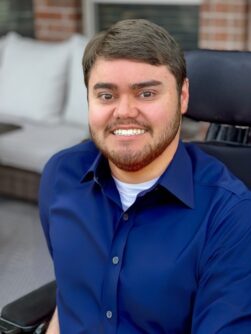
Zach Fine
Zach Fine and his family know firsthand how imperative it is to have an advocate to educate and fight for your needs while receiving medical care. Zach, a twenty-nine-year-old who lives with Duchenne muscular dystrophy (DMD), broke his femur two years ago and experienced severe complications during his emergency hospital stay. Throughout his hospitalization, his mother, Christie West, repeatedly pushed back on standard protocols that she knew would endanger her son, staunchly advocating for the additional considerations that his care required. That advocacy very realistically saved his life. Now, Zach is using his experience as motivation to educate others about the necessary considerations in emergency medical care for people living with neuromuscular disease.
A harrowing experience
In May of 2025, Zach was attempting to adjust his position while sitting in his power wheelchair when he suffered a fall that pinned his leg in the chair while his torso propelled to the ground. His mother immediately called paramedics and Zach was rushed to the hospital with a shattered femur. Zach received an MRI and the doctors at Baylor Hospital walked through their plans for Zach to undergo outpatient surgery to have a titanium rod placed in his leg.
“It was a trauma center at Baylor, so the doctors had unbelievable credentials, best of the best,” Christie says. “But they weren’t educated on Zach’s specific, complex needs or how DMD can impact care. They said he would have the surgery and be home that night. I took the orthopedist outside and explained that putting Zach under anesthesia is an issue and that he has a whole team of docs, cardiologists, pulmonologists who needed to weigh in. He said, ‘Ma’am, we are a trauma center and I got this.” I told him we don’t question how amazing the surgery is going to go, but I need to talk to an anesthesiologist because it is going to be challenging to wake him up and if you lay him down, he won’t be able to breathe. He said, ‘Ma’am, I promise you, we got this. He will be fine and you will have him back home tonight.’ Nine days later, we were still there.”
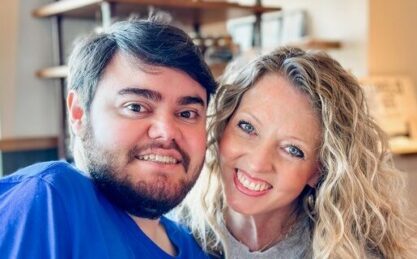
Zach and his mother, Christie West.
Christie attributes what she refers to as a lot of “God moments” for pushing the surgery back and creating more time for her to advocate for and navigate Zach’s needs. After her insistence that the surgical team confer with Zach’s doctors, the surgery was initially delayed until his team could meet and discuss the complexities surrounding taking Zach off of the ventilator after surgery. During that delay, a storm knocked out the air conditioning and a different patient came in as a priority, both further postponing his surgery. Christie shares her emotional belief that if those delays hadn’t occurred and Zach had undergone surgery immediately that he would not have made it home from the hospital.
Even with the delays and coordination, the biggest obstacle remained Zach’s recovery from the anesthesia and weening from the breathing tube post-surgery. Zach was brought to the Trauma ICU after his surgery and the night nursing staff resumed his care. At that time, he began to come out of the anesthesia but still had the tube down his throat. “I had told him to just look at me when he woke up and when he did, I could see that he was very scared,” Christie says. “But the two nurses just weren’t communicating to us, and I kept saying something is wrong and they just said he was uncomfortable because he had a tube down his throat. I had to ask them to stop and look at him, and they both turned and looked at him. And I said, ‘Do you see his eyes? He is trying to tell us that something is wrong. You need to communicate with him about what he is feeling and what is normal or not.’” Christie and Zach worked out a blink system with yes and no and eventually he was able to communicate that he couldn’t feel his legs, which the nurses were able to ease his fear and let him know that was normal post-surgery.
“The most frustrating thing is if I had been there by myself, I wouldn’t have had that communication or been able to get information from the nurses,” says Zach.
More complications and complexities… more advocacy
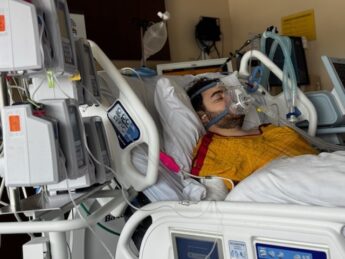
Zach on a ventilator after his surgery.
The next step in care – and need for advocacy – was taking Zach off the ventilator. As the team attempted to do so while he was laying down, his vitals crashed and his body began to go into a-fib. Christie continuously told the team that Zach needed to be sitting up because his lungs were collapsing and he isn’t able to breathe laying down due to his DMD. Met with confident responses that they do this every day and “not to worry”, Christie was terrified and frustrated.
“At one point, I went out in the hall, and a nurse came out and said, ‘Do you need a valium?’ and I said, ‘No, I don’t. I need a moment and nobody is listening to me while my child is struggling.” The trauma doctor on call heard what was happening and came over and sat on the floor with me. And he said, “Mom, tell me what we need to do.” I told him you can’t get him off of the vent like this, you have to sit him up and then get him off. So, the doctor put him back to sleep and said the next morning they would have their A team and that I would walk them through what he needs,” Christie says. “For any other patient, the 99.9% of the people they treat, the hospital staff do an amazing job. But for so many people dealing with neuromuscular disease (NMD), if they are not aware of special considerations, if they don’t listen and look at the chart and know what that disease means, they could kill them. It is scary to think what would have happened if I hadn’t been there.”
Zach echoes that sentiment saying, “People tend to be super sure about what they do know. But when there is something that you know a lot about and then a variable comes in and changes the way that things are, we tend to be overconfident. I feel as though it is important to tell people that you can’t do that in situations that are not the norm – you can’t be overconfident, you have to be open to other people’s experiences and unique needs.”
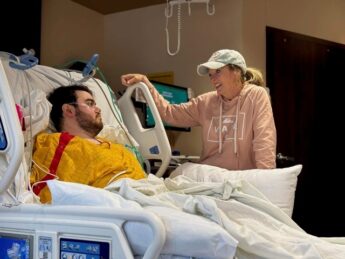
Zach and Christie at the hospital.
Zach was in the ICU for nine days. He faced an additional life-threatening complication after the vent was removed and he was placed on an oxygen machine. Zach and Christie weren’t aware that the oxygen vent was pumping O2 in but was not providing any expiratory airway pressure to remove CO2 from his lungs. Zach suffered CO2 poisoning and had stroke-like symptoms before the oversight was identified and he was switched to a bi-pap machine. The hospital didn’t have a bi-pap machine, so Zach’s family brought his own from home and taught the staff the correct settings. Christie also educated staff on how to use the one and only hoyer lift available at the hospital.
While Zach and Christie both enthusiastically share that the medical team and nursing staff at the hospital were wonderful, they recognize firsthand the incredible danger surrounding a lack of awareness and education about rare disease complications.
Raising awareness and offering advice
“There needs to be a process in place to teach people that they aren’t going to have the same circumstances with every patient,” Zach says. “There needs to be someone who educates staff on different conditions and teaches them how to best serve those with NMD and limited mobility.”
“Zach was literally laying there in the hospital bed thinking of ways to improve medical care for others,” his mom recalls. “He was brainstorming: What if we start volunteering and going to hospitals and presenting to staff, letting them ask questions about how to make care better?”
Now, Zach serves as an MDA Ambassador and participates with the MDA Advocacy Team, attending symposiums, sharing his story, and raising awareness. He also offers advice to others in the neuromuscular disease community, to better prepare them to navigate potential future emergencies.
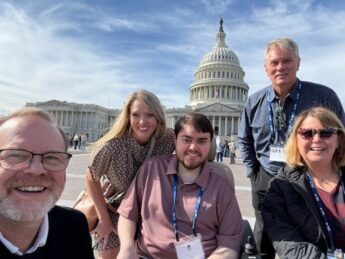
Christie and Zach (second and third from left) join other advocates at Capitol Hill.
He advises others to keep a list of medications and possible negative interactions of those medications with other treatments. Zach keeps his listed on his phone and his mother keeps a copy as well. Zach uses the MyChart app to communicate with his doctors in real time in case a consult is needed. Christie also recommends a print-off sheet that can be given to medical teams to provide additional information about diagnoses, medications, care team contacts, vital equipment, and more. And they both stress the importance of having a reliable group of support people who can assist during an unplanned hospital stay.
“And be patient but persistent with the doctors and nurses,” Zach advises. “They know medicine and they are the experts in all of the hospital things, but we know our loved ones and we know our specific needs. They are very knowledgeable and caring and compassionate about their field, but we need to educate and advocate to raise awareness when it comes to treating people with neuromuscular disease – and that’s exactly what I want to do.”
Next Steps and Useful Resources
- Read Expert Advice for Preparing for Medical Emergencies with NMD.
- Stay up-to-date on Quest content! Subscribe to Quest Magazine and Newsletter.


Disclaimer: No content on this site should ever be used as a substitute for direct medical advice from your doctor or other qualified clinician.