MDA Ambassador Guest Blog: The Part I Let Belong: Learning to Embrace My Disability Identity
By John Scurto | Monday, July 6, 2026
5 Second Summary
MDA Ambassadors play an essential role in furthering MDA’s mission while representing and empowering the neuromuscular disease community. Quest Ambassador Guest Blog series provides a platform to share their personal stories, perspectives, and experience.
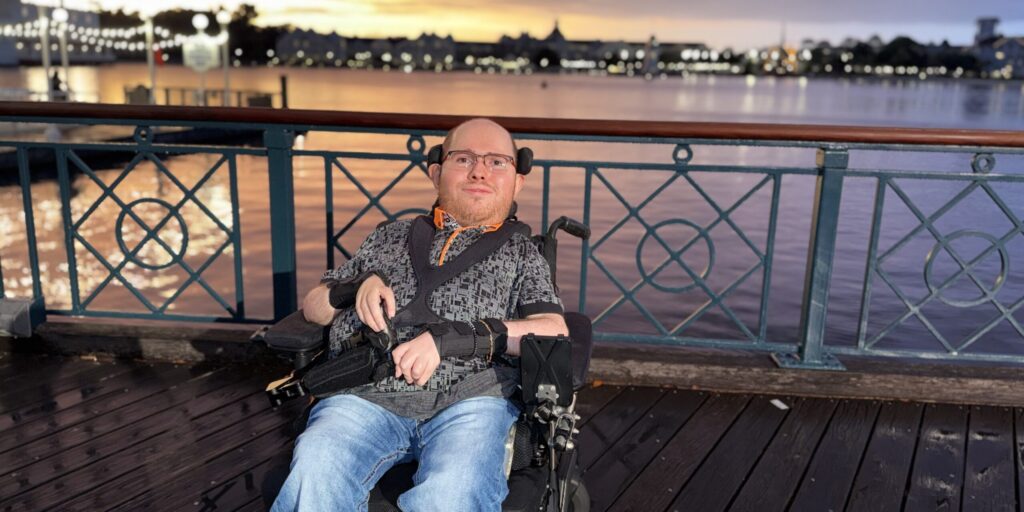
John Scurto is a 29-year-old MDA Ambassador from Boca Raton, Florida, who lives with spinal muscular atrophy (SMA) and is a power wheelchair user. He holds an MBA and a graduate certificate in Disability Studies, and he is especially interested in the intersection of business and disability inclusion. With both lived experience and academic training, he cares deeply about helping create more inclusive and accessible environments for people with disabilities. Outside of that, John is an avid sports fan who enjoys spending time with loved ones, trying new restaurants, and making memories on cruises.
As an adolescent, what I saw in the mirror was very different from how the world saw me. I saw a happy, stylish, and, if I may say so myself, good-looking kid. However, based on the glances, interactions, and the experience of sometimes being overlooked by people around me, it seemed that most people only saw my 400-pound power wheelchair and the atrophied body caused by spinal muscular atrophy.
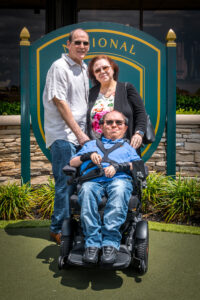
John with his parents at an Ed Morse MDA Golf Classic.
I am blessed to have parents who never made me feel less than because of my disability. They expected me to get good grades, be kind and respectful, and accomplish my goals despite being disabled. I soon realized that the loving and accepting environment my parents created did not always match how the outside world viewed disability.
My main priority when I was younger was to be like everyone else. I never wanted to accept accommodations or receive special treatment because of my disability. The idea of being different was unsettling to me. I wanted to blend in and not stand out from my peers. The visible nature of my disability often brought unwanted attention, endless questions, and awkward exchanges that I wanted to avoid at all costs.
The way people responded to disability made me hate that I was disabled. Truthfully, I was not even that bothered by the physical limitations I experienced. I could handle constant physical assistance, surgeries, and ICU hospitalizations. For me, the hardest part was not the disability itself, but how it affected the way other people saw me. Because of that, I rarely spoke openly about my experiences. I tried to put my disability in incognito mode, even though it still felt like the elephant in the room.
When I started college at Florida Atlantic University, I joined leadership programs that helped me grow and reflect more deeply on my life. During one activity, we were asked to share a two-minute version of our life story. I struggled to tell my story without talking about my disability. For much of my life, my disability was a part of me I tried to downplay or keep in the background. In that moment, I had to confront the fact that my disability was not just a minor part of my story. It had shaped the way I saw the world, my resilience, and who I was becoming in ways I could no longer ignore.
Over time, I started to see myself and my disability differently. I began to understand that my disability was deeply connected to what motivates me and how I want to use my life to help others. The encouragement and support I received throughout my life made me realize that I wanted to give back in the same way. Instead of continuing to view my disability as something that only made me different, I started to see it as something that shaped my purpose.
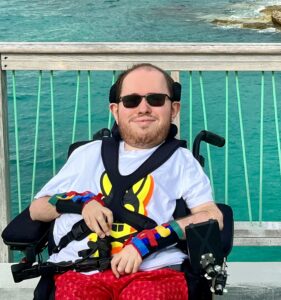
John on a Caribbean cruise vacation.
As I began to accept and embrace my disability, meaningful opportunities came into my life. I joined the board of directors of a nonprofit organization serving people with muscular dystrophy. Additionally, I created a student organization within the University of Florida MBA program focused on disability inclusion in business and contributed to disability inclusion efforts within the corporate environment. I was able to use my lived experience with a physical disability to help make a positive difference. I turned something I had long seen as a weakness into a source of strength.
Today, for me, embracing my disability identity means feeling comfortable talking openly about my disability and educating others. I no longer feel ashamed of a part of myself that has shaped so much of who I am. I even earned a graduate certificate in Disability Studies, which my younger self never would have imagined. At one point, I wanted nothing to do with disability. Now, I want to keep learning so I can help foster a more inclusive world.
I spent much of my life wanting to be like everyone else, but now I no longer want to be anyone other than myself. For a long time, I thought acceptance would come from minimizing the part of me that made me different. But in reality, the more I tried to distance myself from my disability, the more disconnected I became from myself. I realized I could not tell my story honestly without talking about the very part of myself I had spent years trying to avoid. I also came to understand that I could not expect the world to accept me if I had not first learned to accept and love myself. My disability is an important part of my identity, but it is not the entirety of who I am. Rather than spend my life wishing I were different, I found freedom in embracing who I am instead of pushing away a part of myself.
Next Steps and Useful Resources
- Learn more about Spinal Muscular Atrophy (SMA) here.
- To learn more about MDA’s Young Adult Programs, visit here.
- Browse MDA’s Mental Health Hub.
- MDA’s Resource Center provides support, guidance, and resources for patients and families. Contact the MDA Resource Center at 1-833-ASK-MDA1 or ResourceCenter@mdausa.org
- Stay up-to-date on Quest content! Subscribe to Quest Magazine and Newsletter.


Disclaimer: No content on this site should ever be used as a substitute for direct medical advice from your doctor or other qualified clinician.