Foster Care, Adoption, and Surrogacy Considerations for Parents with Neuromuscular Diseases
By Rene Ryan | Tuesday, May 26, 2026
5 Second Summary
Katrina Gossett-Kelly and Matt Curcio, who are both parents living with neuromuscular diseases, know there are many ways to make a family. Here, they share their stories and key steps to prepare for parenthood.
For many people living with neuromuscular diseases — or any disability — the desire to become a parent is steady and deeply felt, even when the path looks different from what others might expect. Pregnancy may be one option, but it is far from the only one. Foster care, adoption (domestic or international), and surrogacy can all be meaningful ways to build a family or nurture kids who need stability.
Each of these paths comes with its own logistics, challenges, and emotional terrain. But one message comes through clearly from community members who have lived it: Disability does not disqualify someone from parenthood. It may shape the planning, the supports you put in place, and how caregiving looks day to day — but it does not limit the love, commitment, and capability you bring.
Below are insights from two parents in the neuromuscular disease community whose journeys to parenthood took different routes: Katrina Gossett-Kelly, who adopted internationally, and Matt Curcio, whose family grew (and continues to grow) through foster care and foster-to-adopt.
Choosing adoption: Katrina’s path to motherhood
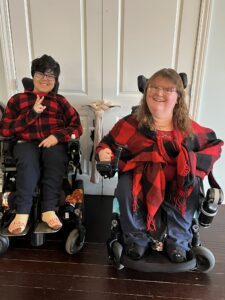
Katrina Gossett-Kelly and her son
Katrina, who lives with spinal muscular atrophy (SMA), knew early on that she wanted to be a mom. It was part of who she was — something that showed up even in childhood, when her imaginary friends were her imaginary children.
She considered pregnancy as she got older but ultimately decided it was not the right path for her.
“The risk to my body, and what I might be left unable to do after pregnancy while trying to care for a baby, just didn’t outweigh the benefits,” she says.
Instead, she turned to adoption — not as a second choice, but as a path she had always seen as equally meaningful. Adoption was already part of her family story; her younger sister had been adopted.
“I’ve never thought of adoption as a second-choice kind of thing,” she says.
When she and her spouse began exploring adoption, domestic infant adoption did not feel like the best fit. In many cases, adoptive parents are selected by the birth parent, and Katrina worried she might face ableism in that process. She was also mindful of the physical demands of caring for an infant.
Instead, she researched other options, including adoption from foster care and international adoption.
Her search led her to organizations such as AdoptUSKids, which connects children in the US foster care system with families, and Rainbow Kids, a resource for international adoption of children who may be harder to place in their home countries.
Another important step was researching which countries were open to adoptive parents with disabilities. “Every country has different requirements,” Katrina says.
Some countries restrict adoption by people who use wheelchairs or have other disabilities, so she focused on those with more flexible policies.
Her search eventually led her to Bulgaria.
Initially, Katrina thought it would be best to adopt a child who could walk, thinking about the realities of daily caregiving. But while looking at a Bulgarian adoption agency’s website, she learned about a little boy in need of a family who also lives with SMA.
“I got chills,” she recalls. “I felt like I was looking at my son.”
The time from seeing his photo to finally bringing him home took about a year — relatively fast for international adoption. The process involved a home study, medical clearances, notarized documents, and training on trauma-informed parenting.
When Katrina first met her son in Bulgaria, toward the beginning of the adoption process, he was 5 years old, and he did not yet have a wheelchair. Seeing how this limited his mobility made an immediate impression. Katrina arranged to send him a wheelchair while he was still in Bulgaria so he could begin using it right away.
After the adoption was finalized and he arrived in the United States, the transition required patience. He did not speak English, and to start the bonding process, Katrina took several months off work, using the adoption leave provided by her employer. This allowed her to dedicate her time to helping him adjust to his new home and family.
Those early weeks were intentionally quiet. She limited visitors and focused on bonding, teaching him new words, and building trust.
“He was like a sponge,” she says.
As she settled into parenting, Katrina discovered that the biggest challenges were not necessarily related to disability.
“I think a lot of people assume the disability will be the hardest part,” she says. “But helping a child through trauma is so much more involved than helping them navigate a physical disability.”
Today, Katrina and her son — now a teenager — have built a life together that includes school, medical care, caregiver teams, and plenty of ordinary moments of joy.
They live in downtown Indianapolis, and on nice days, they can easily take their power wheelchairs to the zoo or a museum. On colder days, they stay home watching movies together. Katrina describes her son as “a mom’s kid.” Even at 13, he still likes to be close by.
Foster care and foster-to-adopt: Matt’s family journey
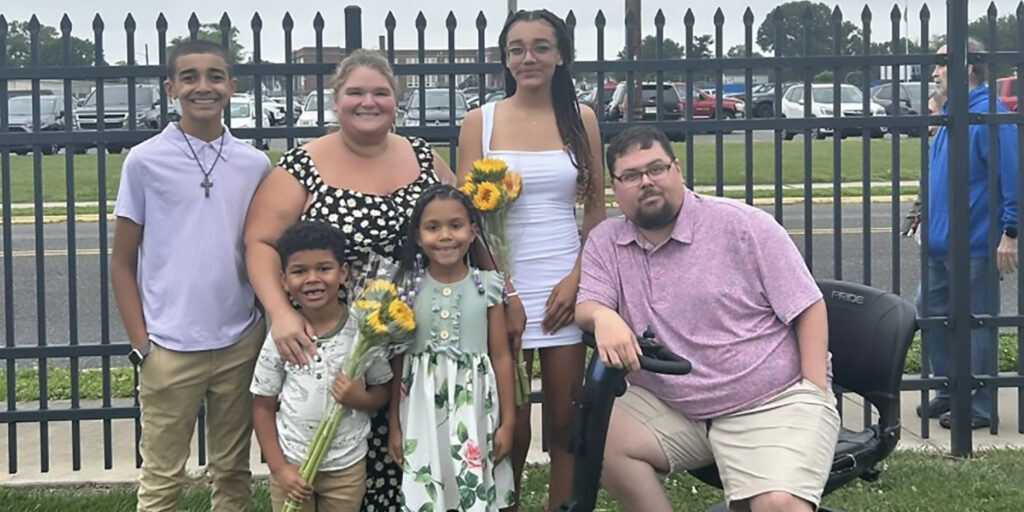
For Matt and his wife, who live in New Jersey, the path to parenthood unfolded through foster care — a journey that has brought joy and challenges.
Matt lives with collagen VI–related muscular dystrophy and uses a power wheelchair. Before becoming a parent, he carried fears many adults with disabilities share: how children might react to his disability, or whether they might resent things he physically could not do.
Parenthood quickly challenged those assumptions.
In his experience, kids tend to adapt to the situation they are in and connect with the person in front of them, not just the physical abilities they see.
Matt first felt drawn to fostering years before becoming a parent. That possibility became a reality when children he and his wife already knew needed a safe place to stay. Their first experience was through kinship care, caring for children within their extended community.
Over time, the couple expanded their role and became an “open home” for foster placements. Their household has welcomed children for days, months, and sometimes years.
The foster system’s primary goal is reunification with biological families whenever possible, something Matt believes prospective foster parents need to understand clearly.
“If you say you want to ‘build a family,’ this isn’t for you,” Matt says. “This is about the kids.”
He describes foster care as stepping into the gap for children who need stability and safety during difficult moments in their lives.
Matt has found ways to connect with each child in his own way — reading and writing together, building models and Legos, and attending sports practices.
“My physical ability does not dampen our joy,” he says. “It just adds complications.”
Some of those complications are practical. Disability can bring additional expenses and logistical challenges, including equipment, home modifications, and transportation.
For a while, Matt’s family could not fit everyone — along with a wheelchair, stroller, and car seats — into a single vehicle. Leasing an accessible minivan finally made it possible for the whole family to travel together.
Despite the challenges, Matt believes people with disabilities may bring unique empathy and resilience to parenting children who have experienced instability.
“I really believe there are people with disabilities who are uniquely equipped to step into the gap for kids who feel unseen,” he says.
Practical considerations for prospective parents
For people considering foster care or adoption, planning ahead can make the process more manageable. Here are three steps to be ready.
1. Build your support system.
Agencies that place children will want to understand who helps you day-to-day, whether that includes a partner, family members, friends, or professional caregivers.
Matt emphasizes the importance of having strong support behind you.
“There’s really not room to romanticize situations,” he says. “You need people behind you.”
Katrina’s household includes care teams supporting both her and her son. She describes herself as the constant in his life — coordinating care, advocating, and providing stability.
2. Be honest about your needs.
Adaptive equipment, personal care assistants, transportation solutions, and accessible housing can all help make parenting sustainable.
“You have to be very real about what your limitations are,” Matt says. “The world isn’t always set up to meet your needs. That’s why you have to be completely honest with yourself and your support system. You have to have the hard conversations, make the calls, and plan in ways many parents never have to. But none of that effort is wasted. Accommodations aren’t burdens, and differences aren’t weaknesses. I’ve struggled with the urge to give up at times, but becoming a dad changed that. I realized that what I need is what allows me to show up for my kids.”
3. Plan for continuity.
It’s a good idea to create documentation with medical information, medications, and care instructions in case someone else needs to step in temporarily.
Katrina says that becoming a parent heightened her awareness of long-term planning, and she keeps detailed records of doctors and medications so her sister can step in if needed.
Parenting on your own terms
For people living with neuromuscular diseases, the path to parenthood may not follow a traditional script. But as Katrina and Matt show, there are many ways to build a loving, stable home.
The key is finding the path that fits your life — and having the courage to pursue it.
What About Surrogacy?
Surrogacy can also be a path to parenthood for people who cannot or prefer not to pursue pregnancy. In gestational surrogacy, an embryo created through in vitro fertilization (IVF) is carried by a surrogate who is not genetically related to the child. For some individuals living with neuromuscular diseases, surrogacy may offer a way to have a biologically related child without the physical risks of pregnancy.
Like adoption, surrogacy often involves significant legal, financial, and emotional planning. Laws governing surrogacy vary by state and country, and the process typically includes working with fertility specialists, legal professionals, and a surrogacy agency or independent surrogate.
Families considering surrogacy may want to look for:
- Attorneys and agencies experienced with disability-inclusive family building
- Clear financial planning and realistic timelines (surrogacy can cost $80,000-$150,000 or more in the United States)
- Medical providers familiar with disability-informed family planning
- Strong support systems for newborn care, particularly if physical caregiving assistance may be needed
For people who are interested in learning more, several organizations provide information about surrogacy and fertility options:
- RESOLVE: The National Infertility Association offers educational resources on fertility treatments, surrogacy, and family-building options
- The American Society for Reproductive Medicine (ASRM) provides medical guidance and patient resources related to assisted reproduction and surrogacy.
- Men Having Babies, which is focused on LGBTQ+ families, has educational guides with clear explanations of the surrogacy process and legal considerations.
Some fertility clinics also offer consultations specifically for individuals with medical conditions or disabilities who want to explore reproductive options.
As with adoption and foster care, people considering surrogacy may find it helpful to connect with others who have gone through the process and to seek guidance from medical professionals familiar with their specific health needs.
Next Steps and Useful Resources
- To build your support system, learn to get comfortable asking for help.
- Learn about the many ways MDA can help you connect with others in the community.
- Read more Quest Media content about parenting.
- Stay up to date on Quest content! Subscribe to Quest Magazine and Newsletter.


Disclaimer: No content on this site should ever be used as a substitute for direct medical advice from your doctor or other qualified clinician.