International Day of Women and Girls in Science: MDA Spotlight on Elizabeth Madole
By Rebecca Hume | Monday, February 9, 2026
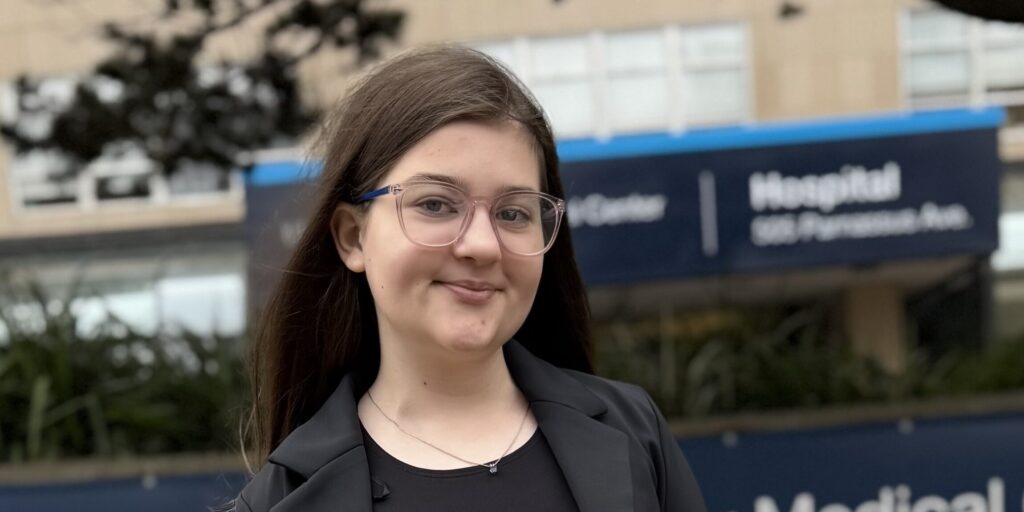
International Women and Girls in Science Day, February 11, endeavors to acknowledge and celebrate the invaluable role that women and girls play in accelerating change and discovery in the professional realm of science, technology, engineering, and math (STEM). In recognition of International Day of Women and Girls in Science, the Muscular Dystrophy Association (MDA) is honored and excited to highlight Elizabeth Madole’s contribution to research, dedication to educating others and advancing treatment, and aspirations to become a pediatric neurologist.
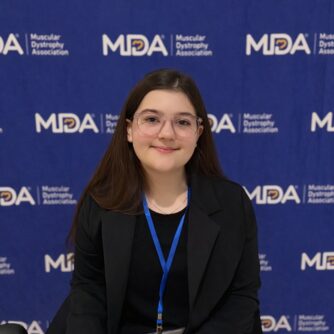
Elizabeth Madole at the 2025 MDA Clinical & Scientific Conference in Dallas, TX.
At only 12 years old, Elizabeth is already making her mark on scientific research through her collaboration on a case-based physiological study on respiratory aspects of neuromuscular disease and co-authoring of a scientific abstract to share those findings. Diagnosed with AChR antibody–positive generalized myasthenia gravis herself, the California native is motivated by her own patient experiences, the support of incredible mentors, and a deep desire to make a positive impact on patient treatment and outcomes.
Elizabeth has traveled to numerous scientific conferences, including the MDA Neuromuscular Symposium in Dallas (2025) and the Stanford Neuromuscular Symposium (2025). She recently spoke on a patient panel at UCSF, where she shared her experience living with neuromuscular disease and her treatment journey with an audience of more than 150 medical students. This March, she will be attending the MDA Scientific Conference in Orlando, FL, where she will present an abstract and poster, as a co-author with her neurologist, about respiratory monitoring in myasthenia gravis.
We checked in with Elizabeth to learn more about her journey, research, personal motivation, and her dreams for the future.
When did you first become interested in participating in medical research and why?
I think I have always been interested in medicine, but I didn’t always know what that interest would turn into. As I got older and lived longer with myasthenia gravis, I started to realize that many of the tools that doctors typically rely on don’t always show how sick someone with a neuromuscular disease can actually be. I could feel my breathing getting weaker, but things like oxygen saturation still looked “normal.”
There were times when I was in respiratory failure, even on maximum non-invasive ventilation, with abnormal blood gases showing that I was still hypercarbic (which means that my body couldn’t blow off carbon dioxide the way that it needed to). And the numbers that doctors usually rely on (oxygen sats) didn’t reflect how severe my exacerbation was – and, unless you are in the ICU, blood gasses aren’t done all the time. That made me start wondering if there was a better, more objective way to understand what was really happening.
That curiosity is what pulled me toward medical research. I want to help find better ways to measure and recognize what patients are experiencing so treatment can happen earlier and more safely.
You are currently collaborating with a physician on a case-based physiological study on respiratory aspects of neuromuscular disease. What does that entail?
I am working with my neurologist, Dr. Alex Fay, MD, PhD, who is part of the team at the MDA Care Center at UCSF Benioff Children’s Hospital. He is the best doctor in the world. He is very influential in neuromuscular medicine, but what matters most to me is how much he truly cares about his patients. No matter how busy he is, he always finds time and he always shows up. He always lets me ask questions and makes me feel like this research matters, even though I’m young.
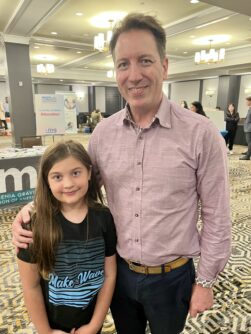
Elizabeth with Dr. Alex Fay, MD, PhD, in 2022, at her first MG Foundation of America Conference.
Our study uses AVAPS ventilator data to better understand respiratory muscle weakness and response to treatment in myasthenia gravis in an effort-independent way. (AVAPS stands for Average Volume-Assured Pressure Support. It is a mode on a noninvasive ventilator that uses an algorithm to automatically adjust the amount of pressure support it provides.) In our study, we look at measurements like peak inspiratory pressure (PIP), minute ventilation (MV), spontaneous breaths, negative inspiratory force (NIF), and MG-ADL to see how breathing and weakness change during flares and how they improve with treatment.
How did you become involved in the study?
Dr. Fay and I both noticed patterns in my ventilator data during times when my breathing and weakness got worse. It happened every flare. One day he showed me a graph that he had made, and I pulled out my laptop and showed him that I had made almost the exact same graph. In that moment, I remember thinking it was really cool that I had done the same thing as Dr. Fay with my data. It made me realize that I must have been on the right track and that what I was seeing was important.
We decided that day that we should write an abstract together, and that’s where it began.
What does the study aim to achieve?
The goal of the study is to show that ventilator data can provide a continuous, effort-independent way to measure breathing strength and response to treatment in myasthenia gravis. Right now, most of the tools that doctors use depend on how hard a patient tries, which isn’t always reliable.
By using AVAPS data, we hope to give doctors a more objective way to understand what is really happening with a patient’s breathing so treatment decisions can be made earlier. I hope it helps make care safer and more objective for MG patients and maybe even people with other neuromuscular diseases too.
What has your role been like?
It’s been fun and challenging. I’ve had to learn a lot of new things and also learn how to separate my emotions from the data, which was kind of hard to do at first. I help gather and analyze data, talk through the results with Dr. Fay, and learn what really goes into doing research. I’ve also gotten to talk about this work with neurologists from many different institutions. Being part of this gives me a real sense of purpose.
I’ve also always noticed patterns and connections, even when I was little. My brain just likes to organize things and see how they change over time, and it turns out that’s really helpful in science, which is probably why I noticed what I did.
So far, what has been the most rewarding part?
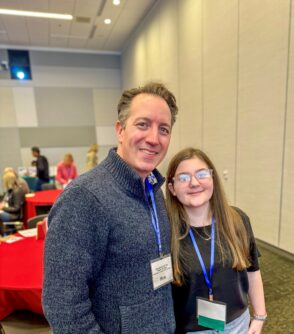
Elizabeth and Dr. Alex Fay, MD, PhD, at a 2025 MDA Symposium at Stanford University.
I would say having the chance to make a meaningful difference and knowing that this research could actually help someone else. If it helps a patient or their doctors recognize what’s going on sooner and start treatment earlier so things don’t become life-threatening. That would make this work completely worth it. Being really sick or ending up in the ICU is not fun at all, so if this research can help prevent that, that would be amazing.
I also love learning new things and realizing that I can do more than I ever thought I could. It feels good to know that something I went through can turn into something that helps other people.
What are you most excited about in the current research and treatment landscape?
Well, lots of things are exciting! Like, how targeted treatments are becoming and how fast science is moving to make new medications. I hope more of them can be used in kids and that insurance is less of a problem one day. Every conference I go to gives me more hope.
I also believe there will be a cure for myasthenia gravis one day, and hopefully for all neuromuscular diseases. My mom has taught me that hope is important, because hope is what keeps you from giving up, even when things get hard.
It’s also kind of fun learning how to say all the medication names, like eculizumab, ravulizumab, rituximab, obinutuzumab, daratumumab, and nipocalimab. There are even more that I’m still practicing and learning about. Sometimes people think it sounds like another language when I say them, which makes me laugh. The fact that so many treatments already exist, and that even more are being studied right now, is really exciting.
Why do you want to become a doctor?
I’ve wanted to be a doctor for as long as I can remember. I even dressed up as one every year on Career Day when I was little!
But living with a serious illness showed me what that dream really means. I’ve seen how much it matters when a doctor listens, believes you, and doesn’t give up on you. I want to use science and my own experiences to help patients feel seen, believed, and have access to treatment that makes them better in the same way my doctors have done for me.
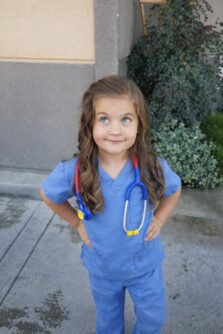
Five-year-old Elizabeth dressed as a doctor for Simpson University’s Career Day.
What specialty do you plan to pursue?
I plan to go into pediatric neurology. I want to become a neuromuscular doctor just like Dr. Fay, and I’m also very interested in research. I’m excited for the day that I get to put on my white coat and help kids like me. I hope all the people who have been part of my journey, and who helped me believe I can do this, will be there that day.
How will living with a neuromuscular disease make you a better doctor?
Living with a neuromuscular disease has taught me more than I could ever learn from a textbook. It has shown me how important it is to listen and really see the patient, not just the labs. It has helped me understand how illness affects everyday life, and that having a disease doesn’t make life less, it just makes it different.
When I was seven years old, I didn’t care what my diagnosis was called. I could barely even pronounce it at first. What I did know was that I could barely sit up, I choked when I tried to drink water, my vision was blurry, and I couldn’t even play at the park anymore because my arms and legs were so weak and tired. What I wanted was a doctor who would help me get better and never give up on me.
I think that’s what every person sitting in front of a doctor really wants. They don’t just want a name for what’s happening, but someone who is willing to fight for them. I want to be that doctor for my patients one day.
Living through what I have lived through will help me treat the person in front of me because I know that behind every chart, every test, and every lab is a real person who just wants to be heard, understood, and to feel better.
I also want to bake cookies for my patients during the holidays so they know I see them as a person, not just a patient. My neurologist did this for me, his other patients, and his staff, and it has always meant so much to me. Sometimes it’s the little things that matter the most.
Do you have mentors or role models who have encouraged you?
Of course, I have so many but here are a few that stand out.
Dr. Alex Fay, MD, PhD has been my biggest role model and mentor. He has always believed in me, even before I knew how to believe in myself. He reminds me that I am capable and that I can make a difference, even when things feel really hard. Somehow, he has always helped me stay positive. He taught me how to write a scientific abstract step by step, and how to think about data in a real and honest way. It’s not something that has to be perfect, but something that tells a story about what is actually happening to a patient. He showed me that the patterns I noticed were real, and that they could matter in ways that might change how doctors take care of people. I have learned so much from him, not just about science, but about what it means to truly care for patients. He is thoughtful, kind, and never gives up on you. I look up to him more than I can explain, and I hope that one day I can be even a little bit like the doctor he is.
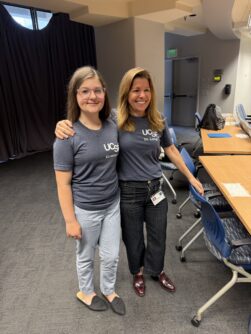
Elizabeth with Dr. Michele Long, MD.
Another doctor who has made a huge impact in my life is Dr. Michele Long, MD (UCSF). She is one of my favorite people. She is silly, energetic, and very direct. She tells you how it is, but at the same time reminds you that you can do hard things. She is the kind of person who will get her shift covered just to show up across the city to watch me speak to a room full of medical students or be the first one jumping up and down when she hears I’m writing a scientific abstract. She even wore my Halloween costume for me one year when I was too weak to put it on. I don’t think she will ever really know how much her support means to me or how much she has shaped the kind of doctor I want to become, even if I might never have as much energy as she does. She has taught me that having a diagnosis doesn’t define what I can do in life; it’s about what I do with what I’m given.
Along my journey, I also met Dr. Remu, a resident at UCSF who focuses on genetics. He has his own medical condition, so he really understands what it’s like to go through hard things. When I talk to him, I never feel alone because he just gets it. He also talks with me about normal life, like hockey and traveling, not just medicine, and that means a lot. He shows me that it’s okay to be human with your patients, not just their doctor. Because of him, I know that my own journey will help me connect with my future patients in a real way, and that’s exactly the kind of doctor I want to be.
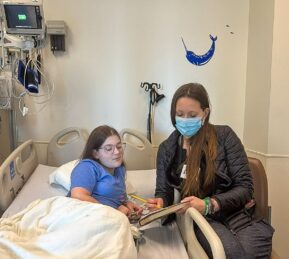
Elizabeth studying with Ms. Erika during one of her treatment cycles.
From the beginning, I’ve also been lucky to have mentors who aren’t doctors, but who have shaped me just as much. Ms. Erika is my hospital schoolteacher at UCSF and is one of my biggest inspirations. Ms. Erika works through UCSF Benioff Children’s Hospital and connects with my home district to keep me on track with schoolwork during admissions, infusions, and long hospital stays. She has been my hospital teacher since I was seven years old and one of my biggest supporters. She cheers me on whether I’m working on a scientific abstract or beating my Wordle streak. I actually think she would sometimes prefer that I skip my afternoon math lesson and get ice cream with a friend. She reminds me to be a kid, which is something I really need sometimes. When I’m sick, she makes me feel like that’s okay too, and that it’s okay to put my books down and rest. She makes me believe I can accomplish anything I dream of. She didn’t just help me with school; she helped me become confident in who I am. I couldn’t imagine having a better teacher, mentor, or friend.
You have also attended MDA Summer Camp over the years. How has your experience at Camp shaped you or helped you grow?
At Camp you see how much people care, like really care, about each other in a way that’s hard to explain unless you’ve been there. It allows you independence, helps your confidence grow, and provides space to just be yourself. At camp everyone understands what it’s like to live in a body that doesn’t always do what you want it to do. You are just simply understood there. It’s a feeling that’s hard to find anywhere else.
My weeks at camp have helped me realize just how capable I am. It’s the only place I’ve ever been where I’ve felt that kind of connection. It is truly the best week of my life every single year.
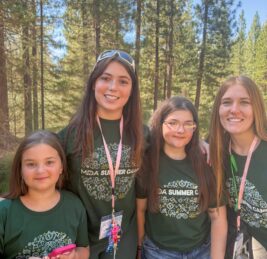
Elizabeth and her sister, Charlotte, with counselors at MDA Summer Camp.
Why do you think women make great STEM professionals?
Women bring perspective. Doctors like Dr. Alice Chan and Dr. Long inspire me because they are smart, strong, and compassionate. They care about the science, but they also care about the people, and that really matters. I remember when I was really sick a couple of years ago and scared to get a line placed in my neck, Dr. Chan called me just to help me feel less afraid. I can’t really explain her empathy in words, but that day she made me feel okay.
Women notice details, ask important questions, and bring empathy into everything they do, including science. When you see problems from different perspectives, science becomes better. My own perspective is different too, and I think that makes science stronger. Women belong in every part of STEM.
What advice would you give to other young women in STEM?
Don’t let anyone tell you that you don’t belong or that you are limited in any way. I promise you can do anything you dream of doing. Don’t let people make you feel like you’re too young, or even too old. Ask questions. Follow your curiosity. Your experiences matter.
Also, be okay when your interests change or grow, just like mine did. I always knew I wanted to be in medicine, but I didn’t know what that would look like, and now I do. STEM is kind of the same way. Science changes every day, and every time it changes, we get one step closer to a cure. And that’s pretty amazing.
Next Steps and Useful Resources
- Stay up-to-date on Quest content! Subscribe to Quest Magazine and Newsletter.


Disclaimer: No content on this site should ever be used as a substitute for direct medical advice from your doctor or other qualified clinician.