RNA Therapies Offer Keys to Treating Genetic Neuromuscular Diseases
By Andrew Zaleski | Monday, February 23, 2026
5 Second Summary
RNA therapies are opening new treatment possibilities for neuromuscular diseases by targeting faulty protein production without changing DNA. From muscular dystrophy to ALS, these flexible treatments offer hope for safer, more personalized care.
While DNA holds our genetic code, RNA plays a vital role in gene expression. Researchers are discovering new ways to use RNA to correct genetic changes that cause diseases.
For example, in type 1 myotonic dystrophy (DM1), a variety of symptoms all stem from a single source: incorrectly produced, toxic proteins. As bricks are to a house, proteins are to the human body. When properly manufactured by the body’s cells, proteins construct our personal biology, allowing all sorts of functions — from running to sleeping — to happen without a hitch. But in DM1, proteins are improperly manufactured, resulting in symptoms like musculoskeletal pain, weakened grip, cataracts, and daytime fatigue, to name a few.

Brian Lin, PhD
But what if the production of those toxic proteins could be halted? Better still, what if those proteins could be manufactured correctly from the start?
Enter RNA-targeted therapies, a treatment protocol with enormous potential for a spectrum of neuromuscular diseases that affect how the body builds proteins.
“RNA therapies are extremely promising for the neuromuscular field,” says Brian Lin, PhD, Research Portfolio Director at MDA. “Because they can be flexibly designed, they can be targeted specifically to what the patient needs.”
Why RNA?
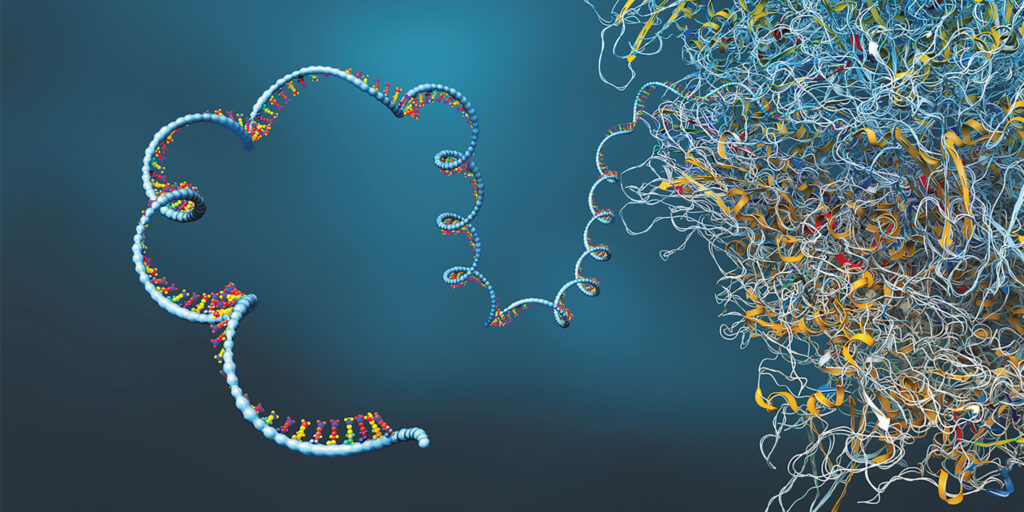
Let’s go back to high school biology for a moment. All living organisms contain deoxyribonucleic acid (DNA), which carries the genetic information for every cell in the body. But DNA can’t function alone. It depends on ribonucleic acid (RNA) to transcribe and deliver DNA’s instructions to the ribosome, the part of the cell that manufactures proteins.
| DNA | RNA | |
| Name | Deoxyribonucleic acid | Ribonucleic acid |
| Function | Stores genetic information | Copies and delivers genetic information |
| Location | Stays in the cell nucleus | Moves in and out of the cell nucleus to deliver DNA instructions |
| Structure | Double-stranded helix | Single-stranded helix |
Think of DNA as the instruction booklet for building a piece of furniture, and RNA as the individual pieces. These pieces are the main types of RNA central to protein creation:
- Ribosomal RNA (rRNA) forms part of the ribosome.
- Messenger RNA (mRNA) carries the genetic instructions to the ribosome.
- Transfer RNA (tRNA) brings amino acids to the ribosome to help them build proteins.
In our bodies, DNA is constantly being transcribed into RNA, which is translated into proteins. But what if RNA is copying a set of instructions with missing or incorrect steps? That is, essentially, what happens in neuromuscular diseases: The translation is the problem.
Deciphering the code
Because neuromuscular diseases begin with abnormal DNA, whatever RNA is transcribed is abnormal as well. In some cases, errors also occur during the transcription process, leading to faulty mRNA. While gene therapies seek to correct faulty genes that cause neuromuscular diseases, RNA-targeted therapies seek to interrupt faulty protein production by blocking or correcting it.
One of the most promising RNA therapy mechanisms is antisense oligonucleotides (ASO). ASOs are short, synthetic strands of RNA designed to enter cells and bind to mRNA sequences, altering the way they are processed.
For example, one known disease mechanism is when the mRNA includes a stop signal too early, telling the ribosome to stop making the protein before it is complete. An ASO can instruct the ribosome to ignore the misplaced stop signal and make the full protein.
An ASO can also alter mRNA that delivers instructions to produce toxic proteins. Small interfering RNA (siRNA), which targets and degrades mRNA, is another way to silence genes that encode harmful proteins. In the case of DM1, researchers are studying both methods to block or reduce the mRNA that leads to the disease’s symptoms.
In other words, RNA therapies target genetic mutations without touching the DNA. And, depending on what a specific disease requires, RNA therapies can increase, decrease, or modulate gene expression to stop faulty protein production or encourage the manufacturing of functional proteins.
According to Dr. Lin, this makes them easier to produce than some other therapeutic modalities and flexible enough to be tailored to different neuromuscular diseases. In addition, there are potentially fewer side effects compared to standard gene therapies delivered by a viral vector. This also means that RNA therapies don’t alter DNA permanently and are reversible.

James Dowling, MD, PhD
“You can give it multiple times, so if you need the effect to happen more than once, you can get that; if there are some side effects, you can discontinue it,” says James Dowling, MD, PhD, a professor of genetics and neurology at the University of Pennsylvania. “Whereas gene therapy can’t be discontinued once it’s been given.”
The tricky thing about RNA therapies currently is that their effectiveness varies by disease. “Muscle turns out to be one of the harder tissues to get therapies to go to when they’re given in the bloodstream,” Dr. Dowling says.
But scientists are getting better at it — particularly when it comes to a class of ASOs known as exon-skipping drugs. Exons are the parts of our genes that are encoded for making proteins, and mRNA transcribes these instructions.
In Duchenne muscular dystrophy (DMD), missing or abnormal exons in the dystrophin gene prevent the body from properly producing dystrophin protein. This protein is essential for keeping muscle cells intact; without it, muscles rapidly break down.
Five exon-skipping therapies for DMD are available now. They all work by instructing cells to skip over specific sections of faulty exons, effectively creating a molecular patch so that those exons are ignored. This enables the body to produce a shorter but functional dystrophin protein. So far, clinical trials and real-world results show that exon-skipping drugs could be effective in more than 80% of people with DMD.
See A Guide to RNA-Targeted Therapies for a list of approved RNA therapies and notable RNA therapies in clinical trials.
The road ahead
Many RNA-targeted therapies are still in preclinical development, which means they have not yet been tested in humans. However, several human clinical trials are studying various types of RNA therapies for neuromuscular diseases, including DMD, DM1, amyotrophic lateral sclerosis (ALS), and facioscapulohumeral muscular dystrophy (FSHD).
There are also several available therapies that demonstrate the future promise of RNA therapies for neuromuscular treatment. For people living with spinal muscular atrophy (SMA), where muscle weakness and wasting occur due to the loss of nerve cells in the spinal cord, there are two already approved by the US Food and Drug Administration (FDA).
Nusinersen (Spinraza) is an ASO drug that increases production of the survival motor neuron protein, while risdiplam (Evrysdi) is a small-molecule drug that achieves the same effect. Both are what’s known as splicing modifiers.
When RNA transcribes genes into mRNA, it initially transcribes exons and introns. But the introns, which are sometimes called junk DNA, are not needed for building proteins. They are removed, or spliced, keeping the exons in the final mRNA strand.
In some people with SMA, an error in this process leaves an exon out of the mRNA. This means part of the instructions for building survival motor neuron protein is missing. Evrysdi seeks to modify the splicing process to ensure that all exons are included in the final mRNA strand.
Progress continues in other areas. Tofersen (Qalsody) is the first approved RNA-targeted therapy for a type of ALS. Mutations in the SOD1 gene cause a rare, inherited form of ALS, which occurs when misfolded SOD1 proteins bunch together and harm motor neurons. Qalsody works by interfering with the mRNA that delivers instructions to produce those harmful proteins.
Such a treatment for ALS is, in fact, emblematic of what RNA therapies can achieve for the neuromuscular community: unique remedies for particular forms of a disease, able to be tweaked or tinkered with over time to make better, more targeted therapies.
“RNA therapies are more conducive to personalized medicines,” Dr. Lin says. “For the ultra-rare diseases, this is great because each individual could eventually have a treatment.”
Andrew Zaleski is a journalist in the Washington, DC, area. He wrote about living with myotonic dystrophy type 1 (DM1) for GQ magazine.
Next Steps and Useful Resources
- The science behind neuromuscular diseases and treatments is complex. MDA makes it simple to learn with print-ready fact sheets on diseases, treatments, clinical trials, and more.
- Stay up to date on Quest content! Subscribe to Quest Magazine and Newsletter.


Disclaimer: No content on this site should ever be used as a substitute for direct medical advice from your doctor or other qualified clinician.