Quest Podcast: More CMT Clinical Trials Than Ever Before: Inside the Research Turning Point
By MDA Staff | Sunday, September 20, 2026
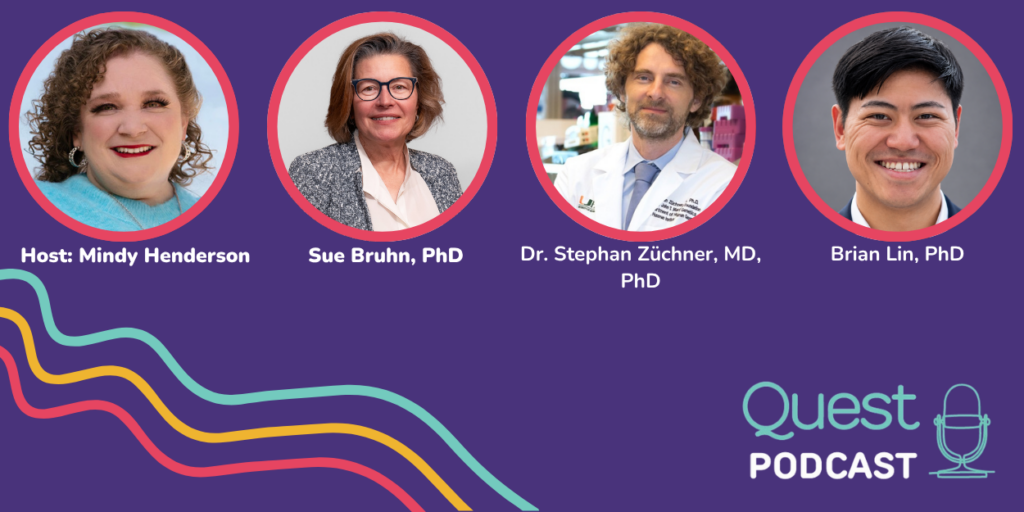
In this episode of Quest Podcast, we chat with Sue Bruhn, PhD, CEO of the Charcot-Marie-Tooth Association (CMTA); Stephan Züchner, MD, PhD, Chief Genomics Officer at the University of Miami Miller School of Medicine; and Brian Lin, PhD, Senior Research Portfolio Director at the Muscular Dystrophy Association. Together, they break down what Charcot-Marie-Tooth disease (CMT) does to the peripheral nerves, why more than 100 different genes can cause it, and what separates a clinical diagnosis from a genetic one. They open up about the parts of living with CMT that research can overlook, from fatigue to the weight of seeing your own future in an older relative with CMT, and walk through the therapies now being tested, what the field has learned from trials that fell short, and how patients can get trial-ready today. Sue, Stephan, and Brian share their experiences, expertise, and genuine optimism about where CMT treatment is headed.
Remember to register for the CMTA Patient & Research Summit, the association’s largest annual gathering of patients, families, researchers, and industry partners, taking place October 9–11 in San Francisco; you can register at https://give.cmtausa.org/event/cmta-patient-and-research-summit/e769535.
Read the interview below or check out the podcast here.
Mindy Henderson: Welcome to the Quest Podcast, proudly presented by the Muscular Dystrophy Association as part of the Quest family of content. I’m your host, Mindy Henderson. Together, we are here to bring thoughtful conversation to the neuromuscular disease community and beyond about issues affecting those with neuromuscular disease and other disabilities and those who love them. We are here for you to educate and inform, to demystify, to inspire, and to entertain. We are here shining a light on all that makes you, you. Whether you are one of us, love someone who is, or are on another journey altogether, thanks for joining. Now let’s get started.
Research in Charcot-Marie-Tooth disease, or CMT, is moving quickly from new genetic discoveries and emerging therapies to better ways of designing clinical trials and measuring whether treatments are actually making a difference. Today, I’m joined by three incredible experts with unique perspectives on that progress.
First, Dr. Stephan Züchner, a leading geneticist and chief genomics officer at the University of Miami. Next is Dr. Sue Bruhn, CEO of the Charcot-Marie Tooth Association and a longtime leader in rare disease drug development. And last but certainly not least, Dr. Brian Lin, MDA’s senior research portfolio director. Together we’ll explore where CMT research stands today, what’s giving the field momentum and what it could mean for people living with CMT and their families.
Thank you all so much for being here. I’m going to start us off, if you all will indulge me, you all have longer lists of credentials than I could possibly fit into an entire podcast episode, but I would love, Sue, maybe to start with you, just to get a little additional background on your work, both with CMT and otherwise.
Dr. Bruhn: Sure. Thanks Mindy. I am trained as a scientist actually, and I started my career in research and drug development and always focused in the rare disease space and was fortunate enough in my career to work at companies big and small and have the opportunity to bring treatments all the way from research to development onto the market. And during that time, work with a lot of patient advocacy organizations and really appreciate the power of the patient voice in drug development. And so when the opportunity came to combine that passion for rare disease drug development with this exciting moment in CMT research, I joined the CMT Association as the CEO about two and a half years ago, and it’s just been amazing. It’s a really exciting time for the community.
Mindy Henderson: Fantastic. Stephan, how about you?
Dr. Züchner: I trained a long while ago as a neurologist, as a doctor, and my interest really in understanding, trying to understand better how diseases start, what causes them brought me to genetic research and this basically took over my professional life. And for the past 20 plus years, I do genetic research for mostly what’s now called rare neurological disorders, including CMT, peripheral neuropathies, and it’s been fantastic. It’s been an amazing time, great progress, great value return to patients.
Mindy Henderson: Love it. And Brian?
Dr. Lin: Thanks Mindy for having me. I also have a research background. I’m currently the research director at MDA and I got into research pretty early on. I think I started back in high school and I kind of knew that I wanted to study neuromuscular and neurodegenerative diseases because of family history with some of those neurodegenerative diseases and also friends with relatives with some of those. And so I studied at the University of Maryland where I did my PhD on ALS and frontal temporal dementia. And then shortly after I knew I wanted to get an idea of the bigger picture around research of how you take something that you do in the lab and move it into the clinic and through the drug development pipeline and so forth. And so I followed that up with doing some more research and postdoc research.
And then I started a role at the Food and Drug Administration as a regulatory reviewer and also a researcher. And there I got to see everything from a very different lens. And as things changed pretty rapidly for better or worse at the FDA, I had the opportunity to then join the MDA and shift gears a little bit and see the patient [inaudible 00:05:07] side of things and how patient foundations like MDA and our collaboration of other orgs like CMTA can help bring all the pieces together for rare diseases. And so that’s a little bit about my background and personal journey.
Mindy Henderson: That’s great. Well, thank you all for taking us through that. And I’ve got to say, I never cease to be amazed by the people that I get to interact with in this industry. It draws just the nicest people into this field. So I am thrilled to have you here. You all clearly have really impressive credentials. Our listeners are largely the families and people who are living with neuromuscular disease. And so I’d really love to break down the science as best we can into layman’s terms. And Dr. Züchner:, I’d like to start with you. For someone who may be hearing about CMT for the first time, what exactly is Charcot-Marie-Tooth disease? What happens to the nerves? And what do we mean when we talk about the different types and genetic subtypes of the disease?
Dr. Züchner: CMT stands for Charcot-Marie-Tooth Disease. This is an awfully complicated name for something which you could also call a neuropathy or a peripheral neuropathy. Now, what is that? It is a disease of the nervous system. So the nerves that happen to sit mainly in our brains, they send very long projections, if you like, into your body. So these nerves run into your arms and legs and connect, for instance, to your muscles, but they also connect to your skin. And when you think about it, when you touch something and you feel this touch, that is something nerves pick up and tell your brain you just touched something. And then you might, if you happen to touch a hot plate, say you really want to move your arm away quickly, and then your brain would quickly react and say, “Move the arm away.” So it sends a signal back using these nerves, these peripheral nerves, to connect now to your muscles and the muscles then move and you take your hand away from the hot plate.
So that’s what the peripheral nerves do. They connect your brain with all these things in your body. And of course it goes way beyond that, but that’s sort of a simple picture. And so in CMT, these nerves don’t work as well. Unfortunately, it’s a disease that is progressive in most patients. It tends to get worse over time, sometimes fast, but luckily in most patients, relatively slowly. And unfortunately, there’s no way to halt the progression as of today.
What happens in these nerves when you look under a magnifying glass is that they break down in different ways, which also means there are different types of CMT. When you look into a peripheral nerve, there are two important things there. There are the nerves themselves, they come from the nerve cells, but they’re also surrounded by other cells that act more like insulation, much like an electric wire in a way, where you also have insulation.
And so these other cells, they’re called Schwann cells, they can also have a disease and we call that one cell neuropathy type. We call it CMT1 and patients who listen know, they have maybe heard this term, CMT1 or demyelinating CMT, it’s a complicated name. And the type where the nerve itself doesn’t work well is called CMT2 or axonal CMT. With genetics now, it gets even more complicated. Use an even higher resolution now and look deep into these cells through the DNA and the DNA maintains these cells. And if the DNA is broken, then this has consequences. Now, when we look at this level, at the genetic level, we now know there are over 100 different genes, different locations in a person’s genome that can actually cause CMT. So to some degree you could say there are over a hundred different types of CMT or over a hundred different reasons why somebody might have CMT.
Mindy Henderson: Wow. That sounds very complicated. It sounds like a really complicated disease to try to treat. How does CMT typically present when someone’s initially diagnosed?
Dr. Züchner: Because they’re different types, it can present in different ways. But these sort of classical symptoms that most patients experience are weakness, weakness especially in your feet, but this can be a weakness that also affects your legs as a whole, and it can also affect your hands first, but can also really affect the arm. So this general weakness, which often comes along with a shrinking of the muscles, which you can imagine if the muscles are not being used, they shrink and that causes this weakness. And the other important part is that many patients report a reduced or an altered sensory feeling. The feeling isn’t so good or even they have feelings that shouldn’t be there like burning or tingling. And that also happens in the same places first in your feet, sometimes in your hands. That’s sort of the main characteristic. Unfortunately, some patients also experience other symptoms like in their eyes with hearing and so on.
Mindy Henderson: Thank you for that overview. Sue, I’d love to come to you next. Clearly, it sounds like CMT can look very different from person to person. What are some of the challenges people living with CMT experience in their everyday lives? And what, if anything, do you think that researchers and drug developers sometimes miss when they think about the impacts of the disease?
Dr. Bruhn: Yeah, thanks, Mindy. That’s an important question, and you’re right, CMT isn’t one disease. It’s an umbrella term in a way for a large collection of inherited neuropathies. And sometimes, as Dr. Züchner: just said, even within one genetic subtype, within one family that shares the same genetic cause, the impact and the progression of CMT can be very different. So it can be complex.
On the topic of family specifically, one thing I think researchers and drug developers miss is that there’s this really important generational impact. So not just how they feel right now, but seeing the future in their parents and grandparents, how they progress over time can be a scary window into the future. Folks might look okay as of right now, but they can see their future in multiple generations of the disease and they wonder if their children will follow their path or a more severe one, and they may be both patients and caregivers, which is a heavy burden.
There’s also often an underlying fear at play in people’s heads, does this new symptom mean that my CMT is getting worse or is it something else? Or is this just the normal difficulty that anyone faces with age? Anything from all of a sudden it’s hard to open a bottle or maybe you’re tripping more, you have new aches and pains. How do you know what to just put to the back of your mind or decide if it needs more attention?
I think in terms of other impacts, many of the everyday challenges of living with CMT are clear, like tripping because of drop foot or dropping items all the time because you lose hand strength. But what we hear all the time is the truly frustrating symptoms that aren’t as clear to others are that exhaustion that comes from having to think about every single step you take or finding new ways to button a shirt and open a drink. And as CMT progresses, fatigue sets in, folks have to think every day about how they’re going to spend their energy. So there’s this aspect of having to constantly adapt to each new stage as CMT progresses. And there’s little calculations every day that other people don’t see, how far do I have to walk? Are there stairs? Can I keep up? If I do this today, am I going to pay for it tomorrow?
And so at each new stage of progression, people living with CMT are drained from mourning in a way, the loss of what their bodies used to be able to do. And I do think researchers miss that fatigue and exhaustion that comes with CMT. It’s invisible. So we focus on fixing the physical symptoms, which is key, but a design needs to fit into that community and our ability to participate, which might include things like the challenges that come with traveling to a clinical site, which could be really difficult.
I think it’s interesting when the CMT Association asks patients through our survey platform called Patients as Partners in Research, what are the common things that are happening in parallel to CMT? We call these comorbidities, what are the most important things? And the top two are anxiety and depression. And I think we can’t ignore the importance of mental health for the burden of people living with CMT and just generally the burden of chronic disease and the way that impacts mental health are really important aspects to consider.
And so when we talk to researchers and drug developers, we talk about how to think about all the complexities of CMT and all the aspects to consider. So I think everyone wants to stop progression and improve function, but we also want things that make everyday life better. Can we fall less? Can we have more energy? That’s meaningful progress, more freedom, more independence, and more choices.
But I’d also say on top of all this, we hear so much enthusiasm and excitement for progress that we’re seeing in the CMT drug development space. There’s a lot of support and interest from patients in playing a role in drug development, and we see this across the board in age, subtype, and progression. So patients are really ready and willing to play a role in moving treatments forward and excited to have their voice be heard.
Mindy Henderson: That’s interesting. A couple more questions are coming to mind for me that any of you are welcome to weigh in on, but as we’re sort of laying the foundation for CMT, I’d love to know, there’s a difference between a clinical diagnosis and a genetic diagnosis, and I’m wondering if it’s always a genetic diagnosis that’s possible at this point. And I’m also wondering about age of onset, which I would imagine maybe can vary quite a bit, but would love to hear your answers on that.
Dr. Züchner: Since I’m doing this research, things have changed a lot and there’s a constant whirlwind of activity. For patients, it may not always seem like this. It may seem somewhat academic or aloof what we do, but we have gone from really being able now to diagnose a good proportion of patients, even though it’s still many patients who don’t get a diagnosis. From that, we went deep into now thinking every day about therapy, and this wasn’t that even 10 years ago.
So CMT is a genetic disease, right? There are other reasons why you can have a neuropathy, for instance, diabetes, as many listeners probably know. But when genetics is at the core of a disease and you try to fix something that’s not quite right in your genes, you can imagine, everybody can instinctively imagine that this is not going to be easy. And also it has to be safe.
So that’s kind of where the discussion has shifted over the last decade from simply like, gosh, what can we possibly even do to, okay, we have some real ideas, we have some real tools here. They work in animals, for instance, or they work in cell lines, but how can we bring it to patients safely? And also how can we demonstrate to the regulatory bodies like the FDA that regulates new drug approval, how can we demonstrate that this new treatment actually works?
And so these are the daily things we are dealing with now, which is kind of great, but we are also experiencing that it’s really hard. We know for many patients why they get the disease. We understand much better what could be done. There are tools now, genetic tools, but also new kinds of drugs, things move faster. There are great scientists who have tested these ideas in cell culture, for instance, or in animal models. And we are really actively working with patients to bring them to the market, as we say, in the industry, bring them to an approval state.
Dr. Bruhn: I agree with that, Stephan. I think that’s a good summary, and I think your observation, Mindy, is correct. There are some people who have a definitive genetic diagnosis, and there’s also some people who just have a clinical diagnosis. So we know it runs in their family, they have all the clinical symptoms, and we’re working all the time to find new genetic causes, and that’s a big part of what Stephan does in his research. But there are a number of folks in our community who have a clinical diagnosis without yet an underlying genetic cause, and I think that’s something we’re working on all the time.
I think it also is why it’s important to have, when we think about potential treatments, approaches that target basic genetic underlying causes, but also treatments that might impact what I would think of as the underlying biology. So things that affect myelin or things that affect the axon health in a way. And so having multiple approaches I think is the best way really to have treatments that are going to impact the entire community, even though there are many, many causes of this disease. And I think that’s a focus that we need to keep pushing on, is having a number of different approaches to the way we think about treatments.
Mindy Henderson: Yeah, I think that makes a ton of sense. So Brian, I’m going to come to you now. There seems to be more CMT research and drug development happening than ever before. What’s changed and what would you say in your observation is driving the momentum?
Dr. Lin: Yeah, there is a lot of CMT drug development happening, and I think the first… Well, there’s many things that really come together, I think, to push the momentum. And I think the first thing we already mentioned that we’ve identified a lot of the genetic causes for a lot of the subtypes, of course, there’s more that we need to find. We understand the underlying biology of a lot of these subtypes, and so that gives researchers the opportunity to really focus on particular mechanisms and have a really focused topic for their research. And you combine that fact with the idea that we now have so many platform technologies and therapeutic modalities across the neuromuscular disease space, and these are things that other diseases have showed have been effective for their particular diseases and are also ones that we can rapidly start to adapt the concepts of gene therapies or RNA therapies or these kind of things towards targeting these CMT subtypes. And so researchers don’t have to really start from scratch. They can take these ideas and try to run with them as long as the mechanisms overlap in the same way.
And second to that, I might be a little bit biased here, but I would say that in the CMT space, there are a lot of patient advocacy groups that are really driving a lot of the efforts. And I think this is important, especially for rare diseases where resources are extremely limited, the funding environments around research is a little bit up in the air. And so foundations are increasingly relied on to help fund a lot of the preclinical and translational programs to de-risk a lot of these to attract the pharma and biotech companies to get in there and really be interested in diseases like CMT. And also patient advocacy organizations are increasingly relied on to really be drivers and conveners and be able to bring all the stakeholders across the fields, interact between industry with patients and clinicians and researchers of industry and bring the researchers to the patients and so forth. And so this collaboration and being open to collaboration has really improved over the last decade.
And then the last point that I want to make is just the fact that I think the ecosystem around rare disease has also become a lot more favorable. And so Dr. Züchner brought up about the FDA and talking to the FDA. I think the FDA themselves has, well, they used to have maybe a little bit more of a wall, but now they’re more open to talking to rare disease researchers, industry folks, and collaborates on ways to address some of these bottlenecks in rare disease research. And so I think that has changed considerably where they’re now actually partners and collaborators and revealing a lot of the data associated with that. And so having all of these things together really provides an environment that fuels drug development for CMT.
Mindy Henderson: Yeah, so much of what you just talked about excites me personally. I live with spinal muscular atrophy myself, and while that’s a completely different condition, I’m a person who’s waited for treatments and therapies. And so it’s been exciting for me to see and understand more and more about, just like you said, Brian, how the discoveries in one area lead to discoveries for other conditions and things, which I love. And I’m also a patient advocate, and so I love hearing you talk about patient advocacy organizations and the work that they’re driving.
Stephan, I’m going to come back to you to talk a little bit about how our understanding of genetics of CMT has changed and how identifying the genetic cause of someone’s CMT, we talked a little bit about this a few minutes ago, but how it’s beginning to open doors to potential treatments.
Dr. Züchner: Thanks for this question. Perfect for me, I would say. There are many aspects to it. As I said, there are about a hundred different genetic causes to have CMT, and every year there are one or two or sometimes three new causes being discovered. So this is still growing. By some accounts, we still cannot diagnose 40% of patients with CMT. So that’s still a significant number of patients. What has changed is that I think we got a lot better organized. Brian mentioned platforms, the CMTA for instance, and also the MDA in the past is supporting a genomics platform. So we’re trying to unify our efforts.
So instead of researchers working for themselves in this arena, we are trying to bring as much data together as possible and then study these data sets together. And so this has changed, the willingness to participate in this. And also, I think this is a baseline, something we need to do to apply these new things like artificial intelligence, because they are based on large data. They need to learn how a CMT gene might look and how a healthy gene may look. So I think we’re going the right direction there with the great help really of the patient advocacy groups.
And then another aspect is that what many listeners might be aware of is that genetics has become so good that many patients that are tested, they receive back from their doctor the message that there is a change in this CMT gene, but we don’t know if it’s disease causing or if it’s just happened to be there. We call these changes variants of uncertain significance. And this is not a small problem. There are now, I would say almost every patient actually that you test will have one or more of these unclear changes in their genome. And this has to do with A, that we are so good at detecting all these changes now, but also on the other hand, we lack good tools so far to understand what all these changes mean.
This is a bit of an uphill battle that genetics is fighting. Probably this might go on for another decade or so. I don’t think there’s a short-term great solution to that, although we are trying hard. And of course, just we take it for granted now that we can sequence entire genomes of a person, which there was always a dream and until 10, 15 years ago was basically not possible. And now it’s routine, in many cases, actually a routine diagnostics. So there’s more to be discovered.
Genetics solves the diagnosis, but it also supports the therapy research. It supports efforts, for instance, we call this modifier genes, even though one gene causes the disease that is sort of basically what we tell patients. In every single case, you can imagine these genes don’t live by themselves. There are other minor, smaller factors, other genes, also environment that influence the outcome. That’s why patients have these different outcomes, like what Sue mentioned. Even with the same gene, they might have different trajectory of disease. So these modifying genes, we are also very interested in finding those. So I think genetics is going to be a very important partner as we go together towards therapeutic solutions.
And maybe one more thing, what we have seen a couple times now is sometimes genetic discoveries can fairly immediately lead to a therapeutic answer. And so we had about five years ago, a gene discovery in CMT, which turned out to be a quite common CMT type. It’s called SORD, S-O-R-D. And within less than a year really, there was a company, there was a clinical trial, patients got enrolled because the genetic discovery immediately suggested a solution. So there were not a decade in between of additional research. So this concept of from genes to therapy is something to watch.
Mindy Henderson: I’m curious, is this where, you mentioned databases and AI, and a big topic of conversation these days, how is that factoring into enabling the work that is happening right now?
Dr. Züchner: So from my vantage point, we use AI tools of different sorts every day. I see the students use them every day for different tasks. And maybe most relevant here, we have really started applying them to trying to diagnose CMT patients. So just interpreting and reading genomes relies these days on AI. It’s not a completely automated AI task by no means, but there’s certain steps in between that work better with AI. And I think we can see how this role of AI is only growing in genetics. So the hope is that AI can actually help us to see patterns that we might have missed, make us better scientists and better doctors. There’s great interest in this. There are real applications of this in genetics. I think it’ll accelerate the general pace of things we do.
Mindy Henderson: So exciting. Brian, there are clearly lots of exciting innovations happening in research around therapeutics for CMT. What do you think are some of the most promising approaches that are currently being explored? And can you explain how these different strategies are intended to work?
Dr. Lin: I think Dr. Züchner already went over the idea with cervical, with SORD neuropathy about going from a gene to a therapy. And in that case, that was kind of like a small molecule that is able to biologically modify certain pathways to supplements or add existing levels of proteins or things that are deficient.
Then there’s also the idea that you can really target these things genetically with some of the technologies that we have. And so I mentioned earlier about things like RNA therapies and gene therapies. And so RNA therapies I think is one of the bigger ones because it can be given in a way that it can be re-dosed. It can be designed in a way to be very specific and targeted. And so in some forms of CMT, the problem is that the system produces way too much of a protein and that can be harmful or it produces a harmful version of the protein because of certain mutations. And so CMT1A is one example of that where there’s just too much of a protein called PMP22.
And so for RNA therapies, a simple way to think about it is that everyone has DNA. This is kind of the building block of the system. It’s a blueprint for producing all the proteins in the body, but how the system actually uses the DNA, it doesn’t go in there and use it directly. It actually creates these transcripts or photocopies of it called RNA, and it uses that as a way to produce the actual protein. And so with RNA therapies like antisense oligonucleotides, for example, they’re specifically designed to go in there and combine specific RNAs and either silence them or turn them down so that the system produces far less of the particular protein. And so that’s one category that if delivered very well to the areas of the nerves where it can have the biggest impact is very promising.
And the second is with gene therapies, and that takes a little bit of a different approach where there’s some CMT types where it’s not too much of a protein, but it’s really too little of a protein. And so these are some of the subtypes that are recessive where you get copies from both of your parents that are faulty and that leads to you having a lot less of the protein than a healthy individual. And so with gene therapies, the idea there is you want to deliver a new healthy copy of the genetic material, a new blueprint that the system can use to produce protein and replace that. And so these are two therapeutic categories on the genetic side that can really help with a lot of the CMT subtypes. And we’ve seen that with many other diseases where it has been effective, like an SMA, for example.
Mindy Henderson: Every time I talk to scientists, I tell myself, I wish I could live inside their brains just for a day and know what they know. It’s fascinating to have these conversations. Sue, where are we today in terms of treatments for CMT and how has the treatment landscape changed in recent years?
Dr. Bruhn: Yeah, it’s actually really one of the most exciting times we’ve seen in CMT clinical development. Right now we have more clinical trials going on than at any time in history. Of course, we don’t have any approved treatments, which is what we’re all looking for. But in terms of covering this complicated landscape for the CMT community, things are really progressing nicely.
So we have trials that encompass multiple CMT subtypes right now in clinical development. We’re seeing multiple kind of modalities like small molecules and large molecules, biologics. We’ve got programs at different stages of development, phase one and phase two and phase three that are pretty advanced. And we have things, as Brian suggested, around correcting or modifying the underlying genetic problem by both gene therapy on the horizon as well as ASO and RNAi coming for genetic forms that we understand. But we also have treatments targeting the underlying biology that could be effective across multiple subtypes that we’re really excited about, including one now in trials that impacts the neuromuscular junction, for example, that could work in a lot of different subtypes.
And I think you don’t have to correct the gene itself to make a meaningful difference to the disease. And so what we feel right now is that this pipeline is real. There’s some actual progress, and I think that pipeline creates momentum that makes people want to bring other treatments forward. And I think that’s the exciting time that we’re in. It’s never fast enough. It’s always frustratingly slow, but I feel like just in the last year or two, things have turned a corner in a way that there’s broad interest and progress. And I think we just need to keep pushing on all fronts to make it as fast as we can.
Mindy Henderson: Yeah. Sue and Brian, you were both involved in a recently published effort to develop recommendations for CMT clinical trials. Can you explain why a common framework is needed and what have we learned about designing trials that can effectively determine whether a treatment is helping?
Dr. Bruhn: There are some things that make drug development challenging in CMT. So first of all, it’s a rare disease. So there’s a small number of patients, but as we have been talking about this afternoon, it’s an umbrella term for a large collection of inherited neuropathies. And so there’s different genes, different biologies and different treatments, and there’s approaches that might affect a genetic cause, but there’s others that could target a broader underlying biology. And so we wanted to push for flexibility in the way that we think about clinical design, feasible to measure in a small number of patients.
I think the other complexities are that the CMT progresses slowly and not in the same way in everyone. Sometimes even in the same family as we’ve been talking about, even when they have the same genetic cause, we call this heterogeneity. And so that heterogeneity means some folks are faster to progress in some ways and some are slower. Some might feel some effects or symptoms in parts of their body and others might not feel that experience in the same way. And so that makes finding a clinical trial that can encompass as many patients as possible a little bit difficult.
And so we really need to work together, regulators with drug companies and with the patient voice to find ways to measure things in a way that’s actually feasible for drug developers and patients. We can’t have a 10-year clinical trial, for example, with placebo. And so along with the MDA and some other advocacy groups, we partnered up with academic physician scientists, biopharma drug developers. It was really an extraordinary collaborative effort to make this case for flexibility in the drug development for CMT. And we came together and created this publication that put out recommendations for how to think about drug development in a way that was flexible and feasible for CMT.
And Brian, do you want to take over and talk a little bit about the recommendations?
Dr. Lin: We made several recommendations on the clinical trial front. I think at the heart of it is really to take into account the patient’s experience and that kind of risk and benefit profile. What we want to see is really that the regulatory path is really quite flexible and amenable to a lot of the CMT genetic subtypes. So that involves being amenable to a lot of the externally controlled data to limit placebo, try to use some of the great natural history that the INC has developed and others have developed around some of the subtypes to also consider phenotype over genotype. And what I mean by that is the fact that a lot of the CMT subtypes may have kind of overlapping mechanisms. And if you’re not going in with a therapy that’s specifically genetically targeted and it may be relevant across subtypes, then potentially you could consider adaptive trial designs and basket trials to group them together.
I guess one of the final things I recall is really the idea that we need very sensitive measures that also capture things that are meaningful for the patients. And so some of the neurological composite scales may be less favorable than some of the new validated functional outcome measures that are made or the health indices that’s taken to account things like each individual’s fatigue and things that are really relevant towards the individual patients. And so those were definitely part of the recommendations. The impetus for it is really to guide industry and help them feel a little bit more comfortable getting into the CMT space because as long as there is a framework, a unified framework around it, then I think they’ll feel more comfortable investing into the CMT space because it’s very difficult and very risky to go into rare diseases if you don’t already have this kind of blueprint outlined.
Mindy Henderson: Stephan, I want to talk about something that maybe is a little bit hard to talk about, but it’s an inevitability in research and that is unsuccessful trials. Speaking from experience, it’s not fun to see trials that don’t go where you may have hoped. And we’ve seen some CMT trials that haven’t produced the results that everyone had hoped for, but what can researchers learn from those experiences? That’s not wasted time, of course. And why are those trials still important for the field moving forward?
Dr. Züchner: Yeah, I mean it is disappointing, of course, when things don’t work out like you wished for. On the other hand, clearly we learn the most from failures, generally speaking in life, correct? So we should keep looking forward. And I observe that we learn a lot from these trials that haven’t fully finished or inconclusive. And I can give you a few examples and it came up already a little bit here. For instance, we learned that the way how we measure what really is important for CMT patients may not have been always the best measure, the methods we have. What I mean by this is the FDA, they want to know, okay, you give this drug to a patient for a year. Do these patients actually have a benefit from this or does it just feel good that you do something? And if it’s not a measurable objective benefit, the FDA will be very skeptical in approving a drug.
So since this is a disease that often progresses fairly slowly, it may be difficult to measure a difference a drug makes in a timeframe of one year or two years. You may have to measure it five years, but these trials are very expensive. The companies who perform these trials or sponsor these trials, let’s say, they don’t have necessarily the resources to do that. And when the small companies think of a startup more, you can imagine how difficult it is for a startup to not have a sellable product for five years and keep investors happy. So these are sort of very practical real life limitations and issues.
So having better methods of measuring, more sensitive measures of measuring the effect of a drug is one. Just generally speaking, I observe with colleagues that there is much more of a more realistic knowledge and expectation how trials should work, how they should be conducted, what these challenges are, maybe don’t rush into a new trial, plan it out carefully. So a very big topic that came out of these, let’s say, failed trials is we need, for instance, better biomarkers. So biomarkers measuring how, for instance, a patient can walk, how fast, how long, and that sort of thing, or how much strength a patient has before and after treatment. You can also measure in a patient’s blood, possibly there are factors you can measure like in diabetes say you can measure insulin. Maybe there’s something in CMT that we can discover that can be measured that goes along with treatment and things of that nature have come to the forefront.
One of the best biomarkers right now is actually imaging, meaning MRI imaging of your leg. This has turned out to be quite responsive to the progression of the disease. So these are learnings we have as a field from failed trials. Also going back to the regulatory body by realizing why we hit this wall, say, to go back to the regulatory body and educate them and motivate them to come up with different or more innovative ways of conducting a trial in the first place for a rare disease like that.
Mindy Henderson: Thank you for that. Sue, I want to come back to you and sort of circle back to a topic that came up earlier in patient advocates and people who are living with these conditions. How important are people living with CMT to the development of new treatments and what can people, patients or families that might be listening today, what can they do today to help accelerate progress?
Dr. Bruhn: Yeah, I think patients are not just people waiting at the end of the drug development pipeline. They’re really partners and can be partners through the entire process. And so different ways that patients can and have supported drug development include things like natural history studies where you’re not testing a treatment, but you’re following patients over time in a clinical study environment, but you need to understand the speed of change of all the complexities of CMT to understand how to develop drugs. This is something that the Inherited Neuropathy Consortium and that database that Brian referred to earlier has done in 10,000 patients today. And so if you want to measure change of a treatment, you have to understand how things change without a treatment. So natural history studies are a way to do that. They can also help develop meaningful outcome measures and help us design and test better patient reported outcomes.
I think being part of efforts that help researchers understand what matters in everyday life, we do that through surveys like our Patients as Partners in Research at our annual Patient & Research Summit that’s coming up in October and staying on top of the latest news so that you know about research studies that are coming up and you’re ready to go when they happen. Of course, the one everyone thinks about is participating in clinical trials where you’re actually measuring the effect of the treatment, but being willing to try a new treatment to understand their benefits and their risks on behalf of the entire community and understanding that you might get a placebo, which is like a sugar pill, but that gives drug developers critical information. Just being clinical trial ready by staying up to date on research, but getting genetic tests.
So all the trials going on right now do require a genetic test, and it’s important for folks to know that there’s new panels all the time that include new genetic types of CMT that are always evolving. And if you haven’t had a genetic test for a few years or you had an inconclusive test or maybe you had an unknown variant, consider requesting another genetic test at your next appointment, and that can get you ready to go if opportunities for research that match your interests are available.
Mindy Henderson: That’s great. And you mentioned an event, a big event coming up that I’d love to just give everyone listening a little bit more information about. In October is your patient summit. Can you tell us a little bit more about the event and how people can attend if they would like to?
Dr. Bruhn: Absolutely. Excited and happy to do so. So the CMTA Patient & Research Summit is our largest annual gathering that brings together patients, families, researchers, clinicians, industry partners, and advocates from across the CMT community. It’s designed to provide both practical information for living well with CMT, as well as the latest updates on research and therapeutic development. The event will take place in October 9th to 11th this year in San Francisco, and it’s a patient-focused weekend that highlights the significant momentum generated through the CMTA’s strategy to accelerate research and our initiatives. And you’ll also hear directly from leading researchers and biopharma partners who are working to bring treatments to patients today.
It starts with an agenda on Saturday that focuses on managing CMT with sessions around centers of excellence, genetic testing, pain management, PTOT, with afternoon workshops on mental health, wellness, exercise, and also we’re providing surgical evaluations with the renowned CMT surgeon, Dr. Glenn Pfeffer.
Sunday morning is dedicated to research. So this is about updates on clinical trials, delivery methods, understanding the path toward treatments, and importantly, how patients can be involved in research, some of what we were talking about here today. And patients who attend will have the opportunity to participate in focus groups with different biopharma partners and can also sign up to be involved with the Stanford Exoskeleton Gate Study that’s looking to find new ways to measure change in clinical trials. So we have an exhibit hall with vendors, including bracing manufacturers, it’s open all weekend, plus a lot of fun activities like a welcome reception, a youth outing, ice cream social for young families, and a young adult’s happy hour. So it’s an in-person event, but we will be sharing the session recordings after the summit, and you can register at www.cmtausa.org/summit, S-U-M-M-I-T, and we hope to see as many people as can attend there.
Mindy Henderson: Wonderful. We’ll put that information in the show notes as well. I have one final question that I would like to give you each an opportunity to share your perspective on that’s a little bit forward-looking. How hopeful should people with CMT be about the future? And what would you say to someone wondering whether they might see meaningful treatment in their lifetime? And if we were having this conversation again five years from now, what would each of you hope we could say has changed? I know that was a big compound question, so feel free to attack any part of it that you would like. Stephan, let’s start with you.
Dr. Züchner: Well, I think we will not go back. I see a clear trajectory from 15 years ago, there were zero clinical trials and industry, pharma industry involvement to, like Sue said, is record high activity in this field. So simply speaking, in five years from now, I would very much hope, and I think this is realistic, that we have the first CMT drug for one subtype, at least one, approved by FDA.
Mindy Henderson: That’s exciting. Brian?
Dr. Lin: Yeah, I think the field should be really optimistic. I think we have all the scientific foundation and resources to really start pushing a lot of these treatments into the clinic, and there’s already so many in the clinic. And so I think we have everything that we need to really make progress over the next five years and see a treatment comes to fruition.
Mindy Henderson: Exciting. And Sue, I’ll give you the last word.
Dr. Bruhn: Yeah, I share the optimism. I am genuinely optimistic. I think where we are now, we’ve got strong science. We understand a lot about genetics and disease mechanisms. Our pipeline is deeper than ever before, both in the clinic and the space heading into the clinic, the preclinical work, and our infrastructure has been built too, natural history, registries, preclinical models, and all of the patient engagement from the advocacy organizations. All the pieces are there, and I feel like we’re moving from an era where we hope there might eventually be a treatment into an era that we’re actually testing potential treatments in people. That’s an important transition, and I think in the next five years, we’ll definitely have treatments available to patients in the market.
Mindy Henderson: Well, I can’t imagine a more exciting note to end on. Again, I know that you all are incredibly busy, and I can’t thank you enough for this conversation. We covered a lot of ground, and I personally learned a lot, so thank you all for being here.
Dr. Züchner: Thank you, Mindy. [inaudible 00:53:43].
Dr. Bruhn: Thank you, Mindy. And thanks to the MDA for having us.
Mindy Henderson: Thank you for listening. For more information about the guests you heard from today, go check them out at mda.org/podcast. And to learn more about the Muscular Dystrophy Association, the services we provide, how you can get involved, and to subscribe to Quest Magazine or to Quest Newsletter, please go to mda.org/quest. If you enjoyed this episode, we’d be grateful if you’d leave a review. Go ahead and hit that subscribe button so we can keep bringing you great content and maybe share it with a friend or two. Thanks everyone. Until next time, go be the light we all need in this world.


Disclaimer: No content on this site should ever be used as a substitute for direct medical advice from your doctor or other qualified clinician.