MDA Clinical & Scientific Conference Sessions Drive Innovation in Neuromuscular Care
By Rene Ryan | Monday, February 23, 2026
From repairing muscles and nerves to making gene therapy safer, this year’s most forward-thinking MDA Clinical & Scientific Conference sessions pull back the curtain on breakthroughs that matter — not just for researchers, but for every individual and family affected by a neuromuscular disease.
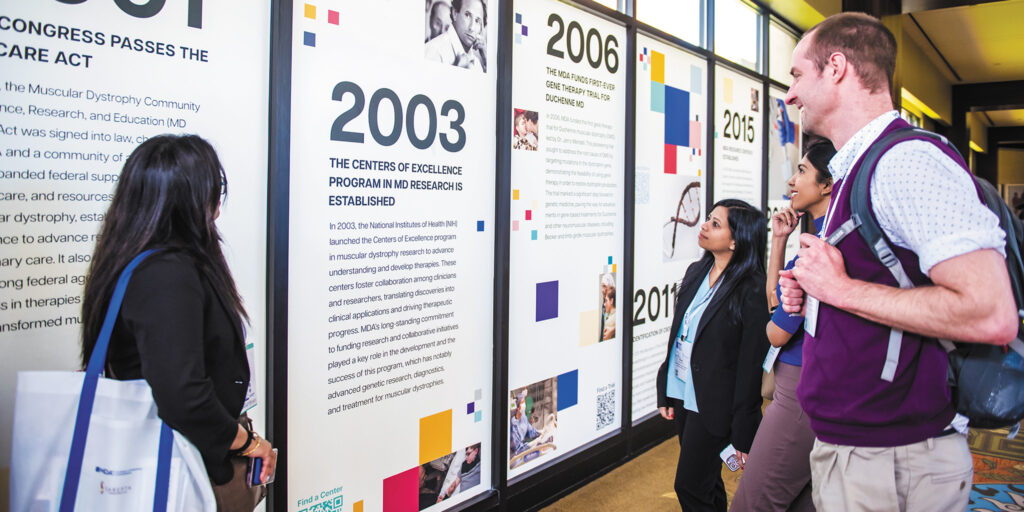
In 2026, MDA’s annual conference, which brings together neuromuscular researchers, clinicians, industry leaders, advocacy organizations, and community members, will be held March 8-11 in Orlando, Florida.
These three planned sessions (out of a packed agenda topping 30 sessions) highlight how discoveries presented at MDA’s conference are poised to transform real-world care.
Topic: Muscle Regeneration and Repair
Chair: Noah Weisleder, PhD, Professor and Chair, Molecular and Cellular Biochemistry, University of Kentucky College of Medicine
Dr. Weisleder will lead a discussion on the rapidly advancing science behind muscle regeneration. Dr. Weisleder studies how muscle fibers die in conditions such as Duchenne muscular dystrophy (DMD) and limb-girdle muscular dystrophy (LGMD) and, just as importantly, how they may grow back.
This session will highlight two complementary therapeutic strategies:
- Stopping muscle cells from dying by helping repair the outer membrane
- Helping muscles grow back by activating special cells that build muscle tissue
Improving these two processes could benefit many different muscle diseases. Dr. Weisleder notes that this could spark new industry collaborations to develop widely applicable treatment approaches.
By sharing the latest discoveries in muscle regeneration and MDA-supported collaboration efforts, this session aims to move promising science closer to real-world therapies that strengthen and restore muscle.
Topic: Inherited Peripheral Neuropathies: Unique Challenges in Drug Developments
Chair: Brett Morrison, MD, PhD, Neurology, Johns Hopkins Medicine
This session, led by Dr. Morrison, will focus on inherited diseases that cause injury to peripheral nerves in the arms and legs, such as Charcot- Marie-Tooth disease (CMT). Because he treats patients with peripheral neuropathies and researches treatments to reverse nerve damage, Dr. Morrison understands the challenges and opportunities in this field from two key viewpoints.
Other speakers will share updates on current and future therapy development, including new treatments targeting CMT subtypes that are in phase 3 clinical trials. For example:
- Megan Waldrop, MD, will discuss a gene therapy trial for CMT type 2S.
- Evan Bailey, MD, will share updates on a novel drug approach for neuropathy caused by SORD gene mutations.
- Vera Fridman, MD, and Jasper Morrow, MBChB, PhD, will report on developing biomarkers to track whether treatment is working in conditions that progress slowly over time.
By addressing the promise and complexity of drug development for inherited neuropathies, this session illustrates how far the field has come — and how collaborative research continues to drive new hope for patients with these diseases.
Topic: Immune Response Considerations in Gene Therapy
Chair: Armando Villalta, PhD, Associate Professor, Physiology & Biophysics, University of California, Irvine, School of Medicine
Dr. Villalta will lead a discussion on one of the neuromuscular field’s most urgent frontiers: understanding and managing immune reactions to gene therapies. Dr. Villalta has spent more than 20 years studying the complex relationship between muscle disease and the immune system.
The session will focus on two key challenges in gene therapy that can make gene therapies less safe or less effective:
- Vector immunity — when the immune system reacts to a viral vector, such as adeno-associated virus (AAV), that is used to carry a healthy gene into cells
- Transgene immunity — when the immune system attacks a new, healthy protein the body makes, thinking it is foreign
The session will also feature presentations by leading researchers, including Melissa Spencer, PhD, and Dongsheng Duan, PhD, about progress in modeling immune responses and developing strategies to mitigate them. Understanding these reactions is critical to delivering gene therapies to more people safely.
The future of neuromuscular medicine
Together, these three sessions highlight how scientists are exploring bold, new ideas to improve the lives of people with neuromuscular diseases. By sharing their discoveries and learning from one another, experts can develop safer, more effective treatments and bring them to patients faster.
Every bit of progress gives hope for a future with better care, more options, and greater independence for everyone affected by neuromuscular diseases.
Rene Ryan is a writer for Quest Media.
Next Steps and Useful Resources
- Did you know MDA community members can attend the MDA Clinical & Scientific Conference virtually, at no cost? To register, visit mdaconference.org and scroll down to “Patients, Caregivers, and MDA Volunteers.”
- Don’t worry if you can’t attend the conference; MDA offers educational events and resources year-round.
- Stay up to date on Quest content! Subscribe to Quest Magazine and Newsletter.


Disclaimer: No content on this site should ever be used as a substitute for direct medical advice from your doctor or other qualified clinician.